
How Much Does a Realtor Make on a $500 000 Sale?
Selling a $500 000 home is one of the biggest financial decisions many homeowners will make. But before signing a listing agreement, many sellers have the same questions:
“How much of my money is going to the Realtor?”
“Does the agent really keep $15,000 or $30,000 from the sale?”
“Am I paying a fair amount for the service I receive?”
These are reasonable concerns because real estate commissions can represent thousands of dollars. For a $500,000 home, even a small difference in commission percentage can change the final cost by several thousand dollars.
The confusion usually comes from looking only at the headline commission number. A commission is not the same as a Realtor’s take-home income. Before an agent receives their final earnings, the money may be divided between agents, shared with a brokerage, used for marketing and business expenses, and reduced by taxes.
After reviewing how real estate transactions are structured, commission agreements, brokerage models, and the costs involved in running a real estate business, this guide breaks down exactly how much does a Realtor make on a $500 000 sale.
You will learn how commissions are calculated, how much an agent may actually keep, what factors affect Realtor earnings, and what sellers should consider before choosing a real estate professional.
$500,000 Home Sale Commission Calculator
The table below shows how different commission rates affect the total cost of selling a $500,000 home. Since commission rates are negotiable, the final amount can vary depending on the agreement, services included, and local market conditions.
| Total Commission Rate | Total Commission on $500,000 Sale | Difference Compared With 6% Commission |
| 2% | $10,000 | Saves $20,000 |
| 3% | $15,000 | Saves $15,000 |
| 4% | $20,000 | Saves $10,000 |
| 5% | $25,000 | Saves $5,000 |
| 6% | $30,000 | Baseline |
How to Read This Calculator
For example, a 5% commission on a $500,000 home sale equals $25,000 in total commission. A 3% commission would reduce the total commission cost to $15,000, creating a $15,000 difference before considering any additional fees or service changes.
However, the lowest commission rate is not always the best option. Sellers should compare what is included in the agreement, such as marketing, negotiation support, transaction management, and local expertise.
Quick Answer
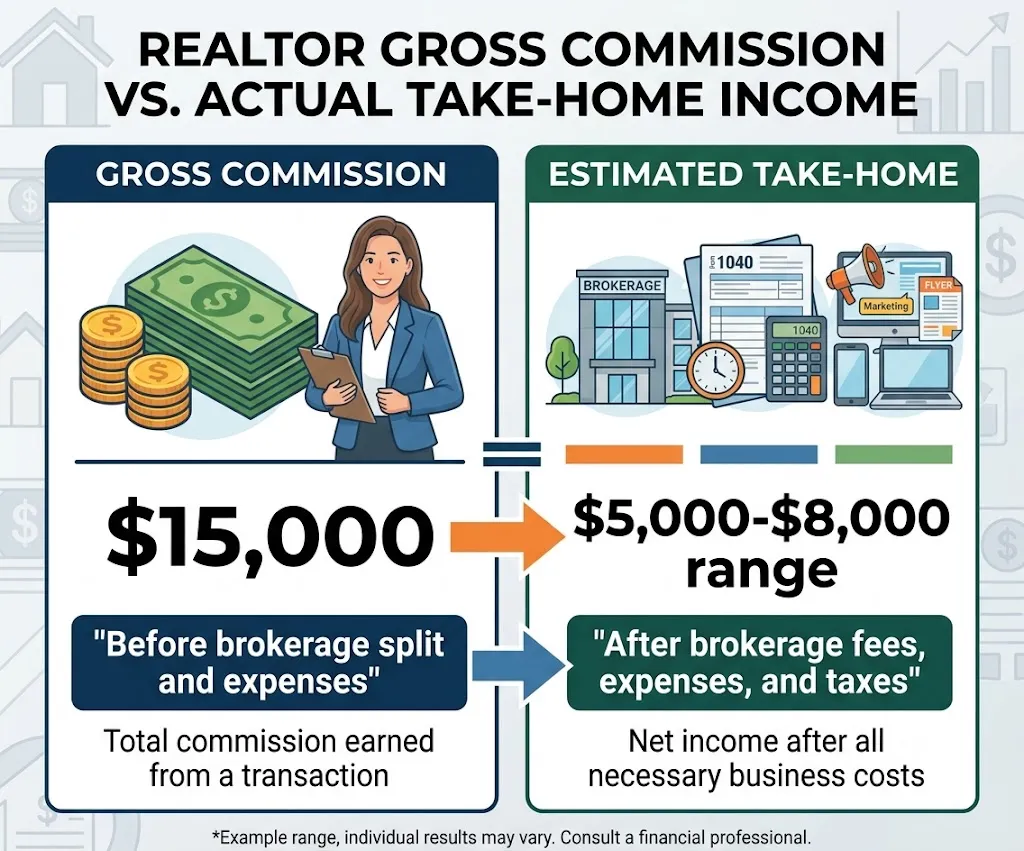
A Realtor working on a $500,000 home sale may receive a gross commission ranging from $10,000 to $15,000 for one side of the transaction when the total commission is between 4% and 6%. After brokerage splits, business expenses, and taxes, the Realtor’s actual take-home income is often much lower.
Key Takeaways
If you are researching how much a Realtor makes on a $500,000 home sale, these are the most important points to understand:
| Question | Short Answer |
| How much is the total commission on a $500,000 sale? | It can range from about $20,000 to $30,000 when using a 4%–6% total commission rate. |
| How much does one Realtor usually receive? | One side of the transaction may be around $10,000 to $15,000 before brokerage splits, expenses, and taxes. |
| Does the Realtor keep the entire commission? | No. The agent may need to share commission with their brokerage and pay business expenses and taxes. |
| How much does a Realtor actually take home? | The final amount varies, but it is often significantly lower than the original commission amount. |
| Are Realtor commissions negotiable? | Yes. Commission rates and compensation agreements can vary depending on the market, services provided, and agreement terms. |
A Realtor may appear to earn thousands of dollars from a $500,000 sale, but their actual income depends on how the commission is divided and what business costs they must cover.
What Is a Realtor Commission?
A Realtor commission is a fee paid for helping buy or sell a property. The commission rewards the professionals involved for services such as:
- Marketing the property
- Listing the home on the multiple listing service (MLS)
- Arranging showings
- Negotiating offers
- Managing contracts
- Coordinating inspections
- Guiding the transaction through closing
The commission is usually calculated as a percentage of the home’s final selling price.
According to the National Association of REALTORS® (NAR), real estate professionals provide services throughout the transaction, including marketing, negotiating offers, managing contracts, and guiding clients through closing. The exact services included depend on the agreement between the client and the real estate professional.
Realtor vs. Real Estate Agent
Many people use the terms Realtor and real estate agent as if they mean the same thing, and while they’re closely related, there’s an important difference.
A real estate agent is a licensed professional who helps people buy and sell property. A Realtor is a licensed real estate professional who is also a member of the National Association of REALTORS® (NAR) and agrees to follow its Code of Ethics.
This means every Realtor is a licensed real estate professional, but not every licensed real estate agent is a Realtor. Throughout this article, the earnings discussed generally apply to licensed real estate professionals working under commission-based agreements.
A real estate broker is a licensed professional who may operate independently, manage agents, or own a real estate brokerage, while many Realtors work under a broker’s supervision.
What First-Time Home Sellers Should Know
If you’re selling a home for the first time, Realtor commissions can seem confusing. Many people assume the agent keeps the full commission, but that’s rarely the case.
Understanding how commissions work can help you compare agents based on both their services and their pricing, not just the commission percentage.
How Much Is the Commission on a $500,000 Sale?
The table below shows the total commission at several common rates.
| Total Commission Rate | Total Commission | One Agent’s Share* |
| 4% | $20,000 | $10,000 |
| 4.5% | $22,500 | $11,250 |
| 5% | $25,000 | $12,500 |
| 5.5% | $27,500 | $13,750 |
| 6% | $30,000 | $15,000 |
*Assumes the commission is divided equally between the listing agent and the buyer’s agent.
These examples are based on simple percentage calculations using a $500,000 sale price. Actual commission rates vary by market and are negotiated between the parties involved in the transaction.
How Is the Commission Split?
In many transactions, the total commission is divided between two professionals: the listing agent and the buyer’s agent. For example:
- Home sale price: $500,000
- Total commission: 6%
- Total commission earned: $30,000
- Listing side: $15,000
- Buyer’s side: $15,000
The actual division depends on the agreement between the parties.
How the 2024 NAR Settlement Changed Realtor Commissions
One of the biggest changes in the U.S. real estate industry came after the 2024 settlement involving the National Association of REALTORS® (NAR). Although commissions were always negotiable, the settlement changed how buyer-agent compensation is handled during many transactions.
Today, buyers are often asked to sign a buyer representation agreement before touring homes. Sellers are also no longer expected to automatically offer compensation to a buyer’s agent through the MLS. Instead, buyer-agent compensation can be negotiated separately as part of the overall transaction.
These changes did not eliminate Realtor commissions, they simply made commission discussions more transparent and emphasized that every agreement should be negotiated based on the services provided.
Does the Realtor Keep the Entire Commission?
No. Many people think a Realtor keeps the full commission, but in reality, the commission is usually shared with the brokerage.
Common brokerage splits include:
| Brokerage Split | Agent Receives |
| 50/50 | $7,500 |
| 60/40 | $9,000 |
| 70/30 | $10,500 |
| 80/20 | $12,000 |
| 90/10 | $13,500 |
These examples assume the Realtor’s side of the commission is $15,000.
Example: Where Does the Commission Actually Go?
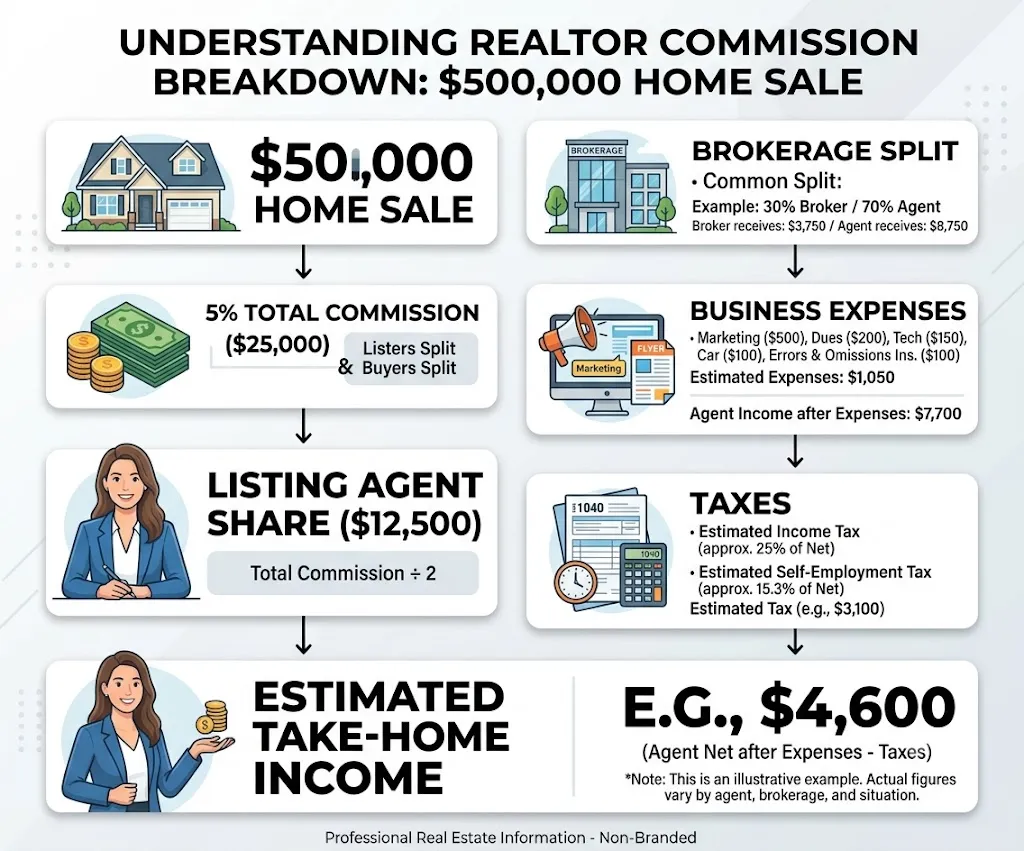
Many people assume a Realtor keeps the entire commission from a home sale, but in reality, the money is divided among several parties before the agent receives their final income. Let’s look at a simple example using a $500,000 home sale with a 5% total commission.
Step 1: Total Commission
If the home sells for $500,000 and the agreed commission is 5%, the total commission equals $500,000 × 5% = $25,000. This is the total commission generated by the transaction.
Step 2: Commission Is Allocated
In many home sales, both the listing agent and the buyer’s agent are compensated. If the commission is divided evenly, each side receives:
- Total commission: $25,000
- Listing agent’s side: $12,500
- Buyer’s agent’s side: $12,500
The exact allocation depends on the agreements between the parties and may differ from one transaction to another.
Step 3: Brokerage Split
Most Realtors work under a brokerage and share part of their commission with that brokerage. For this example, assume the listing agent has a 70/30 commission split:
- Listing agent’s commission: $12,500
- Brokerage share (30%): $3,750
- Agent’s share before expenses: $8,750
Step 4: Business Expenses
Realtors typically pay many business expenses from their commission, for example:
- Professional photography: $250
- MLS and association dues: $150
- Online marketing: $300
- Fuel and travel: $150
- Client closing gift and miscellaneous costs: $350
- Estimated business expenses: $1,200
After these expenses, the Realtor has approximately $7,550 remaining before taxes.
Step 5: Taxes
Most Realtors operate as self-employed independent contractors, meaning their gross commission income is reduced by business deductions, operating expenses, and tax obligations before becoming their net income.
If estimated taxes total $2,100, the Realtor’s remaining income would be approximately $7,550 − $2,100 = $5,450.
Estimated Money Flow
| Stage | Amount |
| Home sale price | $500,000 |
| Total commission (5%) | $25,000 |
| Listing agent’s side | $12,500 |
| After 70/30 brokerage split | $8,750 |
| After estimated business expenses | $7,550 |
| After estimated taxes | ≈ $5,450 |
Key Takeaway
Although a Realtor may appear to earn $12,500 from one side of a $500,000 home sale, that’s not the amount they take home. Brokerage splits, operating expenses, and taxes can significantly reduce their final income. This example is for illustration only, since actual earnings vary based on the commission agreement, brokerage model, business expenses, and individual tax situation.
Other Costs Realtors Pay
Commission is not the same as profit. Many Realtors pay for business expenses from their earnings, including:
- Professional photography
- Online advertising
- Yard signs
- Lockboxes
- Fuel and travel
- MLS membership
- REALTOR® association dues
- Errors and Omissions insurance
- Customer relationship management software
- Continuing education
- Licensing fees
- Office expenses
- Client gifts
- Transaction coordination
These costs reduce the amount the Realtor actually keeps.
Why Realtor Earnings Can Vary
Two Realtors can sell similar homes for the same price and still earn very different amounts. Several factors affect a Realtor’s final income, including:
- The agreed commission percentage.
- The brokerage commission split.
- The number of services included.
- Marketing and advertising expenses.
- Local market conditions.
- The Realtor’s experience.
- Whether the Realtor works independently or as part of a team.
- Self-employment taxes and other business costs.
- Sale price
- Number of homes sold each year
For example, an experienced Realtor working under a 90/10 brokerage split may keep significantly more than a newer agent working under a 50/50 split, even if both sell a $500,000 home.
Why Realtor Earnings Can Vary:
Taxes Also Reduce Take-Home Income
Most Realtors are independent contractors, and they’re responsible for paying their own taxes. Depending on where they work and their income, they may owe federal income tax, state income tax (where applicable), and self-employment tax. Because of these obligations, the amount deposited into the Realtor’s bank account is usually much lower than the original commission.
Many Realtors can also claim eligible business deductions before calculating their taxable income. Depending on their situation, these deductions may include mileage, advertising costs, office supplies, MLS membership fees, professional insurance, continuing education, and technology subscriptions. Because every Realtor’s financial situation is different, the final amount they keep can vary considerably from one transaction to another.
Example: How Much Does a Realtor Really Make?
Let’s look at a simple example. A home sells for $500,000 with a 6% commission:
- Total commission: $30,000
- Listing side: $15,000
- Brokerage split (70/30): $10,500
- Business expenses: -$1,200
- Estimated taxes: -$2,700
- Estimated take-home income: about $6,600
This example shows why commission figures can be misleading if you only look at the percentage.
Can Commission Be Negotiated?
Yes. Real estate commissions are negotiable, and sellers and agents can agree on different commission structures depending on:
- Local market conditions
- Home value
- Services included
- Agent experience
- Competition among brokerages
Some sellers choose full-service agents, while others prefer lower-cost or flat-fee options.
Before signing a listing agreement, sellers should understand the complete fee structure, including the listing agent commission, buyer agent compensation arrangements, transaction fees, and how these costs affect their final net proceeds.
Flat-Fee vs. Percentage Commission
When selling a home, you may choose between a traditional percentage-based commission and a flat-fee listing service.
With a traditional commission, the Realtor earns a percentage of the home’s final selling price, and this option often includes full-service support such as pricing advice, professional marketing, negotiations, contract management, and guidance through closing.
A flat-fee listing service charges a fixed price instead of a percentage. While this can reduce selling costs, the seller may be responsible for handling some parts of the transaction or paying separately for additional services.
The best option depends on your budget, the services you need, and your local market.
What This Means for New Realtors
If you’re thinking about becoming a Realtor, it’s important to understand that commission figures don’t represent guaranteed income. A Realtor’s earnings depend on several factors, including their brokerage agreement, experience, local market, business expenses, and the number of successful transactions they complete each year.
For example, two Realtors may each sell a $500,000 home, but one could take home significantly more because of a better brokerage split or lower operating costs. Building a successful real estate career often takes time, consistent lead generation, and strong client relationships.
Looking beyond the headline commission gives you a more realistic picture of what Realtors actually earn.
Frequently Asked Questions
How much does a Realtor make on a $500,000 house?
In many cases, one side of the commission ranges from $10,000 to $15,000 before brokerage splits and expenses.
Who pays the Realtor commission?
Traditionally, the commission is paid from the seller’s proceeds at closing, although commission arrangements are negotiable.
Does a Realtor keep the whole commission?
No. Most Realtors share their commission with their brokerage and pay business expenses and taxes.
Is the Realtor commission negotiable?
Yes. Commission rates are negotiable and can vary based on the property, the market, and the services provided.
What is the average commission on a $500,000 home?
A total commission between 4% and 6% is common, although actual rates vary by market and agreement.
Does a Realtor get paid if the house does not sell?
In most cases, no. Realtors are typically paid only when a home sale successfully closes. If the property does not sell, the agent usually does not receive a commission unless the listing agreement states otherwise.
Why do some Realtors charge a lower commission?
Some Realtors offer lower commission rates to remain competitive, attract more clients, or operate with lower business costs. Others may provide fewer services than a traditional full-service Realtor. Before choosing an agent, compare both the commission rate and the services included.
How much does a Realtor actually keep after expenses?
The final amount depends on brokerage splits, marketing costs, insurance, licensing fees, taxes, and other business expenses. Although one side of the commission on a $500,000 sale may range from $10,000 to $15,000, the Realtor’s actual take-home income is often much lower after these costs are deducted.
Why do people think Realtors make so much money?
Many people focus on the total commission shown at closing rather than the amount the Realtor actually keeps. In reality, the commission is often shared with the brokerage, and the agent may also pay for marketing, insurance, licensing, technology, and taxes before calculating their final income.
Important: The commission figures and examples in this guide are provided for educational purposes. Actual commission rates, brokerage agreements, operating expenses, and tax obligations vary by brokerage, state, local market, and individual transaction. Always review your listing agreement and consult a qualified real estate professional or tax adviser if you need advice about your specific situation.
Final Thoughts
Understanding how much a Realtor makes on a $500,000 sale requires looking beyond the commission percentage shown on the transaction.
A $15,000 commission share does not mean a Realtor takes home $15,000. The final income depends on several factors, including brokerage splits, marketing expenses, insurance, licensing costs, business operations, and taxes.
One of the most common misunderstandings in real estate is assuming the commission amount is the agent’s profit. In practice, Realtors operate like business owners. They invest time, money, and resources into finding clients, marketing properties, negotiating deals, and managing transactions from start to finish.
For homeowners, the most important takeaway is that the lowest commission is not always the best choice, and the highest commission does not always guarantee the best results. Sellers should compare the full value a Realtor provides, including experience, local market knowledge, communication, negotiation skills, and the services included.
A clear understanding of where commission money goes allows sellers to make better decisions and helps buyers and future Realtors understand the real economics behind a real estate transaction.
Whether you are preparing to sell a $500,000 home or simply researching how Realtor income works, looking at the complete picture, not just the commission percentage, provides a more accurate understanding of real estate earnings.