
Certificate of Occupancy: Requirements, Process, Cost, and How to Get One
Few documents create as much last-minute stress in real estate and construction as a Certificate of Occupancy (CO).
Many property owners spend months building a home, renovating a commercial space, or preparing to open a new business. They assume everything is ready because construction is complete. Then they discover they cannot legally move in, open their doors, or even close a property sale because the Certificate of Occupancy has not been issued.
This situation is more common than many people realize. Buyers experience delayed closings. Business owners postpone grand openings. Contractors schedule additional inspections. Property investors face unexpected costs. In many cases, the building itself is finished—the paperwork is not.
After reviewing guidance from building departments, construction authorities, and real estate resources across the United States, one pattern becomes clear: most Certificate of Occupancy problems happen because people misunderstand when a CO is required, who issues it, and what must happen before approval.
This guide brings everything together in one place using clear, easy-to-understand language. Whether you’re building a new home, buying property, renovating a commercial space, becoming a landlord, or opening a business, you’ll learn:
- What a Certificate of Occupancy is
- When you need one
- How the approval process works
- Typical costs and timelines
- Common mistakes that delay approval
- Practical steps to help your project stay on schedule
Because Certificate of Occupancy requirements vary by city, county, and state, this article focuses on the general process used throughout the United States while highlighting where local rules may differ. By the end, you’ll understand not only what a CO is, but also how to avoid the delays and surprises that catch many property owners off guard.
Key Takeaways
- A Certificate of Occupancy (CO) confirms that a building is safe and legally approved for occupancy.
- It is typically issued by the local building or zoning authority after all required inspections have been completed.
- A CO is commonly required for new construction, major renovations, changes in occupancy, and, in some jurisdictions, property sales or new tenants.
- A building permit allows construction to begin, while a Certificate of Occupancy allows the building to be legally occupied.
- Occupying a building without a required CO may result in fines, delays, insurance issues, or legal complications.
- Requirements vary by jurisdiction, so always verify local regulations before moving into or using a property.
What Is a Certificate of Occupancy?
A Certificate of Occupancy (CO) is an official document issued by a local building or zoning authority confirming that a property complies with applicable building codes and is safe to occupy for its approved use. In simple terms, it’s the final approval that allows people to legally live in, work in, or operate a business from a building.
A Certificate of Occupancy is commonly issued after construction or renovation work has been completed and all required inspections have been successfully passed. It confirms that the completed work matches the approved plans and that essential systems, such as electrical, plumbing, structural, and life-safety features, meet local code requirements.
The certificate also identifies the property’s approved occupancy type. For example, a building may be approved for:
- Residential use
- Commercial use
- Industrial use
- Mixed-use occupancy
Using a property for a purpose that differs from its approved occupancy classification may require additional approvals or a new Certificate of Occupancy, depending on local regulations.
It’s important to understand that a Certificate of Occupancy is not the same as a building permit. A building permit authorizes construction work to begin, while a Certificate of Occupancy is issued only after the work has been completed, inspected, and approved for occupancy. Without a required CO, a property may not be legally occupied, even if construction appears to be finished.
Why Local Requirements Matter
Building regulations in the United States are primarily enforced at the local level. While many jurisdictions base their requirements on model building codes developed by the International Code Council (ICC), cities and counties adopt and modify these codes independently. As a result, Certificate of Occupancy requirements, inspection procedures, and application processes may differ depending on where the property is located.
Definition and Purpose
A Certificate of Occupancy serves two primary purposes. First, it confirms that a building complies with applicable building, safety, and zoning requirements established by the local authority. Many jurisdictions use building codes based on the International Building Code (IBC) and related safety standards when evaluating whether a property qualifies for occupancy. These codes establish minimum requirements for structural integrity, fire protection, accessibility, sanitation, and occupant safety.
Second, it identifies how the property may legally be used. A typical Certificate of Occupancy includes information such as:
- Property address
- Property owner or developer
- Occupancy classification
- Approved building use
- Issuing authority
- Date of issuance
- Applicable building code or code edition (where required)
- Maximum occupant load for certain commercial buildings
Before issuing the certificate, the local authority generally verifies that key building systems have passed required inspections. Depending on the project, these inspections may include:
- Structural components
- Electrical systems
- Plumbing systems
- Mechanical systems
- Fire protection and life-safety systems
- Emergency exits and means of egress
Once these requirements are satisfied, the building department may issue the Certificate of Occupancy, allowing the property to be legally occupied for its approved purpose.
When Do You Need a Certificate of Occupancy?
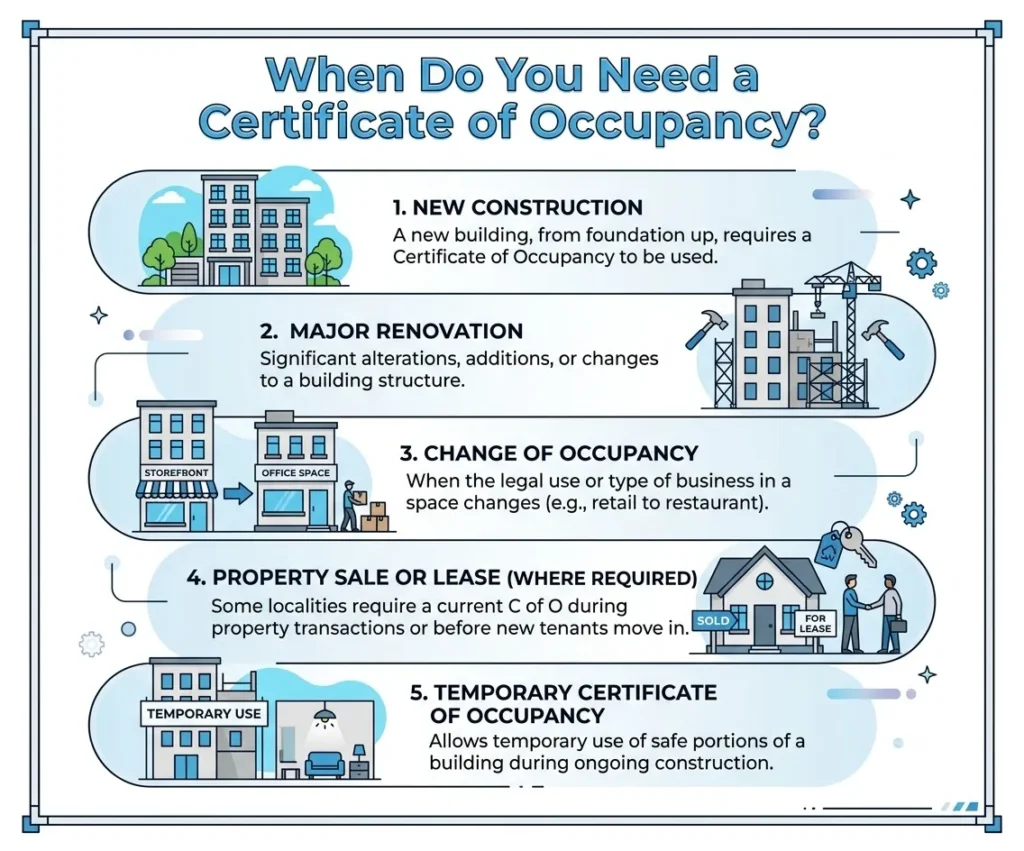
Certificate of Occupancy requirements vary by jurisdiction, but they are commonly required in several situations. Although the specific triggers differ across municipalities, local building departments commonly require one after new construction, major renovations, occupancy changes, or projects that significantly affect building safety. Property owners should always verify local requirements before occupying a building.
| Situation | CO Usually Required? |
| Building a new home | ✅ Yes |
| Building a commercial property | ✅ Yes |
| Major structural renovation | ✅ Usually |
| Converting office into apartments | ✅ Yes |
| Cosmetic remodeling | ❌ Usually No |
| Replacing flooring | ❌ No |
| Selling a property | ⚠️ Depends on local rules |
| Renting to a new tenant | ⚠️ Depends on jurisdiction |
New Construction
Most newly constructed residential and commercial buildings require a Certificate of Occupancy before anyone can legally move in or begin operating a business. The certificate confirms that construction has been completed according to the approved plans and that all required inspections have been successfully passed.
Major Renovations
Large renovation projects that significantly affect a building’s structure, safety systems, or occupancy may require an updated Certificate of Occupancy. Examples include:
- Major structural changes
- Large building additions
- Extensive remodeling
- Renovations affecting fire safety systems
- Projects involving significant electrical or plumbing upgrades
Minor repairs or cosmetic improvements generally do not require a new Certificate of Occupancy, although local requirements differ.
Change of Occupancy or Building Use
Changing how a building is used is one of the most common reasons a new Certificate of Occupancy may be required. Examples include:
- Converting a warehouse into apartments
- Changing a home into office space
- Opening a restaurant in a former retail store
- Converting office space into residential units
Because different occupancy types have different building code requirements, the local authority may require inspections and approval before the new use is allowed.
Property Sales or New Tenants
In some cities and counties, a Certificate of Occupancy or a similar occupancy inspection is required when:
- Selling a property
- Leasing commercial space
- Renting a residential property to a new tenant
These requirements vary by jurisdiction, so buyers, sellers, landlords, and tenants should always verify local regulations before completing a transaction. If you rent residential or commercial property, it’s worth checking whether your city requires a new Certificate of Occupancy or rental inspection before a new tenant moves in, since some municipalities require updated occupancy approval between tenancies while others do not.
Who Should Apply for a Certificate of Occupancy?
The person responsible for obtaining a Certificate of Occupancy (CO) depends on the project and local regulations. In many cases, the property owner, builder, developer, or licensed contractor submits the application after construction has been completed and all required inspections have passed.
You may need to apply for a Certificate of Occupancy if you are:
- Building a new residential home
- Constructing a commercial property
- Completing a major renovation
- Changing the occupancy classification of a building
- Converting a property to a different use
- Developing a mixed-use property
If you’re purchasing an existing property, it’s a good idea to ask the seller whether a valid Certificate of Occupancy already exists. Reviewing this document before closing can help prevent unexpected delays and identify unresolved permit issues.
What Information Is on a Certificate of Occupancy?
Although the format may vary by city or county, most Certificates of Occupancy include similar information. This document identifies the property, confirms its approved use, and shows that it has met the applicable building and safety requirements.
A typical Certificate of Occupancy may include:
- Property address
- Property owner or developer
- Building permit number (where applicable)
- Occupancy classification
- Approved building use
- Maximum occupant load (for many commercial buildings)
- Building code edition used during approval
- Date of issuance
- Issuing building department or authority
- Inspector’s approval or official signature
The exact information depends on your local building department, and some jurisdictions may include additional details based on local regulations.
Why This Information Matters
The information on a Certificate of Occupancy helps building officials, owners, buyers, lenders, and insurers confirm how a property may legally be used. If the property’s occupancy classification or approved use changes in the future, a new Certificate of Occupancy may be required depending on local regulations.
What Is a Temporary Certificate of Occupancy (TCO)?
A Temporary Certificate of Occupancy (TCO) allows a building to be occupied before every part of the project is fully completed. Local building departments may issue a TCO when the property is considered safe for occupancy, even though a few minor items still need to be finished.
For example, a building may be structurally complete and all life-safety systems may be working, while landscaping, exterior signage, or other non-essential work remains unfinished.
A Temporary Certificate of Occupancy usually includes:
- An expiration date
- A list of remaining work
- Conditions that must be completed
- Any occupancy restrictions
Once the remaining work is finished and the final inspection is approved, the TCO is typically replaced with a permanent Certificate of Occupancy. Developers working on large residential or mixed-use projects often rely on Temporary Certificates of Occupancy to allow phased occupancy while finishing approved non-life-safety work, though local rules determine when a TCO is available and what conditions apply.
When Is a Temporary CO Used?
A Temporary Certificate of Occupancy is more common for large commercial projects, but it may also be issued for certain residential projects where permitted by the local authority. Examples include:
- Office buildings nearing completion
- Apartment complexes
- Hotels
- Retail centers
- Mixed-use developments
Temporary Certificate of Occupancy vs. Certificate of Occupancy
| Temporary Certificate of Occupancy | Final Certificate of Occupancy |
| Temporary approval | Permanent approval |
| Has an expiration date | Does not expire unless the property’s use changes or local rules require a new certificate |
| Minor work may still be unfinished | All required work has been completed |
| May include occupancy restrictions | Full approved occupancy |
| Usually replaced after final inspection | Final stage of the permitting process |
How to Get a Certificate of Occupancy
Getting a Certificate of Occupancy is the final step in the construction or renovation process. While the exact process varies by jurisdiction, the overall steps are generally similar across the United States.
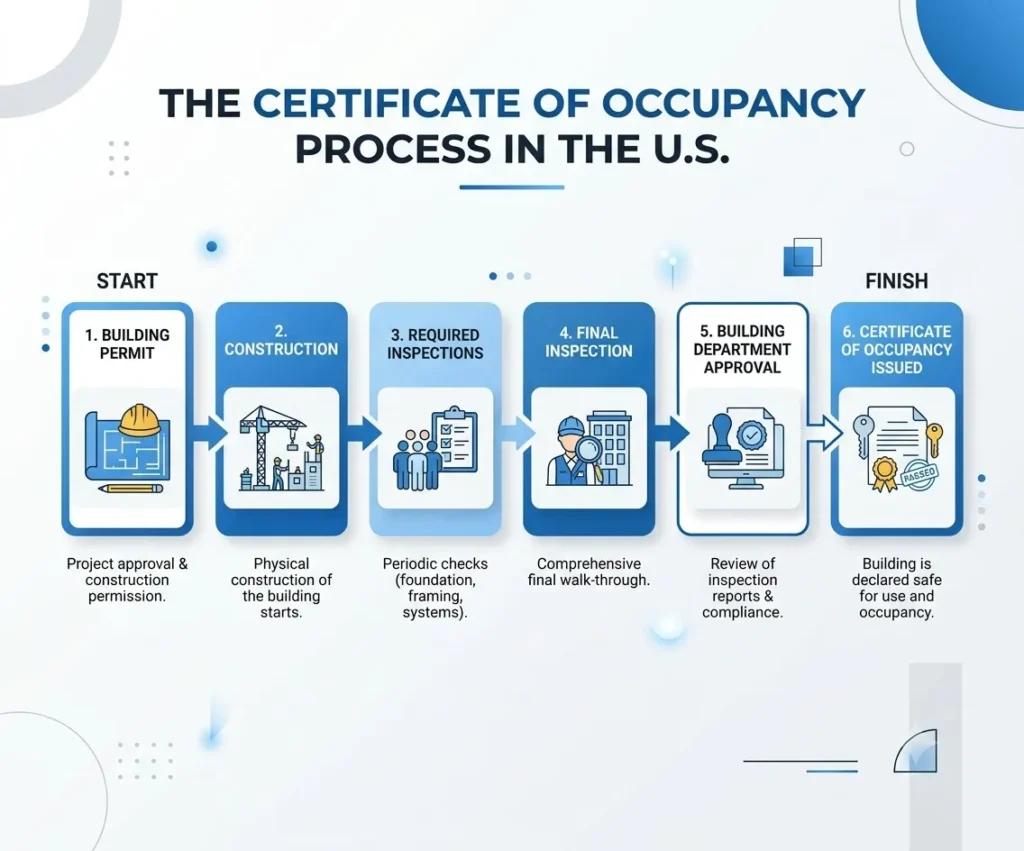
Step 1: Obtain the Required Permits
Before construction begins, obtain all permits required by your local building department. Depending on the project, this may include:
- Building permit
- Electrical permit
- Plumbing permit
- Mechanical permit
- Grading permit (if required)
Starting work without the proper permits can delay or prevent the issuance of a Certificate of Occupancy.
Step 2: Complete Construction According to the Approved Plans
The work must match the plans approved during the permitting process. If significant changes are made during construction, revised plans and additional approvals may be required before the project can continue.
Step 3: Pass All Required Inspections
Throughout construction, inspectors verify that the work complies with local building codes. Depending on the project, inspections may include:
- Foundation inspection
- Framing inspection
- Electrical inspection
- Plumbing inspection
- Mechanical inspection
- Fire safety inspection
- Final building inspection
If an inspection is not approved, the issues must be corrected before moving to the next stage. Contractors can help keep projects on schedule by coordinating inspections early, addressing correction notices promptly, and maintaining accurate permit records throughout construction.
Step 4: Schedule the Final Inspection
After construction is complete, request the final inspection from your local building department. During this inspection, officials verify that:
- Construction matches the approved plans.
- Required inspections have been completed.
- Safety requirements have been met.
- The building complies with applicable codes.
- The property is suitable for its intended use.
Step 5: Receive the Certificate of Occupancy
If the final inspection is approved and all required documents and fees have been completed, the local building department issues the Certificate of Occupancy. Processing times vary by jurisdiction, as some building departments issue the certificate within a few days, while others may take several weeks.
Only after receiving the Certificate of Occupancy can the building generally be legally occupied for its approved use. If you’re opening a retail store, restaurant, office, or warehouse, it’s best to avoid scheduling your grand opening until the required Certificate of Occupancy has been issued, since opening too early may lead to delays, penalties, or additional inspections.
Receiving a Certificate of Occupancy is often straightforward when all requirements have been met. However, several issues can delay approval, including:
- Failed building inspections
- Incomplete construction work
- Outstanding permit issues
- Unapproved changes to the original plans
- Fire or life-safety deficiencies
- Missing documentation
- Unpaid permit or inspection fees
- Incomplete plumbing, electrical, or mechanical work
There is no standard cost for a Certificate of Occupancy in the United States. Fees vary by city, county, state, property type, and the scope of the project. The total cost may depend on factors such as:
- Residential or commercial property
- New construction or renovation
- Required inspections
- Local permit fees
- Municipal processing charges
Some municipalities include the Certificate of Occupancy fee as part of the building permit, while others charge a separate application fee. Because fees and procedures differ by jurisdiction, it’s worth checking your local building department’s official website for current pricing and application requirements before planning your project.
What Happens If You Don’t Have a Certificate of Occupancy?
Occupying a property without a required Certificate of Occupancy (CO) can create serious legal, financial, and practical problems. While the exact consequences vary by state and local jurisdiction, most building departments prohibit occupancy until the required certificate has been issued. Whether you’re a homeowner, landlord, business owner, or property investor, understanding these risks can help you avoid unexpected delays and expenses.
1. You May Not Be Allowed to Occupy the Property
A Certificate of Occupancy confirms that a building is safe for its intended use. Without one, you may not be legally allowed to:
- Move into a newly built home
- Open a commercial business
- Rent a residential property
- Allow employees to occupy an office
- Use the building for its approved purpose
In some jurisdictions, officials may issue a notice prohibiting occupancy until the required approvals have been completed.
2. You Could Face Fines or Penalties
Many local governments have the authority to issue fines when a building is occupied without the required Certificate of Occupancy. Depending on local regulations, penalties may include:
- Daily fines
- Code enforcement actions
- Additional inspections
- Administrative fees
The amount and type of penalty vary by jurisdiction.
3. Property Sales May Be Delayed
A missing Certificate of Occupancy can slow down a real estate transaction, since buyers, lenders, and title companies often verify that required permits have been finalized before closing. If problems are discovered during the sale process, the transaction may be delayed until the issues have been resolved.
If you’re buying a home, it’s worth asking the seller whether a valid Certificate of Occupancy is available before closing. While requirements vary by location, confirming the property’s occupancy status early can help you avoid unexpected delays, additional inspections, or problems with financing and insurance. Investors purchasing distressed, renovated, or commercial properties should verify that all permits have been finalized and that any required Certificate of Occupancy has been issued, since missing approvals can increase renovation costs and delay resale or rental income.
4. Insurance Coverage May Be Affected
Insurance companies expect properties to comply with applicable laws and local regulations. If a property is occupied without the required approvals, it could create complications during the claims process. Always review your insurance policy and discuss any occupancy questions with your insurance provider.
5. Utility Services May Be Delayed
Some utility providers may require proof of legal occupancy before connecting certain services for newly constructed properties. Requirements differ by location and utility company.
6. Additional Construction Costs
If inspectors identify code violations or unfinished work, you may need to complete additional construction, schedule new inspections, hire contractors, and pay additional permit fees. Resolving these issues often takes more time and money than addressing them during construction.
Certificate of Occupancy vs. Building Permit
Many people confuse these two documents, but they serve different purposes.
| Certificate of Occupancy | Building Permit |
| Issued after construction is completed | Issued before construction begins |
| Allows legal occupancy | Allows construction work to begin |
| Confirms code compliance | Approves proposed construction |
| Requires final inspections | Requires approved building plans |
| Final step of the permitting process | First step of the permitting process |
Simply put, a building permit gives permission to build, while a Certificate of Occupancy gives permission to occupy.
Certificate of Occupancy vs. Certificate of Completion
Although these documents are sometimes confused, they are not always the same.
| Certificate of Occupancy | Certificate of Completion |
| Confirms a building is safe to occupy | Confirms construction has been completed |
| Required before legal occupancy | May be issued for projects that do not require occupancy approval |
| Includes occupancy approval | Does not always authorize occupancy |
| Common for residential and commercial buildings | Often used for certain renovation or infrastructure projects |
Not every jurisdiction issues a Certificate of Completion, and local requirements vary.
Can You Check a Certificate of Occupancy Online?
Many cities and counties provide online permit portals where property owners, buyers, contractors, and real estate professionals can verify whether a Certificate of Occupancy has been issued. Depending on your local government, you may be able to search using:
- Property address
- Permit number
- Parcel number
- Owner information
If online records are unavailable, contact your local building department or zoning office to request occupancy information. Checking a Certificate of Occupancy before purchasing, leasing, or renovating a property can help uncover unresolved permit or inspection issues before they become costly problems.
State and Local Requirements May Differ
Certificate of Occupancy requirements are not the same across the United States. Although many jurisdictions follow similar building safety principles, each city or county establishes its own application process, inspection requirements, fees, and occupancy rules. For example, some municipalities require a new Certificate of Occupancy when a property is sold or leased, while others only require one for new construction or major renovations.
Before starting construction, buying property, or opening a business, it’s important to contact your local building department to confirm the specific requirements that apply to your project.
Quick Checklist Before Occupying a Property
Before moving into a property or opening a business, confirm the following:
- Construction has been completed.
- All required inspections have passed.
- The local building department has approved the project.
- The Certificate of Occupancy has been issued.
- The property is being used for its approved occupancy type.
- All required permits have been finalized.
Keeping this checklist in mind can help prevent unexpected delays after construction is complete.
Conclusion
A Certificate of Occupancy may look like a simple document, but in practice it represents the final approval that allows a property to be legally occupied for its intended purpose.
One of the biggest lessons repeated across building departments, construction professionals, and real estate experts is that construction being finished does not automatically mean a building is ready for occupancy. Final inspections, code compliance, approved permits, and local authorization all play an important role before a Certificate of Occupancy can be issued.
During the research for this guide, one trend became clear: most delays are not caused by complicated regulations. They usually happen because property owners wait until the end of a project to ask about Certificate of Occupancy requirements. A simple conversation with the local building department before construction begins can often prevent weeks of delays, unexpected expenses, and unnecessary frustration later.
If you’re planning to build, renovate, buy, lease, or occupy a property, treat the Certificate of Occupancy as an essential part of your project—not just paperwork to collect at the end. Keeping permits organized, completing inspections on time, and confirming local requirements early can make the entire process much smoother.
While every city and county follows its own regulations, the goal remains the same everywhere: to ensure buildings are safe, code-compliant, and suitable for the people who will live, work, or do business inside them.
Key takeaway: Before moving into any newly constructed or significantly renovated property, always confirm that the required Certificate of Occupancy has been issued by your local building authority. That single step can help you avoid legal issues, costly delays, and unexpected problems after construction is complete.
Frequently Asked Questions
What is a Certificate of Occupancy?
A Certificate of Occupancy is an official document issued by a local building authority confirming that a property complies with applicable building codes and is approved for its intended use.
How much does a Certificate of Occupancy cost?
The cost varies depending on the city, county, state, and project type. Fees are typically established by the local building department, so it’s best to check your municipality’s current fee schedule.
How long does it take to get a Certificate of Occupancy?
Processing times vary. Some building departments issue the certificate within a few days after the final inspection, while others may take several weeks depending on workload and local procedures.
Do I need a Certificate of Occupancy for an existing home?
Usually, homeowners already living in their property do not need a new Certificate of Occupancy. However, some jurisdictions require a new inspection or occupancy certificate when a property is sold, leased, or significantly renovated. Always verify local requirements before completing a transaction.
Can I buy or sell a property without a Certificate of Occupancy?
It depends on local regulations. Some jurisdictions require a valid Certificate of Occupancy before closing, while others allow the sale to proceed under certain conditions. Lenders may also have their own requirements.
What is the difference between a Temporary Certificate of Occupancy and a final Certificate of Occupancy?
A Temporary Certificate of Occupancy allows limited occupancy while minor work remains unfinished. A final Certificate of Occupancy is issued after all required work has been completed and approved.
Do all renovation projects require a new Certificate of Occupancy?
No. Minor repairs and cosmetic improvements usually do not require a new Certificate of Occupancy, while major renovations, structural changes, or changes in occupancy often do.