Learning and Development: A Complete Guide for Building Future-Ready Employees
Organizations today face a difficult challenge. The skills employees need are changing faster than ever, yet many companies still struggle with skill gaps, leadership shortages, low employee engagement, and rising turnover.
In my experience reviewing Learning and Development strategies across different industries, one common pattern appears repeatedly: organizations often invest in training programs but fail to connect learning with business outcomes. Employees complete courses, certificates are issued, and learning records look impressive, but performance improvements remain difficult to measure.
At the same time, business leaders are under pressure to prepare their workforce for rapid technological change. New technologies, automation, artificial intelligence, and evolving customer expectations are creating demand for skills that may not have been necessary just a few years ago. Without a structured Learning and Development strategy, organizations risk falling behind competitors and losing valuable talent.
This is where Learning and Development becomes a strategic advantage rather than an HR initiative.
Effective Learning and Development helps organizations close skill gaps, develop future leaders, improve employee retention, and build a workforce that can adapt to change. More importantly, it creates a direct connection between employee growth and business performance.
This guide explains what Learning and Development is, why it matters, the key areas it covers, proven frameworks, implementation strategies, emerging trends, and best practices organizations can use to build a stronger and more future-ready workforce.
| Learning and Development Overview | Details |
| Primary Goal | Improve employee skills, performance, and career growth |
| Business Benefit | Increased productivity, retention, and adaptability |
| Key Focus Areas | Onboarding, skills training, leadership, compliance, soft skills, technical skills, career development |
| Common Methods | E-learning, coaching, mentoring, workshops, on-the-job learning |
| Key Stakeholders | HR, L&D teams, managers, executives, employees |
| Success Metrics | Skill improvement, engagement, retention, productivity, ROI |
Remember: Effective Learning and Development helps organizations close skill gaps, develop future leaders, improve employee retention, and build a workforce that can adapt to change. More importantly, it creates a direct connection between employee growth and business performance. A well-designed Learning and Development strategy can help organizations align employee development with broader business goals.
Why Is Learning and Development Important?
Learning and Development is important because businesses are always changing. New technologies, customer needs, and workplace expectations create new challenges, and employees need updated skills to handle these changes as they come. A strong L&D program helps organizations in several ways.
Why Organizations Are Increasing Their Investment in Learning and Development
Organizations are investing more in Learning and Development because workforce skills are changing rapidly. According to the World Economic Forum’s Future of Jobs Report, many of today’s core job skills are expected to evolve significantly over the coming years due to advances in technology, automation, and artificial intelligence. As a result, companies are focusing on upskilling and reskilling employees to remain competitive and future-ready.
Improves Employee Performance
Employees perform better when they have the right skills and knowledge, and learning programs help workers understand their roles while also improving confidence and decision-making.
Increases Employee Engagement and Retention
Employees want opportunities to learn and grow, and when companies invest in employee development, workers feel genuinely valued in return. This creates stronger engagement and loyalty across the organization. Career development programs also help employees see a future within the company, and as a result, organizations can improve retention and reduce the loss of skilled employees over time.
Why Learning and Development Matters for Different Stakeholders
For HR Leaders
L&D improves retention, succession planning, and workforce capability.
For Managers
L&D helps teams perform better and adapt to changing business needs.
For Employees
L&D supports career growth, skill development, and promotion opportunities.
For Executives
L&D helps build future workforce capabilities and supports business strategy.
How Learning and Development Supports HR Goals
Learning and Development helps HR teams address several workforce challenges, including employee retention, succession planning, workforce readiness, and internal mobility. By investing in employee growth, HR leaders can build stronger talent pipelines and reduce the costs associated with external hiring.
Learning and Development Improves Employee Retention
Employees are more likely to remain with organizations that invest in their professional growth. According to LinkedIn’s Workplace Learning Report, learning opportunities continue to be one of the most important factors influencing employee engagement and retention. When employees see a clear path for growth and development, they’re more likely to stay committed to their organization and contribute to long-term business success.
What Are the 7 Areas of Learning and Development?
A complete L&D strategy covers different areas of employee growth. The seven main areas of Learning and Development include:
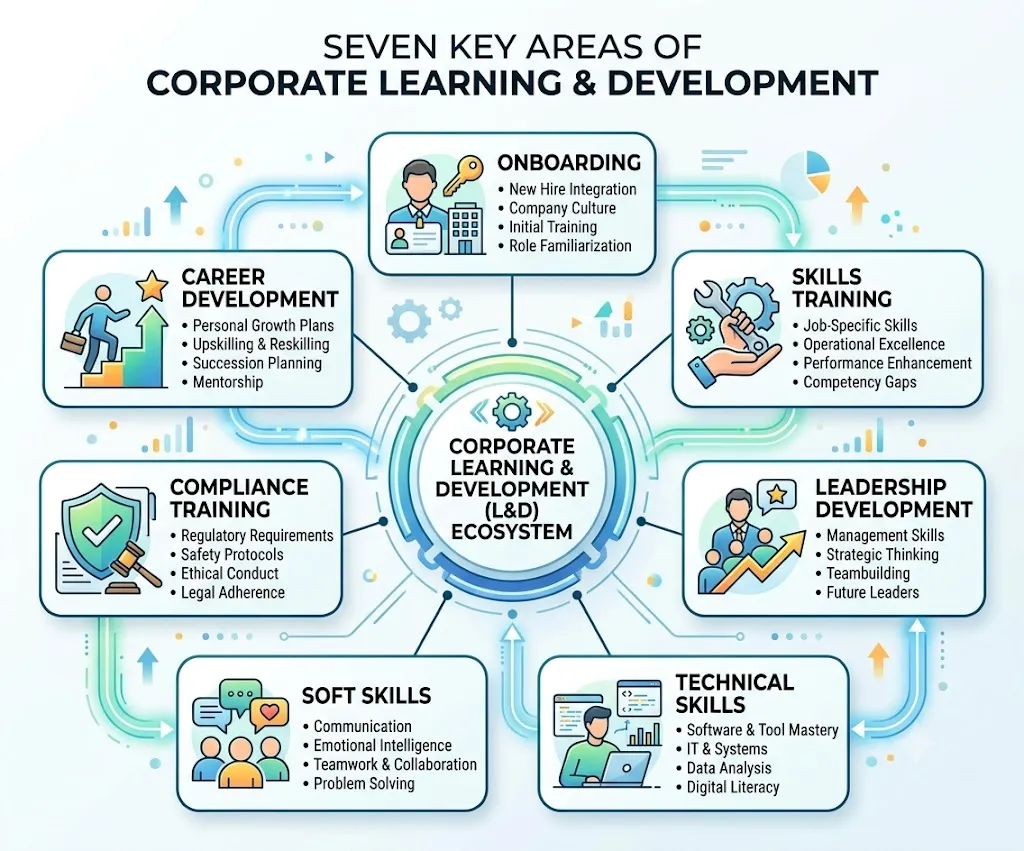
1. Onboarding
Onboarding helps new employees understand their role, company culture, and workplace expectations, and a good onboarding program helps employees become productive much faster. It can include:
- Company introduction
- Role training
- Policy education
- Team introductions
- Workplace tools training
2. Skills Training
Skills training helps employees improve the abilities needed for their jobs, whether that involves technical skills, industry knowledge, or job-specific abilities. Examples include:
- Software training
- Sales training
- Data skills
- Customer service training
Skills training ultimately helps close workplace skill gaps wherever they appear.
3. Leadership Development
Leadership development prepares employees for management and leadership roles, and strong leaders need more than just technical knowledge to succeed. They need skills such as:
- Communication
- Decision-making
- Emotional intelligence
- Team management
- Strategic thinking
Leadership programs help companies build future leaders from within their own ranks.
4. Compliance Training
Compliance training helps employees understand rules, laws, and company policies. Common examples include:
- Workplace safety training
- Data protection training
- Ethics training
- Legal compliance training
Wage and hour rules fall under compliance too, which is why payroll and HR teams often train on topics such as how to calculate time and a half correctly. This kind of training reduces risks and supports responsible business practices overall.
5. Soft Skills Training
Soft skills are personal and social abilities that help employees work effectively with others. Important soft skills include:
- Communication
- Teamwork
- Problem-solving
- Time management
- Conflict resolution
These skills matter in essentially every workplace, regardless of industry.
6. Technical Skills Development
Technology changes quickly, so employees need continuous technical learning to stay effective in their roles. Technical development may include:
- Programming skills
- Data analysis
- Digital tools
- Industry software
- Cybersecurity knowledge
7. Career Development
Career development helps employees plan their professional growth over time. It includes:
- Career paths
- Mentoring
- Coaching
- Internal opportunities
- Skill development plans
Many internal career paths begin in support functions, where employees build the administrative experience needed to move into coordination and management roles. Career-focused L&D improves employee motivation and supports long-term growth for everyone involved.
Typical Learning and Development Activities
Learning and Development teams perform a wide range of activities to support employee growth. These activities may include:
- Training needs analysis
- Curriculum design
- Content development
- Workshop facilitation
- E-learning development
- Coaching and mentoring
- Leadership development programs
- Employee onboarding
- Career pathing
- Succession planning
- Learning Management System administration
- Compliance training
- Employee engagement initiatives
- Learning analytics and reporting
- Vendor management
The exact activities depend on the organization’s size, industry, and specific learning objectives.
What Are the Objectives of Learning and Development?
The main objectives of Learning and Development are to improve both people and business performance together.
Close Skill Gaps
Organizations use L&D to identify missing skills, then create learning programs to improve employee abilities in response. This helps companies prepare for future needs before they become urgent problems.
Improve Performance
The goal of L&D isn’t just completing courses; the real goal is better workplace performance. Effective learning helps employees apply new knowledge in real situations rather than leaving it theoretical.
Supporting Long-Term Business Strategy
For executive leaders, Learning and Development is more than an employee benefit. It’s a strategic investment that helps organizations adapt to market changes, address emerging skill needs, and build a workforce capable of supporting long-term business growth.
Support Career Growth
Employees want opportunities to advance, and L&D programs help workers develop the skills needed for promotions and new responsibilities as they arise.
Create a Continuous Learning Culture
A learning culture encourages employees to improve every day, making learning part of normal work instead of treating it as a one-time activity.
What Are Common Learning and Development Methods?
Organizations use different methods based on their specific goals.
On-the-Job Learning
Employees learn by doing real work, and this method helps workers gain practical experience they can apply immediately. Examples include:
- Job shadowing
- Projects
- Workplace practice
E-Learning
E-learning allows employees to learn online, providing flexibility since employees can learn anytime and anywhere that suits them. Common e-learning formats include:
- Online courses
- Videos
- Digital quizzes
- Learning platforms
Coaching and Mentoring
Coaching helps employees improve specific skills, while mentoring provides guidance from more experienced professionals. Both methods support career growth in complementary ways.
Workshops and Seminars
Workshops allow employees to learn through discussion and practice together. They’re especially useful for:
- Leadership skills
- Communication
- Team building
Social Learning
Social learning happens when employees learn from each other directly. Examples include:
- Team discussions
- Peer learning
- Knowledge sharing
Collaboration like this helps create a stronger learning culture across the organization.
What Is a Learning Needs Analysis?
A Learning Needs Analysis (LNA) is the process of identifying skill gaps and determining what employees need to learn. It helps organizations focus learning investments on areas that will create the greatest business impact.
Common sources of learning needs data include:
- Employee surveys
- Performance reviews
- Skills assessments
- Business objectives
- Manager feedback
A well-executed Learning Needs Analysis forms the foundation of an effective Learning and Development strategy.
How to Build a Learning and Development Strategy
A strong L&D strategy needs careful planning. The following steps help organizations create effective programs.
1. Identify Learning Needs
First, organizations must understand current skill levels within their teams. They can use:
- Employee surveys
- Performance reviews
- Skills assessments
- Manager feedback
This helps identify skill gaps before they become bigger problems.
2. Set Clear Learning Goals
Learning goals should connect directly with business objectives, and good goals are specific and measurable rather than vague. For example: improve customer service skills within six months.
3. Choose the Right Learning Methods
Different skills require different approaches, and companies may use:
- Online learning
- Coaching
- Workshops
- Mentoring
- Practical projects
The best method ultimately depends on the specific learning goal in question.
4. Deliver Learning Programs
Organizations then launch their learning initiatives, and managers should support employees throughout this process, since that support genuinely improves learning success.
5. Measure Results
Companies should evaluate whether their learning programs actually work. Useful L&D metrics include:
- Skill improvement
- Employee performance
- Course completion
- Employee feedback
- Business results
Common Learning and Development Challenges
Even well-designed Learning and Development programs can face obstacles.
Common challenges include:
- Limited budgets
- Lack of leadership support
- Low employee participation
- Measuring training effectiveness
- Skills changing faster than learning programs can adapt
- Limited time for employee learning
Organizations that address these challenges early are more likely to achieve successful learning outcomes and stronger business results.
Learning and Development in Small vs Large Organizations
Learning and Development programs often look quite different depending on company size.
Learning and Development in Small Organizations
Small businesses usually have fewer resources and smaller learning budgets, but they often benefit from:
- Flexible learning approaches
- Personalized coaching
- Informal mentoring
- Faster decision-making
Small organizations can adapt their learning programs quickly as business needs change.
Learning and Development in Large Organizations
Large companies often have dedicated Learning and Development teams and advanced learning technologies at their disposal. Their advantages include:
- Scalable learning programs
- Learning Management Systems
- Leadership development pipelines
- Learning analytics
- Global training initiatives
Large organizations can provide structured learning opportunities across multiple departments and locations simultaneously.
The Role of Technology in Learning and Development
Technology has changed how organizations deliver learning, and modern L&D uses digital tools to create noticeably better learning experiences.
Artificial Intelligence in Learning and Development
AI is becoming an important part of modern L&D. AI can help organizations:
- Personalize learning paths
- Recommend courses
- Identify skill gaps
- Create learning content
- Provide learning support
AI-powered learning helps employees receive training that matches their specific needs more precisely.
Learning Management Systems (LMS)
An LMS helps organizations manage employee learning at scale. It can help with:
- Course delivery
- Progress tracking
- Reports
- Employee records
LMS platforms make large-scale learning considerably easier to administer.
Learning Analytics
Learning analytics uses data to understand learning performance, and organizations can use this data to improve their programs over time. It helps answer questions like:
- Are employees improving?
- Which skills need attention?
- Which programs create better results?
Learning Experience Platforms (LXP)
Learning Experience Platforms (LXPs) focus on personalized learning experiences by recommending content, supporting social learning, and tracking skill development. Many organizations use LXPs alongside LMS platforms to create more engaging learning environments.
Many organizations use both LMS and LXP solutions together to create a more flexible and learner-focused development environment overall.
Learning and Development Frameworks
Several frameworks help organizations design better learning programs.
70/20/10 Learning Model
This model suggests that learning happens through experience, social interaction, and formal education. It shows that workplace learning isn’t limited to the classroom alone.
ADDIE Model
The ADDIE model is a common instructional design framework. It includes:
- Analysis
- Design
- Development
- Implementation
- Evaluation
This framework helps create structured learning programs from start to finish.
Bloom’s Taxonomy
Bloom’s Taxonomy is a framework used to create effective learning objectives, helping organizations design learning experiences that move from basic understanding to advanced thinking. The six levels are:
- Remember
- Understand
- Apply
- Analyze
- Evaluate
- Create
Learning professionals use Bloom’s Taxonomy to develop training programs that encourage deeper learning and stronger skill development.
Kirkpatrick Evaluation Model
The Kirkpatrick model helps measure learning success by focusing on:
- Reaction
- Learning
- Behavior
- Results
This framework helps organizations understand the real impact of their training programs.
Future Trends in Learning and Development
Learning and Development will continue to evolve. Important trends include the following.
Workforce Reskilling Is Becoming a Business Priority
Rapid technological change is creating new skill requirements across industries. According to the World Economic Forum’s Future of Jobs Report, many employees will require upskilling or reskilling in the coming years as automation, artificial intelligence, and digital transformation continue to reshape the workplace. Organizations that invest in continuous learning are better positioned to address skill shortages, improve workforce adaptability, and remain competitive in a changing business environment.
AI-Powered Learning
AI will create more personalized learning experiences going forward, with employees receiving training based on their individual skills and goals.
Skills-Based Organizations
Companies are moving from job-based thinking to skill-based thinking, focusing on what employees can actually do rather than only their job titles.
Continuous Learning
Future workplaces will require constant improvement, and employees will need to learn new skills throughout their entire careers.
Immersive Learning
Virtual reality and simulations will allow employees to practice real situations safely, which can improve both decision-making and practical skills over time.
Learning and Development Metrics and KPIs
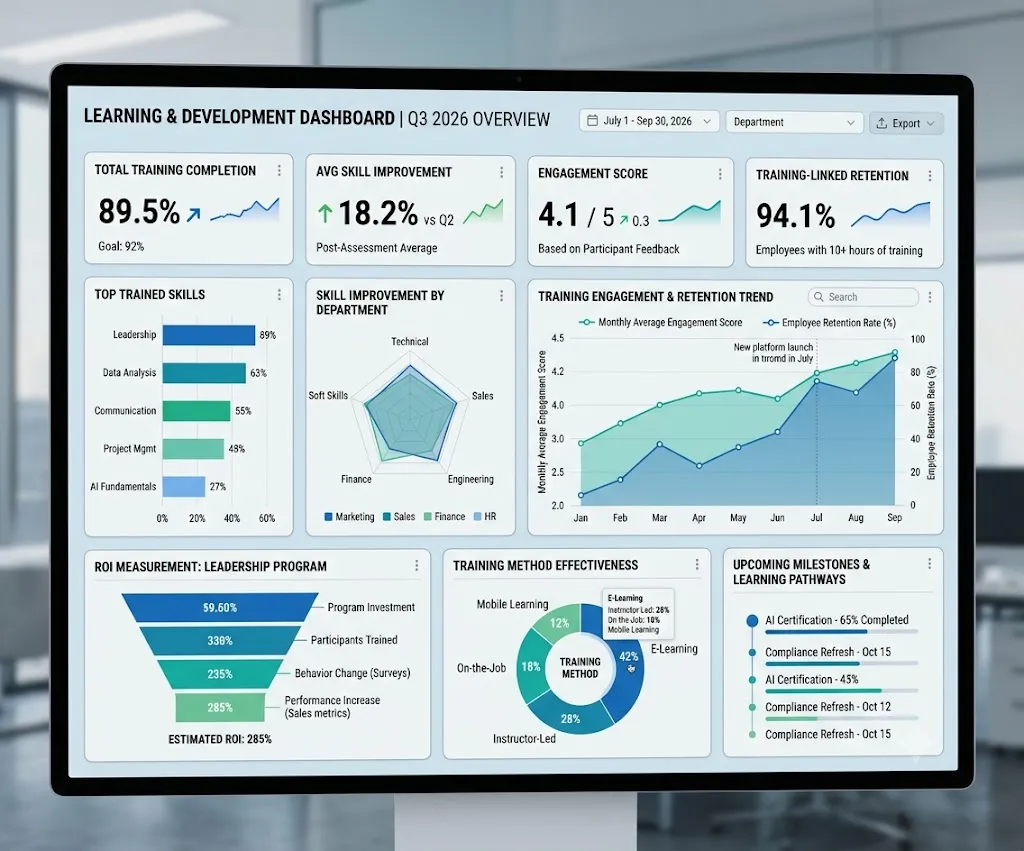
Organizations need clear metrics to measure the success of their Learning and Development programs. Common L&D metrics include:
- Training completion rates
- Assessment scores
- Skill improvement levels
- Time-to-competency
- Employee retention
- Employee engagement
- Productivity improvements
- Internal promotion rates
Tracking these metrics helps organizations understand whether their learning programs are delivering meaningful business results.
The Association for Talent Development (ATD) regularly publishes research on employee development, learning effectiveness, leadership development, and workforce capability building.
How to Measure the ROI of Learning and Development
Measuring the return on investment (ROI) of Learning and Development helps organizations understand whether training programs create real business value. While course completion rates are useful, they don’t always show the full impact of learning initiatives, so organizations should connect learning outcomes to broader business performance metrics.
Common ways to measure Learning and Development ROI include:
- Increased employee productivity
- Higher employee retention rates
- Faster time-to-competency
- Improved customer satisfaction scores
- Increased sales performance
- Reduced workplace errors
- Lower compliance risks
- Higher internal promotion rates
For example, if a sales training program improves revenue generation or a leadership program reduces employee turnover, the organization can calculate the business impact of its learning investment directly. A strong ROI measurement strategy helps Learning and Development teams demonstrate value to senior leadership and secure future investment in employee development.
Using Learning Data to Improve Decision-Making
Modern Learning and Development leaders rely on data to evaluate program effectiveness and identify future development needs. Learning analytics can help organizations understand skill gaps, optimize training investments, and align workforce capabilities with business objectives more precisely.
Learning and Development Best Practices
Organizations that achieve strong learning outcomes often follow several best practices.
Align Learning With Business Goals
Every learning initiative should support a specific business objective or workforce need rather than existing in isolation.
Create Personalized Learning Paths
Employees have different learning needs, so personalized development plans help employees focus on the skills most relevant to their roles and career goals.
Encourage Continuous Learning
Learning should be an ongoing process rather than a one-time event. Coaching, mentoring, online learning, and workplace experiences all support continuous development over time.
Use Data to Improve Learning Programs
Learning analytics help organizations understand what’s working and where improvements are genuinely needed.
Measure Business Impact
Successful organizations measure learning outcomes using metrics such as skill development, employee engagement, productivity, retention, and overall business performance.
Research from the Chartered Institute of Personnel and Development (CIPD) consistently highlights the importance of continuous learning, manager support, and skills development in building high-performing organizations.
Frequently Asked Questions
What is an example of Learning and Development?
Examples include onboarding programs, leadership training, online courses, mentoring, and technical skills training.
Is Learning and Development part of HR?
Yes. L&D is usually part of HR, but it also supports wider business goals beyond the HR function itself.
Why is Learning and Development important for employees?
L&D helps employees improve skills, grow their careers, and prepare for future opportunities as their industries evolve.
How do companies measure L&D success?
Companies measure L&D through skill improvement, employee performance, retention, feedback, and business results.
What is the difference between training and L&D?
Training focuses on specific skills, while L&D focuses on long-term employee growth and organizational capability.
What are the four stages of the Learning and Development cycle?
The Learning and Development cycle usually includes four stages:
- Analysis
- Design
- Delivery
- Evaluation
These stages help organizations identify learning needs, create effective training programs, deliver learning experiences, and measure results along the way.
What are the main benefits of Learning and Development?
The main benefits of Learning and Development include improved employee performance, stronger engagement, higher retention, faster skill development, better leadership capabilities, and improved business results overall.
What is a Learning and Development strategy?
A Learning and Development strategy is a structured plan that helps organizations develop employee skills while supporting business goals. It outlines learning objectives, training methods, measurement approaches, and long-term development priorities.
Conclusion
The organizations that gain the most value from Learning and Development are not necessarily those with the largest training budgets. They are the organizations that treat learning as a business strategy rather than a standalone training function.
Across industries, successful Learning and Development programs share several characteristics. They align learning initiatives with business goals, focus on closing real skill gaps, measure outcomes consistently, and create opportunities for continuous growth at every level of the organization.
One lesson that repeatedly emerges from workforce development research and industry best practices is that employee learning cannot be viewed as a one-time event. Skills evolve, industries change, and new challenges emerge. Organizations that invest in continuous learning are better positioned to adapt, innovate, and remain competitive over the long term.
Whether your goal is to improve employee performance, strengthen leadership pipelines, increase retention, or prepare for future workforce demands, a well-designed Learning and Development strategy provides a foundation for sustainable growth.
As the workplace continues to evolve, Learning and Development will remain one of the most important investments organizations can make, not only for employee success, but for long-term business success as well.