
Profit Sharing Plan: How It Works, Types & Benefits
Choosing the right retirement plan isn’t easy. Many business owners want to reward employees, reduce taxes, and stay competitive, but they’re often unsure which retirement plan offers the right balance of flexibility and long-term value. One of the most common misconceptions is that a profit sharing plan only works when a business earns large profits or that contributions are required every year. Those misunderstandings can prevent employers from considering a retirement benefit that may actually fit their goals.
In practice, questions about profit sharing plans often go beyond simple definitions. Employers want to know how contributions are calculated, whether the plan can help retain employees, what the IRS allows, and how a profit sharing plan compares with options like a 401(k) or SEP IRA. Employees, on the other hand, usually want to understand how employer contributions affect their retirement savings, when those contributions become vested, and what happens if they leave the company.
This guide brings together those answers in one place. It explains how qualified profit sharing plans work, the different allocation methods employers can choose, the tax and compliance considerations involved, and the advantages and limitations of using profit sharing as part of a retirement strategy. Whether you’re evaluating retirement benefits for your business or trying to understand the plan offered by your employer, you’ll gain a practical understanding of how profit sharing plans work under current U.S. retirement plan rules.
Profit Sharing Plan at a Glance
| Feature | Details |
| Plan Type | Defined contribution retirement plan |
| Who contributes? | Employer |
| Employee contributions | Usually not (unless paired with a 401(k)) |
| Contribution requirement | Discretionary |
| Tax treatment | Employer deductions may apply; investment earnings generally grow tax deferred |
| Vesting | Immediate or according to the plan’s schedule |
| Common users | Small and mid-sized businesses |
Key Takeaways
Quick Summary
- A profit sharing plan is an employer-funded retirement plan with discretionary contributions to qualified profit sharing plans.
- Employers generally decide whether and how much to contribute each year.
- Contributions don’t have to depend on company profits.
- Employees typically don’t contribute unless the plan also includes a 401(k).
- Employer contributions may be tax deductible, while investment earnings generally grow tax deferred.
- Allocation methods can include salary proportional, age-weighted, FICA integrated, and new comparability formulas.
- IRS contribution limits and nondiscrimination rules apply.
What Is Profit Sharing?
A profit sharing plan is a type of defined contribution retirement plan that allows an employer to make contributions directly to employee accounts. The employer sets the plan rules and chooses the allocation method that best fits the company’s goals and workforce.
Although it’s called a profit sharing plan, employer contributions do not have to be tied directly to annual profits. Instead, employers decide whether and how much to contribute according to the plan document and applicable IRS rules
All contributions to a traditional profit sharing retirement plan come from the employer, and employees normally do not contribute to the profit sharing portion unless the plan also includes a 401(k) feature. For example, a company might decide to contribute $100,000 to its profit sharing plan for the year. The plan then applies its allocation formula to divide that amount among eligible participants, and the amount each employee receives doesn’t have to be equal — it depends entirely on how the formula is structured.
For employees, a profit sharing plan offers a meaningful opportunity to build retirement savings through employer-funded contributions. Because the amount received is based on the plan’s formula rather than salary deferrals alone, profit sharing can provide several distinct benefits:
- Employer-funded retirement savings
- Flexible employer contributions
- Potential tax benefits
- Investment growth within the retirement plan
- A stronger employee benefits package
- Potential help with employee retention
Who Is Eligible for a Profit Sharing Plan?
Eligibility for a profit sharing plan depends on the specific plan document, though qualified plans must still follow IRS rules. In many cases, employees become eligible after reaching age 21 and completing one year of service, though some employers choose less restrictive requirements to allow employees to participate sooner. Certain plans may also require immediate vesting if they use longer service requirements.
Employers must apply eligibility rules fairly and satisfy federal coverage and nondiscrimination requirements. Before joining a plan, employees should take time to review a few key details:
- Minimum age requirement
- Length of service requirement
- Hours worked requirement, if applicable
- Vesting schedule
- Participation date
The plan document will always explain the exact eligibility requirements that apply.
How Does Profit Sharing Work?
A profit sharing plan follows a defined process, though the exact rules depend on the specific plan document in place.
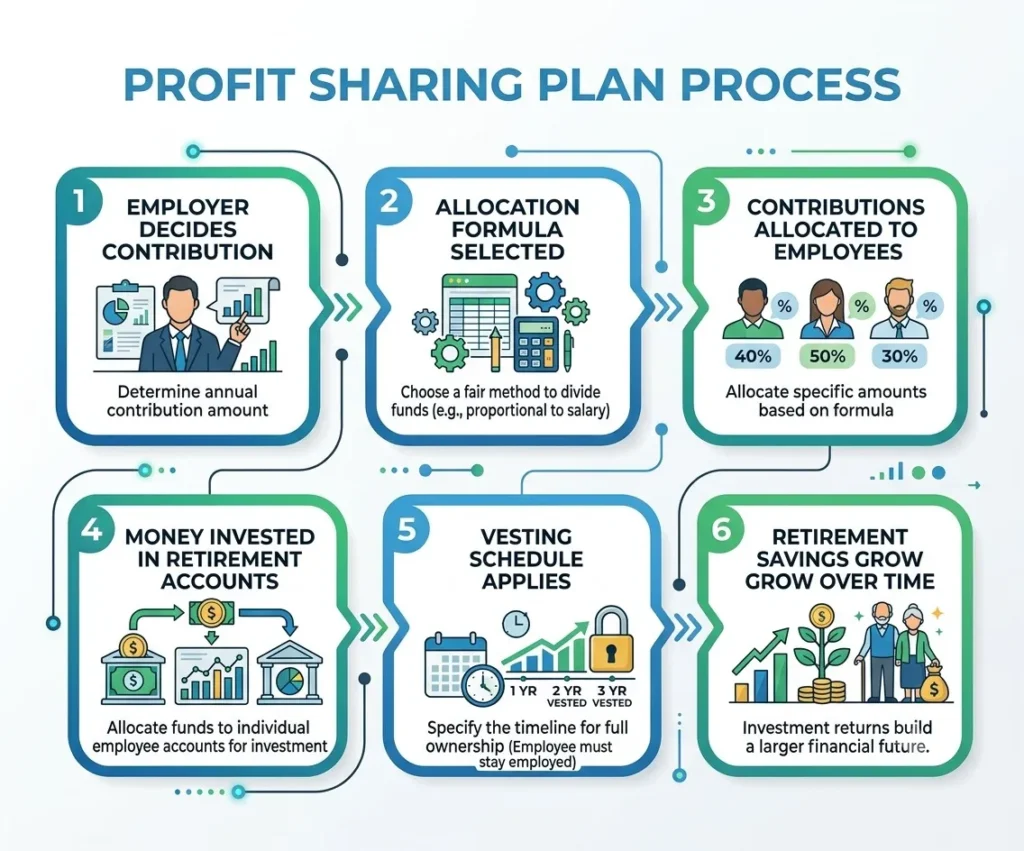
Step 1: The employer decides whether to contribute
Contrary to what many people assume, a qualified profit sharing plan does not require a company to earn a profit before making employer contributions. The IRS allows employers to make discretionary contributions “out of profits or otherwise,” which gives businesses room to adjust based on their financial situation.
Because these contributions are discretionary, employers can contribute different amounts from year to year. In strong years, a company might contribute more, while in weaker years it may decide not to contribute at all — assuming the plan document allows for that flexibility.
Step 2: You decide on an allocation formula
The plan document must clearly explain how contributions are allocated among employees. A simple formula might give each employee the same percentage of eligible compensation. For example, if an employer contributes 5% of eligible compensation, an employee earning $60,000 could receive a $3,000 employer contribution.
Other formulas take additional factors into account, such as age, compensation level, Social Security wage levels, or specific employee groups, allowing for more customized allocation strategies.
Step 3: You distribute the shares
Once the formula is applied, the employer contribution is allocated to individual participant accounts. From there, the money can be invested through the plan’s available investment options, which commonly include mutual funds, stocks, bonds, and other investment vehicles.
It’s important to understand that an employee may not own all employer contributions right away, since many plans use a vesting schedule to phase in ownership over time.
Vesting Example
Suppose your employer contributes $10,000 to your profit sharing account. If you leave the company while you are 60% vested, you would generally keep $6,000 of the employer contribution, while the remaining $4,000 may be forfeited according to the plan’s vesting schedule.
Vesting rules vary from plan to plan, so employees should always review their specific plan document carefully. In short, vesting determines how much of the employer contribution an employee actually owns if they leave the company — some plans offer immediate vesting, while others use a graded or cliff vesting schedule.
Simple Profit Sharing Example
Suppose a company decides to contribute $60,000 to its qualified profit sharing plan for the year, using a salary-proportional allocation formula. Here’s how that might break down:
| Employee | Salary | Contribution Rate | Employer Contribution |
| Sarah | $60,000 | 5% | $3,000 |
| James | $90,000 | 5% | $4,500 |
| Emily | $120,000 | 5% | $6,000 |
Other allocation methods can produce different results. For instance, age-weighted or new comparability formulas may allocate different amounts to different employees while still meeting IRS requirements.
Types of Profit-Sharing Plans
Profit sharing can take several different forms, and the right structure ultimately depends on the employer’s goals along with the plan’s legal design.
Cash Profit-Sharing Arrangements
A cash profit-sharing arrangement gives employees a direct payment instead of depositing the money into a retirement account. For example, a company might create a bonus pool tied to its financial results and then distribute that pool among eligible employees.
While cash payments offer employees an immediate reward, they generally carry different tax treatment than employer contributions made to a qualified retirement plan. It’s also worth noting that a cash bonus is not the same as a qualified retirement profit sharing plan, so employers should be careful to use the correct structure for their goals.
Deferred Profit-Sharing Plans
A deferred profit sharing arrangement places employer contributions directly into a retirement plan, where the money remains invested over time. Investment earnings generally receive tax-deferred treatment until they’re distributed, subject to applicable tax rules — the Department of Labor notes that federal and most state taxes typically don’t apply to contributions and earnings until distribution.
This structure can be especially helpful for employees looking to build retirement savings steadily over the long term.
401(k) Profit Sharing
A profit sharing contribution can also be added to an existing 401(k) plan, and this distinction matters. A 401(k) allows an employee to defer part of their paycheck into the plan through payroll deductions, while a profit sharing contribution comes separately from the employer.
Because of this, a company can offer both features within one retirement plan — employees can make their own 401(k) contributions while the employer separately makes a discretionary profit sharing contribution. The IRS treats employee elective deferrals, employer matching contributions, and employer nonelective contributions as distinct parts of the overall contribution rules.
Profit Sharing vs. a 401(k)
A profit sharing plan and a 401(k) plan are not the same thing, and the main difference comes down to who provides the money.
| Feature | Profit Sharing | 401(k) |
| Main funding source | Employer | Employee, plus possible employer contributions |
| Employee salary deferral | Usually no | Yes |
| Employer contribution | Yes | May be available |
| Contribution flexibility | Often high | Depends on plan design |
| Retirement focused | Yes | Yes |
| Can be combined | Yes | Yes |
A traditional profit sharing plan usually doesn’t allow employees to make their own contributions, though a 401(k) feature can always be added to the plan. This means a business can use both approaches together — employees save through the 401(k), while the employer adds profit sharing money on top.
Combination Plans
Some employers choose to combine multiple types of rewards into a single benefits strategy. For example, a company may offer a 401(k) feature, an employer match, a profit sharing contribution, and other employee benefits all at once, creating a broader and more comprehensive retirement package.
The exact contribution rules will always depend on the specific plan document, and combined contributions must stay within applicable annual limits.
Phantom Stock as an Alternative to Profit Sharing
Phantom stock differs from a traditional profit sharing retirement plan in a key way: it gives employees an incentive tied to company value or performance without actually granting them company shares. Employees do not become shareholders simply by participating in a phantom stock arrangement.
This approach can be useful when an owner wants to create an ownership-like incentive without transferring real ownership. That said, phantom stock should never be treated as equivalent to a qualified retirement profit sharing plan.

How Is Profit Sharing Calculated? Common Formulas
Once an employer decides on its contribution, the plan’s allocation formula determines how that amount is divided among eligible employees.
Flat dollar plan
A flat dollar formula gives each eligible employee the same dollar amount. For example, a company might allocate $2,000 to each eligible employee. While this method is simple to administer, it doesn’t take differences in compensation into account.
Pro-rata plan
A pro-rata plan allocates contributions based on compensation, offering a simple way to connect the contribution amount to pay. For example, if a company contributes 5% of eligible compensation:
- An employee earning $50,000 could receive: $50,000 × 5% = $2,500
- An employee earning $100,000 could receive: $100,000 × 5% = $5,000
The Department of Labor identifies this compensation-based formula as one of the most common ways to allocate employer contributions.
Age-weighted plan
An age-weighted plan takes both compensation and age into account, meaning older employees may receive a larger allocation than younger employees with similar compensation. One key reason for this is that older workers generally have less time remaining to build retirement savings. The exact calculation will depend on the specific plan design and applicable rules.
Cross-tested plan
A cross-tested plan can apply different allocation rates to different employee groups — for example, groups based on job classification or other permitted criteria. However, these designs must satisfy applicable coverage and nondiscrimination rules, since a plan cannot simply favor highly compensated employees without meeting the required standards. The IRS continues to closely review plan designs that could create discriminatory results.
Salary Proportional
A salary-proportional formula gives employees a contribution based on a set percentage of their eligible compensation. For example:
- Employee salary: $80,000
- Contribution rate: 6%
- Employer contribution: $4,800
This structure is often considered one of the easiest formulas for employees to understand at a glance.
FICA Integrated
A FICA-integrated formula coordinates the allocation with Social Security wage levels, providing an additional allocation for compensation above a Social Security taxable wage base. For 2026, that taxable wage base is $184,500.
It’s important to note that the actual formula is more complex than simply giving everyone a higher contribution above that threshold — the plan must still follow all applicable rules.
New Comparability Plans
A new comparability approach allows different contribution levels for different employee groups, such as groups based on permitted job classifications or employee categories. This gives employers greater flexibility, though the plan must still meet applicable nondiscrimination and coverage requirements.
Because of this added complexity, employers should work with a qualified retirement plan professional when designing this type of allocation method.
Discretionary Contributions
One of the biggest advantages of a profit sharing plan is its contribution flexibility. An employer can generally decide how much to contribute each year, contributing more during strong years and less — or nothing at all — during weaker ones, assuming the plan allows for it. This flexibility sets profit sharing apart from plans that require the same contribution amount every year.
That said, “discretionary” doesn’t mean “unlimited.” The plan must follow its written terms as well as federal retirement-plan rules. For 2026, the annual additions limit for a participant in a defined contribution plan is generally the lesser of 100% of compensation or $72,000, with special catch-up rules applying to certain 401(k) participants.
Many people confuse the annual additions limit with the maximum employer profit sharing contribution, but they are not the same thing. The annual additions limit represents the total amount that can generally be added to a participant’s account during the year, and it may include:
- Employee 401(k) salary deferrals
- Employer matching contributions
- Employer profit sharing contributions
- Certain forfeitures
Because several contribution types count toward this limit, employers should carefully review the overall contribution rules before finalizing allocations.
The employer deduction limit is a separate rule entirely. For a defined contribution plan, an employer’s deduction generally cannot exceed 25% of compensation paid or accrued during the year to eligible participating employees. This 25% rule doesn’t mean every employer can contribute exactly 25% to every employee — the plan’s terms and other applicable tax rules still apply on top of it.
Tax Benefits
A qualified profit sharing plan can offer meaningful tax benefits to both employers and employees alike. Employers can generally deduct qualifying contributions within applicable limits, which helps offset the cost of offering the benefit.
For employees, employer contributions to a qualified retirement plan generally aren’t included in taxable income at the time they’re contributed. Instead, taxes typically apply when the money is eventually distributed, subject to the plan and applicable tax rules, while investment earnings continue to grow on a tax-deferred basis in the meantime.
For example, if an employer contributes $5,000 to an employee’s qualified profit sharing account, the employee doesn’t receive that $5,000 as current cash wages. Instead, the contribution stays in the retirement plan, where it can be invested, and any later distributions may be taxable under applicable rules.
Tax treatment can look quite different for cash profit sharing, since a cash payment is generally taxable as income as soon as it’s received. Because tax rules can change over time, employers should always confirm current requirements with the IRS or a qualified tax professional.
Flexible Investments
Profit sharing plans typically offer a range of investment choices to participants. The Department of Labor notes that plan investments may include stocks, bonds, mutual funds, money market funds, savings accounts, and other investment vehicles, though the actual investment menu will depend on the specific plan.
Before making decisions, employees should take time to review a few key factors:
- Available investments
- Investment fees
- Risk levels
- Historical performance
- Diversification
- Retirement time horizon
It’s worth remembering that a profit sharing contribution does not guarantee investment growth — account values can rise or fall depending on how the underlying investments perform.
Allocation Methods
The allocation method used by a plan determines exactly how the employer contribution gets divided among participants. A simple plan might apply the same percentage of compensation to everyone, while a more complex plan may factor in age, compensation, Social Security wage levels, or separate employee groups.
The main allocation methods generally fall into these categories:
- Salary Proportional
- FICA Integrated
- Age-Weighted
- New Comparability
The employer is required to describe the allocation method clearly within the written plan document. This matters because two employees earning the same salary could receive very different contributions depending on how the plan is designed — and it matters even more for business owners, since any plan that gives larger allocations to owners or highly compensated employees must satisfy applicable nondiscrimination requirements.
Profit Sharing Advantages and Disadvantages
Profit sharing can offer real value to both employers and employees, though it also comes with some limitations worth considering.
Pros:
- It can support employee retention. A strong retirement benefit can help a company compete for talent, though it works best alongside other retention drivers such as career growth and learning opportunities, and the Department of Labor notes that profit sharing plans can help employers attract and keep skilled employees.
- It can reward employees for company success. Employees can receive an additional employer-funded benefit whenever the business performs well.
- It can provide retirement savings. Employer contributions can build meaningful retirement accounts over time.
- It gives employers flexibility. Employers can adjust contributions based on business conditions, subject to the plan terms and applicable rules.
- It can offer tax advantages. Qualified plan contributions and investment earnings can receive favorable tax treatment under applicable rules.
Cons:
- Contributions are not always guaranteed. A discretionary plan can have a year with no employer contribution at all.
- Plan administration takes work. Qualified retirement plans come with recordkeeping, reporting, disclosure, fiduciary, and compliance requirements.
- Employees may receive different amounts. The allocation formula can produce different contributions depending on compensation, age, or other plan factors.
- Vesting can limit ownership. An employee may not immediately own all employer contributions.
- Complex plans require professional help. Age-weighted and cross-tested designs often require careful testing and ongoing administration.
Is Profit Sharing Right for Your Company?
A profit sharing plan can be an excellent fit for a company that wants a flexible, employer-funded retirement benefit. It tends to work particularly well when a business wants to attract and retain employees, build meaningful retirement benefits, reward company performance, make flexible employer contributions, and strengthen its overall benefits package.
Before moving forward, employers should first consider their budget and long-term goals, and decide whether they want a simple allocation formula or a more complex, customized design. It’s also important to review the plan’s eligibility, contribution, allocation, vesting, investment, and compliance requirements in detail.
Overall, a profit sharing plan may be a strong choice if your business has variable profits and you want flexibility in deciding annual employer contributions. It can also work particularly well for companies looking to strengthen employee retention without committing to fixed yearly contribution amounts. A retirement plan professional can help you compare the available options and choose the right path forward.
Should You Choose a Profit Sharing Plan?
| If your business wants to… | Is a Profit Sharing Plan a Good Fit? |
| Reward employees with retirement benefits | ✅ Yes |
| Keep employer contributions flexible | ✅ Yes |
| Reduce taxable business income | ✅ Often yes |
| Require employees to contribute | ❌ Not by itself |
| Provide guaranteed annual contributions | ❌ Usually no |
| Combine employer and employee retirement savings | ✅ Yes, with a 401(k) feature |
| Create ownership incentives | ⚠️ Consider phantom stock or ESOP instead |
This is incredibly useful for business owners.
How to Set Up a Profit-Sharing Plan
Setting up a profit sharing plan requires careful planning and a few key steps.
Decide on the pool
Start by determining how much the company wants to contribute. This amount can change from year to year if the plan permits discretionary contributions, giving the business ongoing flexibility. Smaller companies often size the pool against their annual financial projections so the contribution stays affordable in weaker years.
Create a plan document
The written plan should clearly explain important features, including eligibility, contributions, allocation method, vesting, investment rules, and distribution rules. The Department of Labor notes that the written plan should describe key features such as whether contributions are discretionary, how they’re allocated, and when they vest, while the IRS requires qualified retirement plans to be established with a written plan document covering all of these areas.
Set up a trust if needed
Qualified retirement plans generally require plan assets to be held in an appropriate trust or other permitted structure, and the plan must also follow applicable ERISA and tax rules throughout its operation.
Set up recordkeeping
Good recordkeeping is essential to running a compliant plan. The plan needs accurate information about employee eligibility, compensation, contributions, allocations, vesting, investment balances, and distributions. Many employers rely on a retirement plan administrator or financial institution to help manage these ongoing tasks.
Communicate with employees
Employees need a clear understanding of how the plan works, including who can participate, how contributions are allocated, whether contributions are guaranteed, how vesting works, what investment choices are available, and what happens if an employee leaves the company.
Providing employees with a Summary Plan Description (SPD), enrollment materials, and regular account updates can improve understanding and encourage greater participation in the retirement plan. Clear, consistent communication can go a long way toward preventing confusion down the line.
Common Mistakes to Avoid
Even well-designed profit sharing plans can create problems if employers overlook important details. Common mistakes include:
- Assuming a company must earn a profit before making contributions.
- Confusing the annual additions limit with the employer deduction limit.
- Choosing an allocation formula without understanding nondiscrimination requirements.
- Failing to communicate vesting rules clearly to employees.
- Waiting until year-end to think about retirement plan contributions.
- Not reviewing the plan regularly as the business grows.
Avoiding these mistakes can help employers keep the plan compliant while ensuring it continues to meet business and employee goals.
Final Thoughts
A profit sharing plan can be a valuable retirement benefit when it matches a company’s financial goals and workforce needs. One of its greatest strengths is flexibility. Unlike retirement plans that require fixed annual employer contributions, a qualified profit sharing plan generally allows employers to adjust contributions based on business circumstances while still helping employees build long-term retirement savings.
At the same time, choosing a profit sharing plan shouldn’t be based on tax advantages or contribution limits alone. Employers should also consider eligibility rules, vesting schedules, allocation methods, administrative responsibilities, and ongoing compliance requirements. A well-designed plan can improve employee retention and strengthen a company’s benefits package, but it should always align with the organization’s long-term financial strategy.
From a practical standpoint, the businesses that benefit most from profit sharing are usually those that take the time to understand how the plan works before adopting it. Reviewing the written plan document, understanding IRS and Department of Labor requirements, and working with qualified retirement plan professionals can help reduce costly mistakes and ensure the plan continues to meet both business and employee needs.
Whether you’re an employer evaluating retirement benefit options or an employee trying to understand your workplace retirement plan, taking the time to learn how profit sharing plans operate is an important step toward making informed financial decisions.
FAQs
What is profit sharing?
A profit sharing plan is an employer-funded retirement plan where the employer makes contributions to eligible employee accounts using a formula outlined in the plan document. Because contributions can be discretionary, the amount may change from year to year.
How does profit sharing work?
A company first decides whether to make an employer contribution. If it does, that contribution is divided among eligible employees using the plan’s allocation formula, and the money is then held and invested through the retirement plan.
What’s the difference between profit sharing and a 401(k)?
A profit sharing contribution comes from the employer, while a 401(k) allows employees to defer part of their own pay. An employer can also make contributions to a 401(k), and both features can exist together within the same retirement plan.
Is profit sharing taxable?
It depends on the type of arrangement. Employer contributions to a qualified retirement profit sharing plan generally receive tax-deferred treatment, with taxes applying when distributions are made. Cash profit sharing, on the other hand, is generally taxable when the employee receives the payment.
Can a small business offer a profit sharing plan?
Yes. Profit sharing plans are available to small businesses, and the Department of Labor describes them as a flexible option for businesses that want control over their employer contributions. That said, the employer must still follow the plan document and all applicable retirement-plan rules.
What are the 2026 profit sharing plan limits?
For 2026, the general defined contribution annual additions limit is $72,000 or 100% of compensation, whichever is less. This limit applies to annual additions, which can include both employer and employee contributions, subject to the specific rules. The 2026 compensation limit used for certain retirement plan calculations is $360,000, and the Social Security taxable wage base is $184,500. The employer deduction limit is generally 25% of eligible compensation for a defined contribution plan — a separate figure that shouldn’t be confused with the $72,000 annual additions limit.