How to Calculate Time and a Half
Have you ever looked at your paycheck after working overtime and wondered whether the numbers were actually correct?
You’re not alone. Many employees work extra hours expecting higher pay but aren’t completely sure how overtime is calculated. Some aren’t certain whether they qualify for time and a half, while others struggle to understand why their overtime rate doesn’t match their regular hourly wage. Even employers and payroll teams can make mistakes when calculating overtime if they don’t use the correct regular rate of pay.
The good news is that calculating time and a half is much easier than most people think. Once you understand the formula, you can estimate your overtime earnings in just a few minutes, verify your paycheck with confidence, and better understand how overtime affects your weekly income.
In this guide, you’ll learn what time and a half means, who typically qualifies for overtime, how to calculate it step by step, and how different pay structures such as hourly wages and eligible salaries can affect your overtime rate. You’ll also see practical examples, common payroll mistakes, and answers to frequently asked questions so you can calculate overtime accurately.
Why You Can Trust This Guide
This guide is based on the overtime requirements established by the Fair Labor Standards Act (FLSA), guidance from the U.S. Department of Labor, and current payroll best practices. Every calculation and example has been reviewed for mathematical accuracy and written in plain English so it’s easy to follow. Where overtime rules can vary by state or employment classification, we’ve noted those differences instead of making broad assumptions.
What Is Time and a Half?
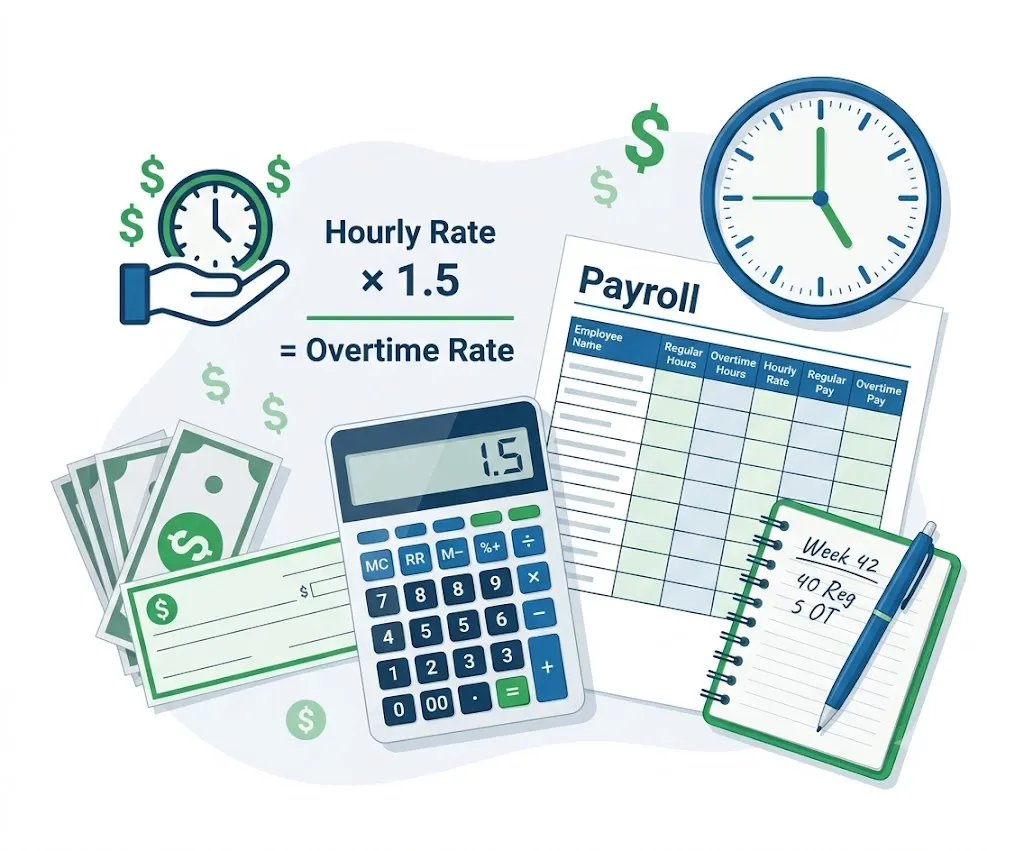
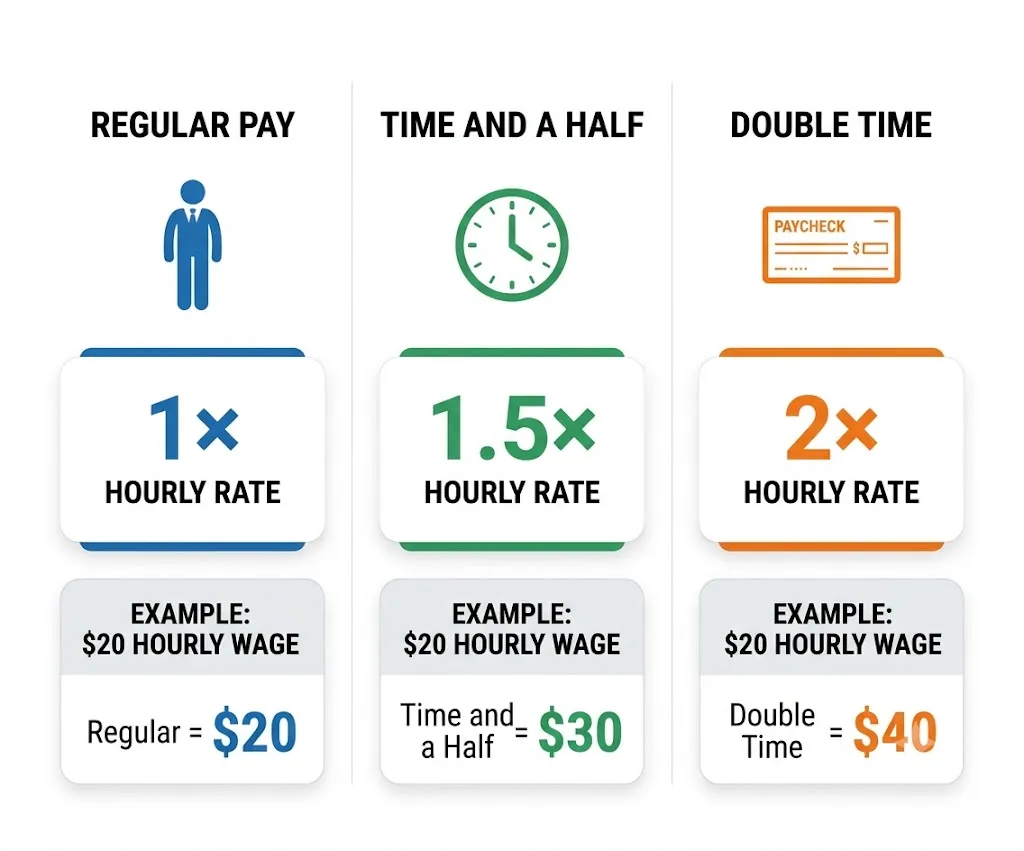
Time and a half is an overtime pay rate equal to 150% of an employee’s regular rate of pay. Instead of receiving the normal hourly wage, eligible employees earn one and one-half times their regular rate for each qualifying overtime hour.
In simple terms, if your regular hourly wage is $20, time and a half means you earn $30 per hour for every qualifying overtime hour.
Many employers use this pay rate when employees work overtime under applicable federal or state labor laws. Some companies also choose to pay time and a half for holidays or other special work schedules, although those payments usually depend on company policy rather than federal law.
Time and a half is one of the most common methods of calculating overtime pay in the United States, and knowing how it works makes it easier to estimate your earnings, review your paycheck, and understand your employer’s payroll calculations.
What Is the Regular Rate of Pay?
Before calculating overtime, it’s important to understand your regular rate of pay. Many people assume their regular rate is always the same as their hourly wage, and in many cases that’s true. However, depending on how you’re paid, your regular rate may include certain types of additional compensation that are considered when calculating overtime.
Examples may include:
- Non-discretionary bonuses
- Shift differentials
- Commissions
- Other qualifying forms of compensation
For example, if you earn $20 per hour and receive no additional qualifying compensation, your regular rate of pay is generally $20 per hour. However, if you earn additional qualifying payments, your employer may need to calculate an adjusted regular rate before determining your overtime pay.
This distinction matters because overtime is generally calculated using an employee’s regular rate of pay, not simply the advertised hourly wage.
Once the regular rate has been determined, employers calculate the overtime premium, which is the additional amount paid above the employee’s regular hourly wage for qualifying overtime hours.
Quick Tip: Your regular hourly wage and your regular rate of pay are often the same, but they are not always identical.
Who Qualifies for Time and a Half?
Not every employee automatically qualifies for overtime pay. Whether you receive time and a half depends on your employment classification and the overtime laws that apply to your job.
Following federal overtime rules also helps employers maintain wage compliance and avoid payroll disputes. However, some employees are classified as exempt, meaning they are generally not entitled to overtime pay under federal law.
If you’re unsure about your eligibility, don’t assume that being paid a salary automatically means you are exempt from overtime. Your job duties, how you’re paid, and applicable labor laws all play a role in determining whether you qualify.
In general, employees who often qualify for overtime include:
- Hourly employees
- Many retail workers
- Manufacturing employees
- Warehouse workers
- Construction workers
- Hospitality employees
- Healthcare support staff
- Customer service representatives
- Many non-exempt salaried employees
Remember: Support and office roles are commonly non-exempt as well, so anyone building administrative support experience should confirm their classification before assuming they’re exempt.
Some executive, administrative, professional, outside sales, and certain computer employees may qualify for an exemption if they meet specific legal requirements. Understanding your employment classification is the first step toward calculating overtime correctly.
Federal Overtime Rules Under the Fair Labor Standards Act (FLSA)
The Fair Labor Standards Act (FLSA) is the primary federal law that governs minimum wage, overtime pay, recordkeeping, and child labor standards in the United States. Under the FLSA, most non-exempt employees must receive overtime pay at not less than one and one-half times their regular rate of pay for all hours worked over 40 in a single workweek.
The law establishes the minimum federal overtime standard. Employers may choose to provide more generous overtime benefits, but they generally cannot provide less than what federal law requires for covered, non-exempt employees. The FLSA also explains which employees may qualify for exemptions based on factors such as job duties and compensation.
The U.S. Department of Labor’s Wage and Hour Division (WHD) enforces the Fair Labor Standards Act (FLSA) and publishes official guidance on overtime eligibility, regular rate calculations, and wage compliance.
State Overtime Laws May Be Different
While the FLSA sets the federal minimum standard, some states have overtime laws that provide additional employee protections. For example, certain states require overtime after a specific number of hours worked in a day, while others follow only the federal 40-hour workweek standard. Some states also have unique rules for specific industries or occupations.
Because overtime requirements vary by location, employees and employers should always review the labor laws that apply in their state in addition to federal requirements.
Good to Know: If both federal and state overtime laws apply, employers generally follow the rule that provides the greater benefit to the employee.
Basic Time and a Half Formula
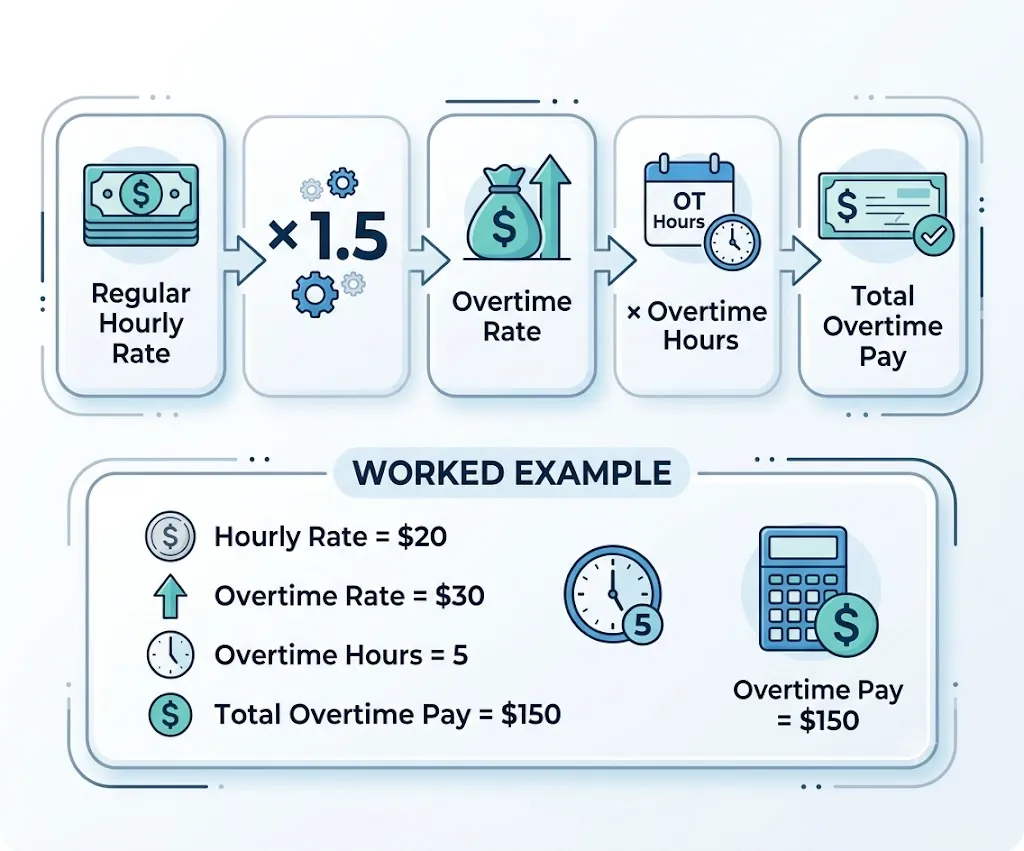
Calculating time and a half is straightforward once you know your regular hourly rate. Use this formula:
Regular Hourly Rate × 1.5 = Time and a Half Rate
Once you’ve calculated your overtime rate, multiply it by the number of qualifying overtime hours you worked:
Time and a Half Rate × Overtime Hours = Overtime Pay
Finally, add your regular wages and overtime earnings to determine your total pay:
Regular Pay + Overtime Pay = Total Earnings
This three-step process works for most hourly employees and many eligible salaried employees after their regular hourly rate has been determined.
Example
Suppose you earn $20 per hour and work 45 hours in a workweek.
- Step 1: Calculate your overtime rate $20 × 1.5 = $30 per hour
- Step 2: Calculate your overtime hours 45 − 40 = 5 overtime hours
- Step 3: Calculate overtime pay 5 × $30 = $150
- Step 4: Calculate regular pay 40 × $20 = $800
- Step 5: Calculate total weekly earnings $800 + $150 = $950
Keeping these formulas handy makes it easier to estimate your overtime pay, verify your paycheck, and understand how employers calculate overtime wages.
For Employers and Small Businesses
If you own a business or manage payroll, understanding how to calculate time and a half helps ensure employees are paid accurately and consistently. Using the correct overtime formula can reduce payroll errors, improve compliance with applicable wage laws, and build trust with your workforce. Many employers reinforce this through compliance and learning and development programs that keep managers current on wage rules.
Step-by-Step Guide to Calculating Time and a Half
Now that you know the formula, let’s walk through the calculation step by step. Whether you’re checking your paycheck or estimating your overtime earnings before payday, the same process applies in most situations.
Step 1: Determine Your Regular Hourly Rate
Start by identifying your regular hourly wage. For hourly employees, this is usually the amount you earn for each regular hour worked.
Example: Regular hourly wage = $20
Step 2: Calculate Your Time and a Half Rate
Multiply your regular hourly rate by 1.5.
Formula: Regular Hourly Rate × 1.5 = Time and a Half Rate
Example: $20 × 1.5 = $30. Your overtime rate is $30 per hour.
Step 3: Calculate Your Overtime Hours
Next, determine how many qualifying overtime hours you worked during the workweek.
Example: Hours worked = 46, Regular hours = 40, so 46 − 40 = 6 overtime hours.
Step 4: Calculate Your Overtime Pay
Multiply your overtime rate by your overtime hours.
Formula: Time and a Half Rate × Overtime Hours = Overtime Pay
Example: $30 × 6 = $180. Your overtime earnings are $180.
Step 5: Calculate Your Regular Pay
Now calculate your regular earnings.
Formula: Regular Hours × Hourly Rate = Regular Pay
Example: 40 × $20 = $800
Step 6: Calculate Your Total Weekly Earnings
Finally, add your regular wages and overtime earnings together.
Formula: Regular Pay + Overtime Pay = Total Weekly Earnings
Example: $800 + $180 = $980. Your total pay for the week is $980.
You can use these same steps whether you calculate manually or with an online calculator.
Time and a Half Rates for Common Hourly Wages
If you’re wondering “How much is time and a half for my hourly wage?”, use this quick reference table.
| Regular Hourly Rate | Time and a Half Rate |
| $10.00 | $15.00 |
| $12.00 | $18.00 |
| $15.00 | $22.50 |
| $18.00 | $27.00 |
| $20.00 | $30.00 |
| $22.00 | $33.00 |
| $25.00 | $37.50 |
| $30.00 | $45.00 |
| $35.00 | $52.50 |
| $40.00 | $60.00 |
| $45.00 | $67.50 |
| $50.00 | $75.00 |
| $60.00 | $90.00 |
| $75.00 | $112.50 |
| $100.00 | $150.00 |
This table helps you find your overtime rate quickly without performing the calculation yourself.
Quick Tips for Accurate Overtime Calculations
Before calculating your overtime pay, make sure you:
- Know your regular hourly rate.
- Count only qualifying overtime hours.
- Use your regular rate of pay if additional qualifying earnings apply.
- Separate regular hours from overtime hours.
- Double-check your math before comparing it with your paycheck.
Following these simple steps can help you calculate your overtime pay accurately and avoid common payroll mistakes.
How to Calculate Time and a Half for Salaried Employees
Many people believe salaried employees never receive overtime, but that’s a common misconception. While some salaried employees are exempt from overtime requirements, others may qualify for overtime pay depending on their job duties, salary basis, and employment classification.
If you’re a non-exempt salaried employee, you must first determine your regular hourly rate before calculating time and a half. Once you’ve calculated your hourly rate, the overtime formula remains the same:
Regular Hourly Rate × 1.5 = Overtime Rate
The only difference is how you calculate your regular hourly wage.
Salary Overtime Calculation Example
Suppose you earn an annual salary of $52,000 and qualify for overtime pay.
Step 1: Calculate Your Weekly Salary
Divide your annual salary by 52 weeks: $52,000 ÷ 52 = $1,000 per week.
Step 2: Calculate Your Regular Hourly Rate
Assuming a standard 40-hour workweek, divide your weekly salary by 40: $1,000 ÷ 40 = $25 per hour.
Step 3: Calculate Your Overtime Rate
Multiply your hourly rate by 1.5: $25 × 1.5 = $37.50 per hour.
Step 4: Calculate Overtime Pay
Suppose you worked 6 overtime hours: 6 × $37.50 = $225. Your overtime earnings equal $225.
Calculating Time and a Half Using Different Pay Periods
Not every employee is paid weekly some receive a biweekly, semi-monthly, monthly, or annual salary. Before calculating overtime, convert your pay into an hourly rate.
Weekly Salary
Divide your weekly salary by the number of regular hours worked each week.
Example: Weekly salary = $960, Hours worked = 40, so $960 ÷ 40 = $24 per hour. Now calculate overtime: $24 × 1.5 = $36 per hour.
Biweekly Salary
A biweekly salary covers two workweeks.
Example: Biweekly salary = $2,400. Weekly salary = $2,400 ÷ 2 = $1,200. Hourly rate = $1,200 ÷ 40 = $30 per hour. Overtime rate = $30 × 1.5 = $45 per hour.
Semi-Monthly Salary
A semi-monthly salary is paid 24 times each year. To estimate your hourly rate, multiply your semi-monthly salary by 24, divide by 52 to find your weekly salary, then divide your weekly salary by 40.
Example: Semi-monthly salary = $2,500. Annual salary = $2,500 × 24 = $60,000. Weekly salary = $60,000 ÷ 52 = $1,153.85. Hourly rate = $1,153.85 ÷ 40 = $28.85. Overtime rate = $28.85 × 1.5 = $43.28.
Monthly Salary
Multiply your monthly salary by 12 to determine your annual salary.
Example: Monthly salary = $4,500. Annual salary = $4,500 × 12 = $54,000. Weekly salary = $54,000 ÷ 52 = $1,038.46. Hourly rate = $1,038.46 ÷ 40 = $25.96. Time and a half = $25.96 × 1.5 = $38.94.
Annual Salary
Converting an annual salary is straightforward.
Formula: Annual Salary ÷ 52 = Weekly Salary; Weekly Salary ÷ 40 = Hourly Rate; Hourly Rate × 1.5 = Overtime Rate.
Example: Annual salary = $78,000. Weekly salary = $78,000 ÷ 52 = $1,500. Hourly rate = $1,500 ÷ 40 = $37.50. Time and a half = $37.50 × 1.5 = $56.25.
Reverse Overtime Calculation
Sometimes you already know your overtime rate but want to determine your regular hourly wage. In that case, simply divide the overtime rate by 1.5.
Formula: Regular Hourly Rate = Overtime Rate ÷ 1.5
Example 1: Overtime rate = $45. $45 ÷ 1.5 = $30. Regular hourly wage = $30.
Example 2: Overtime rate = $60. $60 ÷ 1.5 = $40. Regular hourly wage = $40.
Reverse Time and a Half Table
Use this table if you already know your overtime rate and want to estimate your regular hourly wage.
| Time and a Half Rate | Regular Hourly Rate |
| $22.50 | $15.00 |
| $27.00 | $18.00 |
| $30.00 | $20.00 |
| $37.50 | $25.00 |
| $45.00 | $30.00 |
| $52.50 | $35.00 |
| $60.00 | $40.00 |
| $75.00 | $50.00 |
| $90.00 | $60.00 |
| $112.50 | $75.00 |
| $150.00 | $100.00 |
This reverse calculation is useful if you’re reviewing a paycheck, checking payroll records, or verifying an overtime rate provided by your employer.
Holiday Pay vs. Time and a Half
Many employees assume that working on a holiday automatically means they’ll receive time and a half. In reality, holiday pay and overtime pay are two different types of compensation.
Federal law does not require private employers to pay extra simply because an employee works on a holiday. Instead, holiday pay is usually determined by an employer’s policies, an employment contract, or a collective bargaining agreement. Time and a half, on the other hand, generally applies when an eligible employee works qualifying overtime hours under applicable overtime laws.
Holiday Pay vs. Overtime Pay
| Holiday Pay | Time and a Half |
| Paid because an employee works on a holiday (if offered by the employer). | Paid because an eligible employee works qualifying overtime hours. |
| Usually determined by company policy or an employment agreement. | Generally based on applicable overtime laws. |
| May be paid at the regular rate, time and a half, or another premium rate. | Commonly paid at 1.5 times the employee’s regular rate of pay. |
For example, if you work eight hours on Independence Day but your total weekly hours are 38, you may receive only your regular hourly wage unless your employer offers premium holiday pay. However, if working that holiday causes your total weekly hours to exceed the applicable overtime threshold, eligible overtime hours may qualify for time and a half in addition to any holiday pay your employer provides.
Company Policies May Provide Additional Benefits
Federal overtime laws establish minimum requirements, but many employers choose to provide benefits beyond those minimum standards. For example, some employers offer:
- Premium pay for holidays
- Weekend pay
- Evening or night shift premiums
- Extra compensation for emergency call-outs
- Paid holidays even when employees do not work
These benefits vary from one employer to another and should be explained in your employee handbook, employment agreement, or payroll policy.
Reference: U.S. Department of Labor – Wage and Hour Division guidance.
What Is a Shift Differential?
A shift differential is additional compensation paid to employees who work less desirable shifts, such as evenings, nights, weekends, or rotating schedules. Unlike overtime pay, a shift differential is not automatically based on the number of hours worked; instead, it’s an extra amount an employer chooses to pay for certain work schedules.
Common industries that use shift differentials include:
- Healthcare
- Manufacturing
- Warehousing
- Public safety
- Hospitality
- Transportation
Shift differentials can be paid as a fixed amount per hour, a percentage of the hourly wage, or a flat payment for each qualifying shift.
Shift Differential Example
Suppose you earn $24 per hour and receive a $3 night shift differential. Your adjusted hourly rate becomes $24 + $3 = $27 per hour. If your shift differential must be included in your regular rate of pay, your overtime calculation may be based on the adjusted regular rate rather than your base hourly wage.
Because payroll calculations involving shift differentials can vary depending on the type of premium pay and applicable rules, employees should review their employer’s payroll policy if they are unsure how overtime is calculated.
Do Bonuses Affect Time and a Half?
Yes, some bonuses can affect overtime calculations. Not every bonus changes your overtime rate, but certain types of bonuses may need to be included when determining an employee’s regular rate of pay. Examples of qualifying bonuses may include:
- Performance bonuses
- Production incentives
- Attendance bonuses
- Sales commissions
Discretionary bonuses, such as an unexpected holiday gift or one-time appreciation payment, may be treated differently.
Bonus Example
Suppose an employee earns an hourly wage of $20, a weekly production bonus of $100, and works 5 overtime hours. Depending on the type of bonus and applicable payroll rules, the employer may first determine the employee’s regular rate of pay before calculating overtime. Because bonus calculations can vary, employers should follow applicable wage laws and payroll guidance when determining overtime.
Common Overtime Scenarios
Every workplace is different, but the way overtime is calculated usually follows the same basic formula. Here are a few common situations employees encounter.
Scenario 1: Retail Employee
A retail associate earns $18 per hour and works 44 hours during a busy holiday week. The employee calculates the regular hourly rate, time and a half rate, and four overtime hours, which helps verify that the paycheck reflects the correct overtime earnings.
Scenario 2: Healthcare Employee
A healthcare support worker frequently works evening shifts and occasional overtime. Understanding the difference between a shift differential and overtime pay helps the employee understand how each type of compensation affects total earnings.
Common Payroll Mistakes When Calculating Time and a Half
Even small mistakes can lead to incorrect overtime calculations. Some of the most common payroll errors include:
- Using the wrong regular hourly rate.
- Forgetting to separate regular hours from overtime hours.
- Applying the overtime rate to every hour worked instead of only qualifying overtime hours.
- Overlooking qualifying earnings that may affect the regular rate of pay.
- Miscounting total hours worked during the workweek. Inaccurate timekeeping can also lead to overtime calculation errors, especially when employees forget to clock in or out correctly.
- Assuming weekend or holiday work automatically qualifies for time and a half.
- Forgetting to review state overtime requirements when they provide additional protections.
Reviewing your hours before payday can help identify errors early and ensure your overtime pay is calculated correctly.
Overtime Myths vs. Facts
Many employees misunderstand how overtime works. The following table clears up some of the most common misconceptions.
| Myth | Fact |
| Salaried employees never receive overtime. | Some salaried employees qualify for overtime if they are classified as non-exempt. |
| Working on Saturday automatically means time and a half. | Weekend work alone does not automatically qualify for overtime pay. |
| Holiday work is always paid at time and a half. | Holiday pay depends on employer policies and applicable laws. |
| Overtime starts after eight hours every day. | Federal overtime is generally based on more than 40 hours in a workweek, although some states have additional daily overtime rules. |
| Every employee qualifies for overtime. | Eligibility depends on employment classification and applicable overtime laws. |
Understanding these myths can help you estimate your earnings more accurately and avoid common payroll misunderstandings.
Avoiding Overtime Calculation Errors
Before comparing your calculation with your paycheck, take a few minutes to review the details. Use this checklist:
- Confirm your regular hourly rate.
- Count only qualifying overtime hours.
- Use the correct overtime multiplier.
- Include qualifying earnings when determining your regular rate of pay.
- Review your employer’s overtime policy.
- Check whether your state has additional overtime requirements.
- Compare your calculations with your pay stub before reporting a payroll concern.
Following these simple steps can help employees and employers reduce payroll errors and ensure overtime pay is calculated as accurately as possible.
Frequently Asked Questions
Is time and a half the same as overtime?
Not always. Time and a half is one common overtime pay rate, meaning an eligible employee earns 1.5 times their regular rate of pay for qualifying overtime hours. While this is the most common overtime calculation, some employers may offer higher premium rates in certain situations, such as double time.
What is time and a half for $20 an hour?
Multiply your hourly wage by 1.5: $20 × 1.5 = $30 per hour. If you work five overtime hours, your overtime earnings would be $30 × 5 = $150.
Do salaried employees receive time and a half?
Some do. Whether a salaried employee qualifies for overtime depends on factors such as their employment classification, job duties, and applicable overtime laws. Eligible non-exempt salaried employees can calculate overtime after determining their regular hourly rate.
Does working on a holiday automatically mean time and a half? No. Federal law generally does not require private employers to pay time and a half simply because an employee works on a holiday. Holiday pay is usually determined by employer policy, an employment contract, or a collective bargaining agreement.
How many hours do you have to work to receive time and a half? Under federal law, eligible non-exempt employees generally earn overtime after working more than 40 hours in a workweek. Some states have additional daily overtime requirements.
Can I calculate time and a half without a calculator?
Yes. Simply find your hourly wage, multiply it by 1.5, multiply the result by your overtime hours, and add overtime earnings to your regular wages.
How do I know if my paycheck is correct? Compare your paycheck with your own calculations. Review your hourly rate, total hours worked, overtime hours, overtime rate, and total earnings. If the numbers don’t match, speak with your employer or payroll department for clarification.
Payroll Terms You Should Know
Understanding a few common payroll terms makes overtime calculations much easier.
| Term | Meaning |
| Regular Rate of Pay | The hourly rate used to calculate overtime. |
| Overtime Hours | Qualifying hours worked beyond the applicable overtime threshold. |
| Time and a Half | An overtime rate equal to 150% of the regular rate. |
| Non-Exempt Employee | An employee generally eligible for overtime pay. |
| Exempt Employee | An employee who generally does not qualify for overtime under applicable rules. |
| Shift Differential | Additional pay for working certain shifts, such as nights or weekends. |
| Holiday Pay | Extra compensation some employers provide for working on holidays. |
| Workweek | A fixed, recurring period of seven consecutive 24-hour days used to calculate overtime. |
Key Takeaways
Before you calculate overtime pay, remember these essential points:
- Time and a half means earning 1.5 times your regular rate of pay.
- Most eligible employees calculate overtime after exceeding 40 hours in a workweek under federal law.
- Always determine your regular rate of pay before calculating overtime.
- Holiday pay and overtime pay are not the same.
- Some salaried employees may qualify for overtime depending on their employment classification.
- State overtime laws may provide greater protections than federal law.
- Reviewing your paycheck regularly can help you identify payroll errors early.
Where to Learn More About Overtime Pay
If you need more information about overtime rules or want to verify your eligibility, consult official government resources rather than relying solely on online calculators or third-party websites. Helpful resources include:
- U.S. Department of Labor (Wage and Hour Division)
- Fair Labor Standards Act (FLSA)
- Your state labor department
- Your employer’s payroll or employee handbook
These resources provide the most reliable information on overtime eligibility, wage requirements, and employee rights.
Conclusion
Understanding how to calculate time and a half is one of the simplest ways to take control of your earnings. Whether you’re checking your own paycheck, estimating overtime before accepting extra shifts, or managing payroll for a business, knowing the formula helps you verify calculations with confidence instead of relying on guesswork.
While the math is straightforward, overtime rules aren’t always. Your eligibility, regular rate of pay, bonuses, shift differentials, and state labor laws can all affect the final amount you receive. That’s why it’s important to look beyond the basic formula whenever your pay includes additional compensation or you’re unsure how overtime applies to your situation.
If there’s one takeaway from this guide, it’s this: calculate your regular rate first, apply the time-and-a-half formula carefully, and compare the results with your pay statement. Spending a few minutes checking the numbers can help you catch payroll mistakes, better understand your earnings, and feel more confident about the overtime you’re paid.
Whether you’re an hourly employee checking your paycheck, an eligible salaried worker estimating overtime, or an employer processing payroll, understanding this calculation helps reduce errors and improve confidence in your pay.
While the formula is simple, remember that overtime eligibility can vary depending on federal law, state regulations, and your employment classification. If you’re ever unsure, review your employer’s payroll policy or consult official labor guidance.