

What Is 8 Figures? Meaning, Salary, Income, Net Worth & Business Explained
Most people first come across the term “8 figures” on social media, in business podcasts, or while reading about entrepreneurs, athletes, and celebrities. Yet despite how often it’s used, many people aren’t sure what it actually means.
A common misconception is that $8 million is an 8-figure amount. Others assume an 8-figure business automatically makes its owner worth at least $10 million, or that an 8-figure salary is the same as an 8-figure net worth. These terms are frequently used interchangeably, even though they describe different financial concepts.
While researching this topic, one pattern became clear: many articles answer only part of the question. Some explain the number itself but ignore how it applies to salary, income, business revenue, company valuation, and net worth. Others focus on motivational stories without explaining the financial terminology accurately.
This guide takes a different approach.
Instead of giving a one-line definition, it explains what 8 figures means in every major financial context, using simple language, practical examples, and widely accepted financial definitions. By the end of this article, you’ll know exactly what qualifies as an 8-figure amount, how to identify it, and how to interpret the term whenever you see it used.
8 Figures at a Glance
If you only need a quick answer, here’s what you should know.
| Topic | Answer |
| Definition | An 8-figure number contains eight digits. |
| Amount | $10,000,000 to $99,999,999 |
| Smallest 8-Figure Amount | $10,000,000 |
| Largest 8-Figure Amount | $99,999,999 |
| Next Figure Level | 9 figures begin at $100,000,000 |
| Common Uses | Salary, income, net worth, business revenue, company valuation, investments |
What Are 8 Figures?
An 8-figure amount is any number made up of eight digits. In financial terms, it refers to an amount between $10,000,000 and $99,999,999.
For example, $10,000,000, $25,000,000, and $75,500,000 are all 8 figures, and $99,999,999 is still 8 figures too. However, $9,999,999 is only 7 figures, while $100,000,000 is already 9 figures.
The term “8 figures” doesn’t describe only salaries. It can also refer to annual income, business revenue, company valuation, net worth, investment portfolio, real estate holdings, legal settlements, or sports contracts.
Why Is It Called “Figures”?
The word figure simply means a digit or numerical symbol. Each digit in a number counts as one figure.
For example:
| Number | Figures |
| 8 | 1 figure |
| 85 | 2 figures |
| 850 | 3 figures |
| 8,500 | 4 figures |
| 85,000 | 5 figures |
| 850,000 | 6 figures |
| 8,500,000 | 7 figures |
| 85,000,000 | 8 figures |
This is exactly why people say someone earns a “six-figure salary” or owns an “eight-figure business.” They’re referring to the number of digits in the amount, not a specific profession or lifestyle.
How to Count Figures
Learning to count figures is easier than most people think. Simply count the digits in the whole number while ignoring commas, currency symbols, and decimal places.
Here are some examples.
| Amount | Number of Figures |
| $95 | 2 figures |
| $850 | 3 figures |
| $7,250 | 4 figures |
| $45,000 | 5 figures |
| $650,000 | 6 figures |
| $5,500,000 | 7 figures |
| $25,000,000 | 8 figures |
| $250,000,000 | 9 figures |
A quick way to remember is that 7 figures begin at $1 million, 8 figures begin at $10 million, and 9 figures begin at $100 million.
Many people mistakenly believe that $8 million is 8 figures. It isn’t. Since 8,000,000 has only seven digits, it’s still a 7-figure amount.
How Many Zeros Are in 8 Figures?
Many people confuse the number of digits with the number of zeros. However, an 8-figure number is identified by its total digits, not by how many zeros it contains.
The smallest 8-figure number is 10,000,000. It contains 8 digits, 7 zeros, and 1 non-zero digit.
As the value increases, the number of digits stays the same, but the number of zeros changes.
| Number | Figures |
| 10,000,000 | 8 Figures |
| 15,000,000 | 8 Figures |
| 28,750,000 | 8 Figures |
| 99,999,999 | 8 Figures |
A simple way to identify an 8-figure number is to count all the digits while ignoring commas and decimal places.
Definition and Scale
Understanding the scale of different figure levels helps put large amounts of money into perspective.
| Figure Level | Amount |
| 1 Figure | $0–$9 |
| 2 Figures | $10–$99 |
| 3 Figures | $100–$999 |
| 4 Figures | $1,000–$9,999 |
| 5 Figures | $10,000–$99,999 |
| 6 Figures | $100,000–$999,999 |
| 7 Figures | $1,000,000–$9,999,999 |
| 8 Figures | $10,000,000–$99,999,999 |
| 9 Figures | $100,000,000–$999,999,999 |
| 10 Figures | $1,000,000,000–$9,999,999,999 |
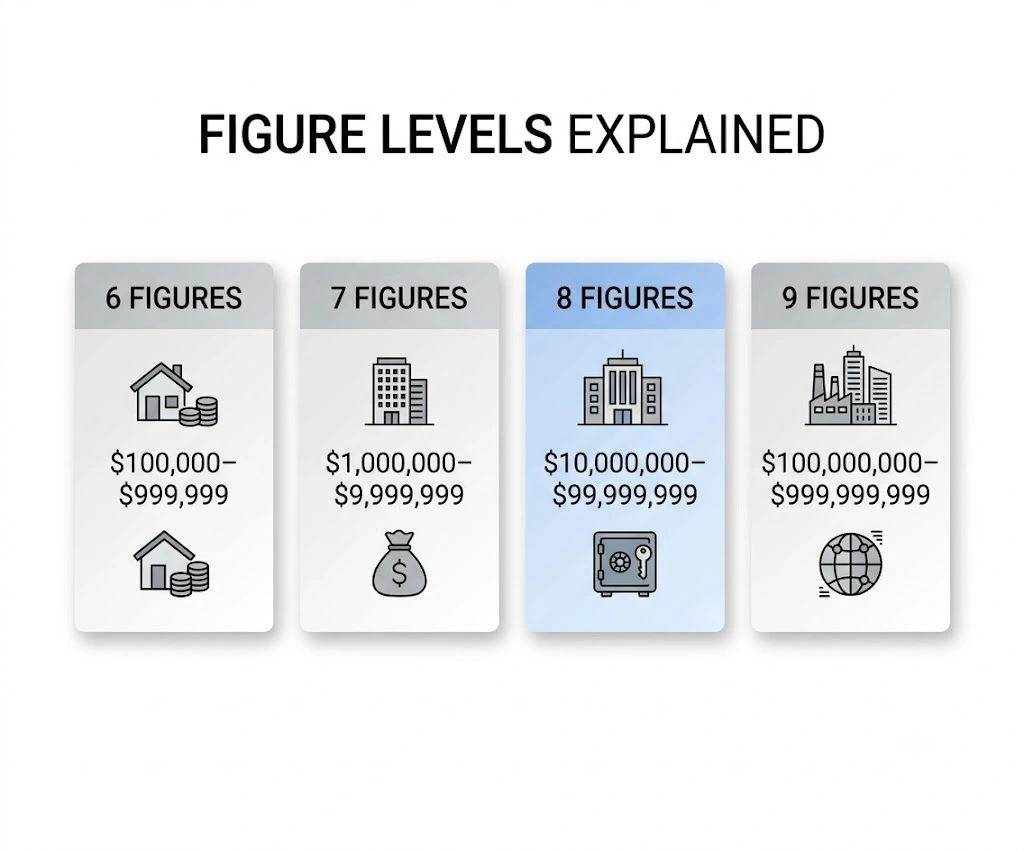
Each time you move up one figure level, the minimum amount increases by ten times. A 6-figure income starts at $100,000, a 7-figure income starts at $1 million, and an 8-figure income starts at $10 million. This is exactly why reaching each new figure level represents such a significant financial milestone.
Where You’ll Hear the Term “8 Figures”
The phrase 8 figures is commonly used in business, finance, and the media. Although the number always represents $10 million to $99,999,999, the meaning depends on the context.
You may come across the term in business news discussing company revenue or acquisitions, executive compensation reports, professional sports contracts, celebrity earnings, startup funding announcements, luxury real estate transactions, investment portfolios, and personal finance articles.
Comparison With Other Figure Levels
People often compare different figure levels to measure income or wealth. While every increase is important, the jump between each level is much larger than many people realize.
| Figure Level | Minimum Amount | Increase From Previous Level |
| 6 Figures | $100,000 | — |
| 7 Figures | $1,000,000 | 10× higher |
| 8 Figures | $10,000,000 | 10× higher |
| 9 Figures | $100,000,000 | 10× higher |
6 Figures
A six-figure income ranges from $100,000 to $999,999. Many experienced professionals, doctors, lawyers, engineers, and business owners earn six figures each year.
7 Figures
A seven-figure income starts at $1 million. Successful entrepreneurs, executives, entertainers, and investors often fall into this category.
8 Figures
An eight-figure income starts at $10 million. This level is much rarer and is usually associated with highly successful founders, elite athletes, major entertainers, hedge fund managers, and top corporate executives.
9 Figures
A nine-figure income begins at $100 million. Very few people reach this level, and it’s often associated with global business leaders, celebrities with multiple income streams, founders after major company exits, and world-class investors.
What Is an 8-Figure Salary?
An 8-figure salary means a person earns between $10 million and $99,999,999 per year before taxes and deductions.
For example, $10 million per year, $18.5 million per year, and $50 million per year are all 8-figure salaries.
An 8-figure salary is extremely uncommon. It’s typically earned by Fortune 500 CEOs, professional athletes, Hollywood actors, best-selling musicians, successful founders, hedge fund managers, and private equity executives.
It’s important to remember that salary is only one type of income. Many wealthy individuals earn most of their money through business profits, investments, dividends, stock options, or company ownership rather than a traditional salary.
While an 8-figure salary is possible, it’s exceptionally uncommon. Most occupations in the United States earn far less, according to the U.S. Bureau of Labor Statistics (BLS), highlighting just how rare an 8-figure salary really is. This highlights just how rare it is for someone to receive an annual salary of at least $10 million.
What Is an 8-Figure Income?
An 8-figure income means a person earns between $10,000,000 and $99,999,999 within a year from one or more income sources.
For tax purposes, the Internal Revenue Service (IRS) treats salary, business income, investment income, and capital gains differently.
What Is an 8-Figure Net Worth?
An 8-figure net worth means a person’s total assets, minus their liabilities, are worth between $10 million and $99.9 million.
Net worth is different from annual income. Income measures how much money you earn over a period, while net worth measures everything you own after subtracting your debts.
Assets may include cash and savings, stocks and bonds, retirement accounts, real estate, businesses, investment properties, luxury vehicles, and valuable collectibles. Liabilities may include mortgages, business loans, personal loans, credit card balances, and other outstanding debts.
For example:
| Assets | Value |
| Home | $6,000,000 |
| Investment portfolio | $9,500,000 |
| Cash | $1,200,000 |
| Business ownership | $4,300,000 |
| Total Assets | $21,000,000 |
| Liabilities | Value |
| Mortgage | $2,000,000 |
| Business Loan | $1,000,000 |
| Total Debt | $3,000,000 |
Net Worth: $21,000,000 − $3,000,000 = $18,000,000
This person has an 8-figure net worth.
The U.S. Securities and Exchange Commission (SEC) defines net worth as the value of total assets minus total liabilities. This definition is widely used in finance and investment planning.
What Is an 8-Figure Business?
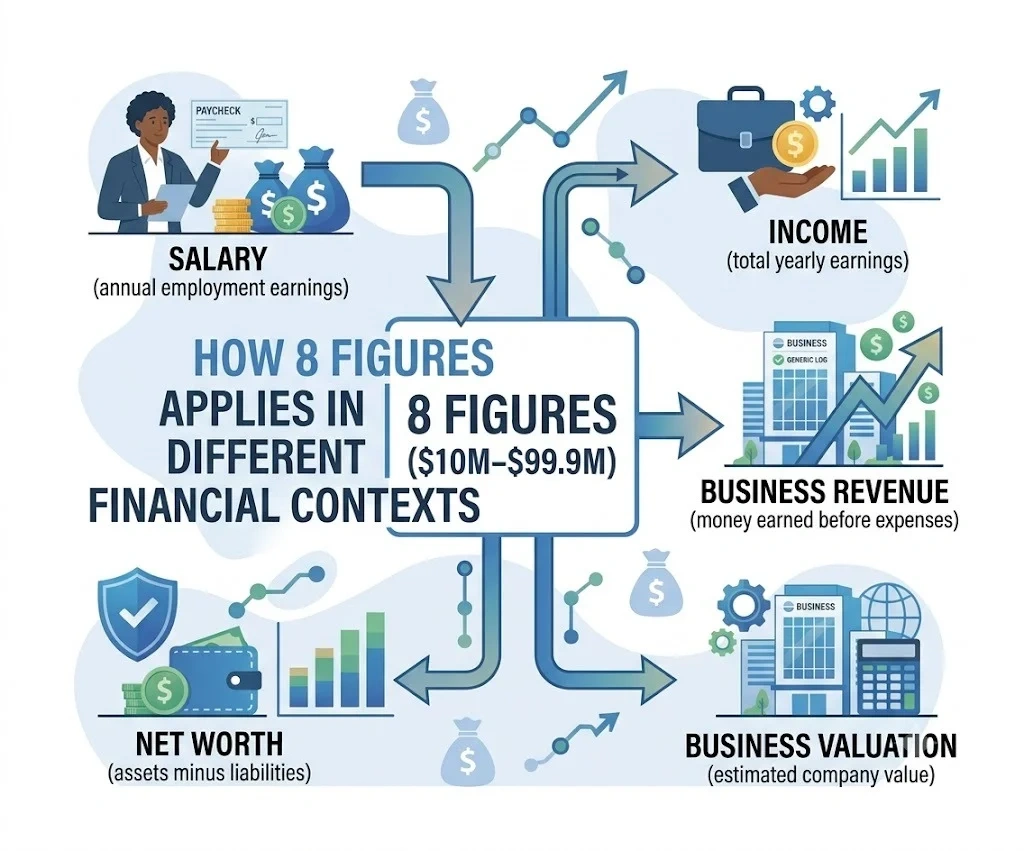
An 8-figure business usually refers to a company that generates at least $10 million in annual revenue or has a valuation between $10 million and $99.9 million. However, the exact meaning depends on the context, since some entrepreneurs use the term to describe annual sales while others use it to describe company valuation. That’s why it’s important to ask what the number actually represents.
For example, a company generating $12 million in annual revenue may be called an 8-figure business. A startup valued at $40 million is also an 8-figure business, even if it earns little profit. A private company sold for $18 million is considered an 8-figure exit.
The phrase alone doesn’t tell you whether someone is talking about revenue, valuation, profit, or sale price.
Entrepreneurs often describe their companies using annual revenue because it’s a simple way to measure business size. Investors, however, may focus more on profitability, growth potential, and valuation. For this reason, the phrase “8-figure business” can mean different things depending on who’s using it. If you’re evaluating a growing company, understanding startup financial modeling can help you see how investors estimate revenue, profitability, and future business value.
Revenue vs. Profit vs. Valuation
Many people use these financial terms interchangeably, but they have genuinely different meanings. Understanding the difference helps you interpret claims about an 8-figure business more accurately.
| Financial Term | Meaning | Can It Be 8 Figures? |
| Revenue | Total money earned before expenses | Yes |
| Profit | Money left after expenses | Yes |
| Business Valuation | Estimated value of the company | Yes |
| Sale Price | Amount paid to acquire the business | Yes |
Revenue represents the total income a business earns before expenses, while profit is the amount remaining after operating costs, taxes, interest, and other expenses have been deducted.
Revenue
Revenue is the total amount of money a business receives before paying expenses. A company with $15 million in annual sales has 8-figure revenue, though that doesn’t mean it earns $15 million in profit.
If you’re new to business finance, think of revenue as all the money a business earns before paying bills, while profit is the money left after those bills have been paid. This is exactly why a company can report millions of dollars in revenue but much less profit.
Profit
Profit is the money that remains after paying operating costs, taxes, salaries, and other expenses. A company may generate $25 million in revenue but keep only $2 million in profit. In this example, the company has an 8-figure revenue but not an 8-figure profit.
Understanding this difference helps you interpret financial headlines more accurately. For example, a company with $20 million in revenue isn’t necessarily making $20 million in profit.
Business Valuation
Business valuation is an estimate of what a company is worth. Investors often calculate this using several factors, including revenue, profit, growth rate, industry, market demand, and future earnings.
A software company making $3 million per year could still receive a valuation above $20 million if investors expect rapid growth.
Business valuations aren’t based on a single formula. Buyers and investors evaluate companies using several factors, including profitability, recurring revenue, future growth potential, industry trends, market demand, and comparable business sales. Because of this, two companies with similar revenue can have very different valuations.
Sale Price
Sale price is the amount someone pays to purchase a company. For example, if a founder sells their business for $35 million, that transaction is considered an 8-figure business sale.
The founder may not receive the full amount after taxes or if they own only part of the company.
Can an 8-Figure Business Make the Owner Rich?
Not always. Many people assume an 8-figure company automatically makes its owner wealthy, but that isn’t always true. Several factors affect the owner’s personal wealth, including ownership percentage, outstanding business debt, investors, taxes, and operating expenses.
For example, a business is valued at $20 million, and the founder owns 40% of the company. Their share is worth approximately $8 million before taxes and other obligations. Even though the company is an 8-figure business, the founder may not personally have an 8-figure net worth.
For example, imagine a company is acquired for $20 million. If the founder owns 30% of the business, their share is worth $6 million before taxes, legal fees, and other transaction costs. Although the company completed an 8-figure sale, the founder didn’t personally receive an 8-figure payout.
This example shows why it’s important to understand ownership structure before assuming someone’s personal wealth.
What Jobs Can Earn an 8-Figure Income?
Only a small percentage of people earn an 8-figure annual income. Most reach this level after building businesses, leading major organizations, or becoming leaders in highly competitive industries.
Some careers with the potential to generate an 8-figure income include professional athletes, Hollywood actors, recording artists, Fortune 500 CEOs, successful entrepreneurs, venture capital partners, hedge fund managers, private equity executives, technology founders, and high-profile entertainers.
Many people in these careers also earn money through endorsements, investments, licensing agreements, royalties, and stock ownership. As a result, their total annual income can be much higher than their base salary.
How Rare Is an 8-Figure Income?
An 8-figure income is extremely rare. Most professionals, even those in high-paying careers, never earn between $10 million and $99,999,999 in a single year.
Many people assume doctors, lawyers, or engineers regularly earn eight figures. While these careers can provide excellent incomes, reaching the 8-figure level usually requires building a successful business, owning valuable assets, or receiving substantial investment returns.
People who earn 8 figures often have multiple income sources instead of relying on one paycheck. These income sources may include business ownership, equity in a company, stock options, dividends, capital gains, royalties, licensing agreements, and brand partnerships.
This is exactly why many entrepreneurs, investors, entertainers, and professional athletes are more likely to earn an 8-figure income than someone working in a traditional salaried role.
Wage data published by the U.S. Bureau of Labor Statistics shows that annual earnings of $10 million or more are exceptionally uncommon.
Common Examples of 8-Figure Earnings
The phrase “8 figures” appears in many financial situations. It’s not limited to salaries.
Here are some common examples.
| Example | 8 Figures? |
| Annual salary of $12 million | ✅ Yes |
| Business generating $18 million in revenue | ✅ Yes |
| Company valued at $45 million | ✅ Yes |
| Personal net worth of $22 million | ✅ Yes |
| Home sold for $15 million | ✅ Yes |
| Legal settlement of $30 million | ✅ Yes |
| Sports contract worth $75 million | ✅ Yes |
| Investment portfolio worth $11 million | ✅ Yes |
Although every example represents 8 figures, they describe genuinely different financial concepts.
Real-World Examples of 8 Figures
| Example | Meaning |
| $15M salary | Salary |
| $20M company | Revenue |
| $40M acquisition | Business Sale |
| $18M house | Asset |
| $22M portfolio | Net Worth |
Common Misconceptions About 8 Figures
Many people misunderstand what qualifies as an 8-figure amount. Here are some of the most common misconceptions.
Is $8 Million an 8-Figure Amount?
No. This is one of the most common mistakes. Although the number contains the digit eight, $8,000,000 has only seven digits. It’s a 7-figure amount, not an 8-figure amount.
Is $10 Million 8 Figures?
Yes. $10,000,000 contains eight digits, making it the smallest possible 8-figure amount.
Is $99 Million Still 8 Figures?
Yes. Any amount up to $99,999,999 remains an 8-figure number. Once the amount reaches $100,000,000, it becomes a 9-figure amount.
Does an 8-Figure Salary Mean You Keep All the Money?
No. Salary is usually reported before taxes and deductions. The actual amount a person keeps depends on several factors, including income taxes, state taxes, retirement contributions, insurance, investment choices, and other financial obligations.
This is exactly why an 8-figure salary doesn’t automatically translate into an 8-figure increase in personal wealth every year.
Does an 8-Figure Business Mean the Owner Is Personally Worth 8 Figures?
Not necessarily. A business may be worth millions of dollars, but the owner’s personal wealth depends on factors such as ownership percentage, company debt, investor ownership, taxes, and business liabilities.
Someone can own part of an 8-figure company without having an 8-figure net worth themselves.
Why Do People Say “8 Figures” Instead of Giving the Exact Amount?
There are several reasons people use the phrase “8 figures” instead of sharing an exact number.
Some prefer privacy and don’t want to disclose their personal finances. Business owners may also have confidentiality agreements that prevent them from revealing exact figures from investments, acquisitions, or company sales.
In marketing, broad terms like “7 figures” or “8 figures” are often used to highlight success without revealing sensitive financial information.
Frequently Asked Questions
How Much Is 8 Figures?
Eight figures means any amount between $10,000,000 and $99,999,999.
How Many Zeros Are in an 8-Figure Number?
The smallest 8-figure number, 10,000,000, contains seven zeros and one non-zero digit. Larger 8-figure numbers may contain fewer zeros because other digits replace them.
For example, 10,000,000, 18,500,000, 52,364,198, and 99,999,999 are all 8-figure numbers.
Is an 8-Figure Salary Before or After Taxes?
When people discuss salaries, they almost always refer to the gross annual salary, which is the amount earned before taxes and deductions. Your take-home pay will usually be lower.
Can a Business Have 8-Figure Revenue but Not 8-Figure Profit?
Yes. Revenue is the total amount of money a business earns before expenses, while profit is the amount remaining after all expenses have been paid. A company can generate $20 million in revenue while earning only $2 million in profit.
What Is the Difference Between an 8-Figure Income and an 8-Figure Net Worth?
Income refers to the money earned over a period, usually one year. Net worth is the total value of a person’s assets after subtracting all debts. Someone may have an 8-figure net worth without earning an 8-figure income each year.
Can an Investment Portfolio Be 8 Figures?
Yes. If the total value of an investment portfolio is between $10 million and $99,999,999, it’s considered an 8-figure portfolio.
Conclusion
Understanding what 8 figures means is about more than recognizing a large number. It’s about understanding the financial context behind the term.
Throughout this guide, we’ve looked at how 8 figures can describe a salary, annual income, business revenue, company valuation, net worth, investment portfolio, or sale price. Although each represents a value between $10 million and $99,999,999, they are not interchangeable. Confusing these terms can lead to misunderstandings about personal wealth, business success, or financial performance.
One consistent takeaway from reviewing how this phrase is used across business publications, financial education resources, and everyday discussions is that context matters more than the number alone. A business with an 8-figure valuation is not the same as an owner with an 8-figure net worth, and an 8-figure revenue does not necessarily mean an 8-figure profit.
If you remember one thing, let it be this: always ask what the figure represents before drawing conclusions. Once you understand that distinction, interpreting financial headlines, business claims, and conversations about wealth becomes much more straightforward.