
States With No Property Tax: The Truth About Property Taxes
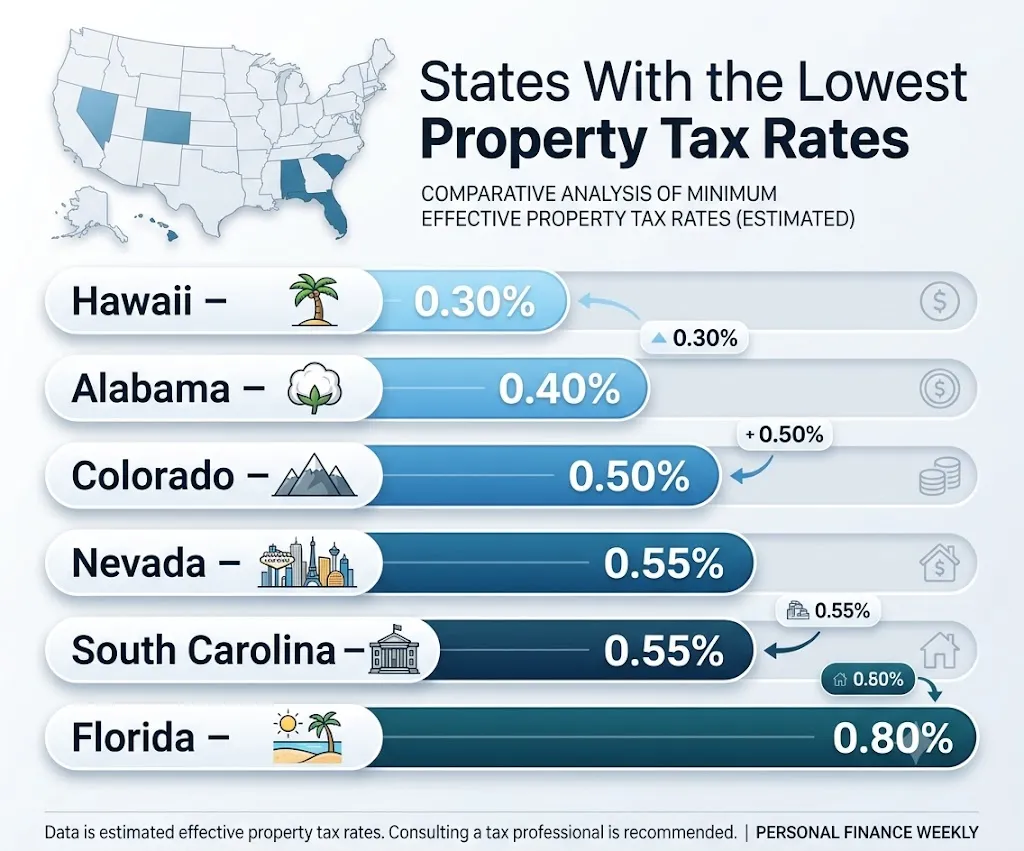
There are no states with no property tax. Every state allows local governments to collect property taxes. However, states such as Hawaii, Alabama, Colorado, Nevada, and South Carolina consistently report some of the lowest effective property tax rates in the United States.
If you’ve ever received a property tax bill and wondered whether there’s a state where you could avoid it altogether, you’re not alone.
Many homeowners, retirees, and people planning a move search for states with no property tax in hopes of lowering their housing costs. The problem is that much of the information online is misleading. No U.S. state completely eliminates property tax, but some states have significantly lower rates and more generous tax relief programs than others.
After reviewing property tax data, state tax policies, and homeowner tax relief programs, one thing becomes clear: the lowest property tax rate doesn’t always result in the lowest tax bill. Home values, local tax rates, reassessment rules, and exemptions can have an even bigger impact on what you actually pay each year.
In this guide, you’ll learn whether any states truly have no property tax, which states have the lowest effective rates, how property taxes are calculated, and practical ways to reduce your property tax burden.
Key Takeaways
✓ No U.S. state completely eliminates property tax.
✓ Property taxes are typically collected by counties, cities, and school districts.
✓ Hawaii consistently reports the lowest effective property tax rate.
✓ The lowest tax rate does not always mean the lowest annual tax bill.
✓ Exemptions, reassessment rules, and home values can significantly affect what homeowners pay.
✓ Compare total tax burden not just property taxes before relocating.
Do Any States Have No Property Tax?
No. There are no states with no property tax. Every state allows counties, cities, school districts, or other local governments to collect property taxes, and these taxes provide essential funding for local communities.
Many websites claim that certain states have “no property tax,” but in reality, they usually mean one of two things: either the state simply doesn’t collect a state-level property tax while local governments still do, or certain homeowners qualify for exemptions that reduce or even eliminate their individual tax bill.
Texas offers a good example of this confusion in action. It has no state income tax, so many people assume it also has no property tax, but the opposite is actually true. Texas relies heavily on local property taxes to fund public services, which is exactly why many Texas homeowners end up paying some of the highest property tax bills in the country.
Florida creates a similar kind of confusion. It has no state income tax either, but homeowners there still pay property taxes to their local county and school district. The important takeaway is simple: no state is completely property-tax free, and what really changes from place to place is how much property tax you pay and who collects it.
Quick Answer
| Question | Answer |
| Are there any states with no property tax? | No. |
| Who collects property tax? | Local governments such as counties, cities, and school districts. |
| Can you pay little or no property tax? | Yes. Some homeowners qualify for exemptions or live in areas with very low tax rates. |
| Which state has the lowest effective property tax rate? | Hawaii consistently ranks among the lowest, although high home prices increase the actual dollar amount many homeowners pay. |
Why No State Has Zero Property Tax
Property taxes are a type of ad valorem tax, meaning they are based on the value of real property. Property tax is one of the oldest sources of local government funding in the United States, and unlike federal or state income taxes, it stays entirely within local communities. When you pay property tax, your money helps fund services that directly affect your neighborhood, and these services often include:
- Public schools
- Police departments
- Fire protection
- Emergency medical services
- Public libraries
- Local roads and bridges
- Parks and recreation
- Street lighting
- Waste collection
- Stormwater systems
Without this property tax revenue, local governments would need to replace billions of dollars through higher sales taxes, higher income taxes, or new service fees, and this is exactly why no state has completely eliminated property taxes. Instead, states use different approaches to ease the burden: some offer lower tax rates, while others provide generous exemptions or limit how quickly a home’s taxable value can increase. Understanding these differences is far more useful than simply searching for a state with “no property tax.”
According to the U.S. Census Bureau, property taxes remain one of the largest sources of local government revenue in the United States, and local governments use this revenue to fund schools, public safety, transportation infrastructure, and other essential community services.
State Property Tax vs. Local Property Tax
Property taxes are generally imposed by local taxing authorities such as counties, municipalities, school districts, and special districts.
State Government
Most state governments do not collect a statewide property tax on residential homes. Instead, they raise money through sources such as:
- State income taxes
- Sales taxes
- Business taxes
- Fuel taxes
- Licensing fees
Local Government
Property taxes are usually collected by local governments instead, including:
- Counties
- Cities
- School districts
- Fire districts
- Water districts
- Special taxing districts
Each local authority sets its own tax rate based on its own budget needs, which means homeowners living only a few miles apart can end up paying very different property tax bills.
States Commonly Associated With No State-Level Property Tax
| State | Statewide Property Tax | Local Property Tax |
| Florida | No | Yes |
| Texas | No | Yes |
| Tennessee | No | Yes |
| Nevada | No | Yes |
| Washington | No | Yes |
| Wyoming | No | Yes |
| South Dakota | No | Yes |
This distinction explains why many people mistakenly believe certain states have no property tax at all.
The Tax Policy Center notes that property taxes are primarily imposed by local governments rather than state governments, and this distinction explains why many people mistakenly believe some states have no property tax when local taxes still apply in practice.
Why People Think Some States Have No Property Tax
This misunderstanding usually comes down to three common myths.
Myth 1: No Income Tax Means No Property Tax
This is the biggest misconception of all. States such as Florida, Texas, Tennessee, Nevada, and Wyoming do not charge a state income tax, but homeowners in these states still pay local property taxes just like everywhere else. In fact, Texas consistently ranks among the states with the highest effective property tax rates in the entire country.
Myth 2: Property Tax Exemptions Eliminate Taxes for Everyone
Some homeowners do qualify for genuinely generous exemptions. For example, many states provide tax relief for seniors, disabled veterans, people with disabilities, and primary homeowners through homestead exemptions. These programs reduce taxes for eligible homeowners, but they don’t eliminate property tax for everyone across the board.
Myth 3: Social Media Claims Are Accurate
Videos and online posts often promote certain states as “property tax free,” and most of these claims leave out important details. They usually refer to low effective tax rates, specific homeowner exemptions, small local jurisdictions, or temporary tax proposals rather than the full picture. Always verify property tax information through your state Department of Revenue or local tax assessor before making any financial decisions.
Key Takeaways
- No U.S. state is completely free from property tax.
- Property taxes are collected mainly by local governments.
- Some states have much lower effective property tax rates than others.
- Exemptions can significantly reduce a homeowner’s tax bill.
- Comparing tax rates alone is not enough because home values and local tax rules also affect what you actually pay.
States With the Lowest Property Tax Rates
Although no state is completely free from property tax, several states maintain much lower effective property tax rates than the national average. An effective property tax rate is simply the percentage of your home’s market value that you pay in property taxes each year.
A lower rate often means a smaller tax bill, though that’s not always the case. Home values vary considerably across the country, so a low tax rate on an expensive home can still result in a higher annual bill than a higher tax rate on a less expensive home elsewhere.
The table below highlights states that consistently rank among the lowest for effective property tax rates.
| Rank | State | Approximate Effective Property Tax Rate | What to Know |
| 1 | Hawaii | 0.27% | Lowest effective rate, but very high home prices |
| 2 | Alabama | 0.38% | Low rates and some of the lowest annual tax bills |
| 3 | Idaho | 0.43% | Low rates with homeowner tax relief programs |
| 4 | Arizona | 0.43% | Assessment limits help many homeowners |
| 5 | South Carolina | 0.45% | Lower assessment ratio for owner-occupied homes |
| 6 | Tennessee | 0.45% | No state income tax and relatively low property taxes |
| 7 | Nevada | 0.47% | Assessment caps help control tax increases |
| 8 | Delaware | 0.47% | Low property taxes and no state sales tax |
| 9 | Utah | 0.49% | Primary residence exemption reduces taxable value |
| 10 | Colorado | 0.49% | Lower tax rates despite rising home values |
These statewide averages provide a helpful starting point, though local tax rates can still vary significantly between individual counties and cities.
Property tax rankings can vary slightly depending on methodology, but data published by the Tax Foundation consistently shows that states such as Hawaii, Alabama, and Colorado tend to have some of the lowest effective property tax rates in the country.
Property Tax Examples by Home Value
Property tax rates can feel pretty abstract on their own, so looking at actual dollar amounts often provides a much clearer picture. The examples below use approximate effective property tax rates and are intended for comparison purposes only.
Estimated Taxes on a $250,000 Home
| State | Estimated Annual Property Tax |
| Hawaii | $675 |
| Alabama | $950 |
| Florida | $2,000 |
| Texas | $4,000 |
| New Jersey | $5,500 |
Estimated Taxes on a $500,000 Home
| State | Estimated Annual Property Tax |
| Hawaii | $1,350 |
| Alabama | $1,900 |
| Florida | $4,000 |
| Texas | $8,000 |
| New Jersey | $11,000 |
Estimated Taxes on a $1 Million Home
| State | Estimated Annual Property Tax |
| Hawaii | $2,700 |
| Alabama | $3,800 |
| Florida | $8,000 |
| Texas | $16,000 |
| New Jersey | $22,000 |
These examples show why homeowners should compare both tax rates and home values before deciding where to buy property.
What Homebuyers Should Check Before Purchasing a Home
Property taxes can significantly affect your monthly housing costs, so before buying a home, be sure to review:
- Current annual property tax bill
- Assessment history
- Local tax rates
- School district taxes
- Available homestead exemptions
- Reassessment schedules
A home with a lower purchase price may not always have lower long-term ownership costs once these factors are taken into account.
The Lowest Property Tax Rate Doesn’t Always Mean the Lowest Tax Bill
This is one of the biggest misconceptions about property taxes. Many people assume the state with the lowest tax rate also has the lowest annual property tax bill, but that isn’t always true. Your annual property tax actually depends on two separate factors: your home’s taxable value and your local property tax rate.
A state with expensive homes can still produce a larger tax bill even with a very low tax rate. For example:
| State | Effective Rate | Typical Home Value | Estimated Annual Property Tax |
| Hawaii | 0.27% | Very High | Moderate to High |
| Alabama | 0.38% | Much Lower | One of the Lowest |
| New Jersey | 1.89% | High | Among the Highest |
The lesson here is simple: always compare both the property tax rate and the average home value before deciding where it’s actually cheapest to own a home.
States With the Lowest Actual Property Tax Bills
If your goal is to pay the smallest property tax bill each year, these states deserve a closer look. They combine relatively low property tax rates with lower home values, and as a result, homeowners there often pay much less than homeowners in states with expensive real estate.
Some of the lowest annual property tax bills are found in:
- Alabama
- West Virginia
- Arkansas
- Louisiana
- Mississippi
These states generally offer affordable housing along with lower property taxes, though lower taxes can sometimes come with trade-offs. Some areas may have lower school funding, fewer public services, smaller local government budgets, and less spending on roads and infrastructure. This doesn’t make these states better or worse; it simply highlights the importance of looking beyond property taxes alone when choosing where to live.
A Closer Look at the Lowest Property Tax States
Each low-tax state has its own reasons for keeping property taxes below the national average.
Hawaii
Hawaii has the lowest effective property tax rate in the United States, but it also has some of the highest home prices in the country. Because of this combination, many homeowners still end up paying several thousand dollars each year in property taxes. Even so, Hawaii remains attractive to homeowners who value predictable tax rates and stable assessments over time.
Why Hawaii’s Property Taxes Are Low
Several factors help Hawaii maintain such low property tax rates, including strong tourism revenue, state funding for many public services, a different school funding structure compared to most other states, and limited reliance on local property taxes overall.
Alabama
Alabama offers one of the best combinations of low home prices and low property tax rates anywhere in the country, and as a result, many homeowners there pay one of the smallest annual property tax bills nationwide. This makes Alabama especially attractive for retirees and first-time homebuyers looking to reduce their long-term housing costs.
Tennessee
Tennessee doesn’t charge state income tax on wages, and it also maintains relatively low property tax rates compared to many other states. For homeowners, this combination can significantly reduce their overall state tax burden.
Nevada
Nevada is another state without state income tax, and its property tax system includes limits on annual increases for many homeowners. This helps protect long-term residents from dramatic increases in their property tax bills during periods of rising home values.
Delaware
Delaware consistently ranks among the states with lower property taxes, and it also doesn’t impose a state sales tax. Many retirees consider Delaware for exactly this reason, since it combines moderate living costs with a relatively favorable overall tax environment.
States With Higher Property Taxes
Understanding high-tax states helps provide some useful context. The following states generally report some of the highest effective property tax rates in the country:
| State | Approximate Effective Rate |
| Illinois | Around 1.9% |
| New Jersey | Around 1.9% |
| Connecticut | Around 1.6% |
| New Hampshire | Around 1.5% |
| New York | Around 1.4% |
Higher property taxes often help fund highly rated public schools, larger municipal budgets, expanded public transportation, parks and recreation, and local emergency services. For many homeowners, these higher taxes also support stronger public infrastructure and community services in return.
Property Tax Rates Can Vary Within the Same State
State averages only tell part of the story, since property taxes are usually determined at the local level. That means two homeowners living in the same state can still end up paying very different property tax bills. Several factors influence local tax rates, including:
- County tax rates
- City tax rates
- School district funding
- Special taxing districts
- Local voter-approved tax measures
For example, one county may charge nearly twice as much as a neighboring county, even when home values are similar. Before buying a home, always review the property’s county tax history rather than relying only on statewide averages.
Quick Comparison
| If Your Goal Is… | Consider Looking At |
| Lowest property tax rate | Hawaii |
| Lowest annual property tax bill | Alabama, West Virginia |
| No state income tax with lower property taxes | Tennessee, Nevada, Wyoming |
| Lower overall housing costs | Alabama, Arkansas, Mississippi, West Virginia |
Key Takeaways
- Hawaii has the lowest effective property tax rate in the United States.
- Alabama combines low tax rates with affordable home values, leading to some of the lowest annual property tax bills.
- Local property taxes vary by county, city, and school district.
- Comparing tax rates alone does not tell the full story.
- Always consider home prices, exemptions, and local tax rules before deciding where to buy property.
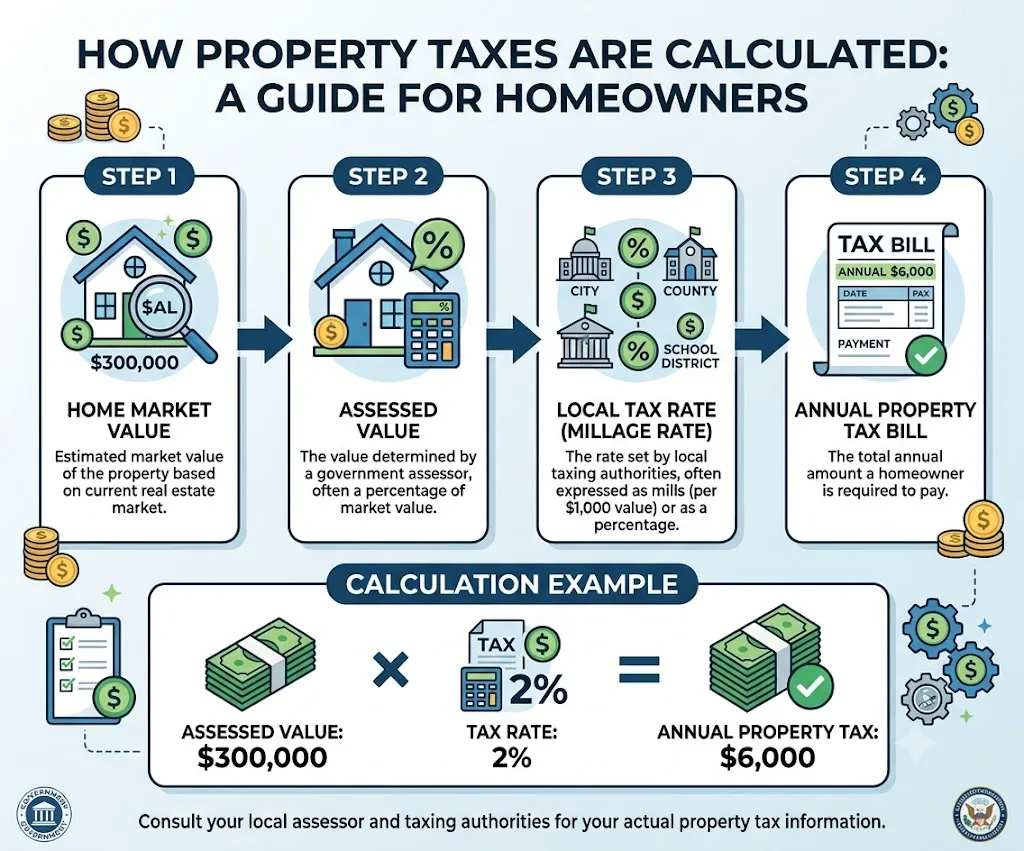
How Property Taxes Are Calculated
Understanding how property taxes work can help you estimate your future costs and identify opportunities to lower your tax bill. Local governments establish annual tax levies to generate revenue for public services. Although the exact process varies by state and county, most local governments follow the same basic steps.
Step 1: Determine Your Home’s Market Value
The process starts with your property’s market value, which is simply the amount your home could reasonably sell for in the current real estate market. Local tax assessors estimate this value using factors such as:
- Recent sales of similar homes
- Property size
- Lot size
- Home condition
- Location
- Renovations and improvements
Some counties reassess homes every year, while others only reassess every few years.
Step 2: Calculate the Assessed Value
Many homeowners think they pay taxes on the full market value of their home, but that isn’t always true. Many states apply an assessment ratio, meaning only part of your home’s value is actually taxable. For example:
- Market value: $400,000
- Assessment ratio: 80%
- Assessed value: $320,000
Some states tax 100% of market value, while others use lower assessment percentages for primary residences, and this is one reason property tax bills differ so much across states.
Step 3: Apply the Local Tax Rate
Many local governments express property tax rates as a millage rate, which represents the amount of tax charged per $1,000 of assessed property value.
Example
- Assessed value: $300,000
- Combined local mill rate: 25 mills
- Property tax: 300 × 25 = $7,500 per year
This amount may include taxes collected for county government, city government, public schools, fire districts, water districts, and special assessment districts, since each local authority contributes its own share to the final tax bill.
Property Tax Formula
The basic formula looks like this:
Property Tax = Assessed Value × Local Tax Rate
Example:
$300,000 Assessed Value × 2% Tax Rate = $6,000 Annual Property Tax
Property Tax Terms Every Homeowner Should Know
Property taxes involve several terms that often confuse homeowners, and understanding them can make it much easier to estimate your tax bill and identify potential savings.
Assessor A county official responsible for determining the value of taxable property.
Assessment Ratio The percentage of market value that is subject to taxation.
Mill Rate A tax rate expressed per $1,000 of assessed value.
Special Assessment An additional charge used to fund specific projects or improvements that benefit a property.
Understanding these terms can help homeowners better evaluate their annual property tax bill.
Market Value vs. Assessed Value vs. Taxable Value
These three terms often confuse homeowners, so here’s an easy way to understand the difference between them.
| Term | Meaning |
| Market Value | What your home could sell for today. |
| Assessed Value | The value assigned by your local tax assessor. |
| Taxable Value | The amount left after exemptions reduce your assessed value. |
For example:
- Market value: $500,000
- Assessed value: $475,000
- Homestead exemption: $50,000
- Taxable value: $425,000
Your property taxes are based on the taxable value, not necessarily the market value itself.
Why Property Tax Bills Change
Many homeowners are surprised when their property tax bill increases, and several factors can cause this to happen.
Rising Home Values
If home prices increase in your area, your county may raise your assessed value during the next reassessment. Higher assessed values usually lead to higher property taxes unless exemptions or tax limits apply to your situation.
Local Budget Changes
Property tax rates can increase whenever local governments need more revenue. For example, voters may approve funding for new schools, road improvements, fire stations, or public safety projects, and these changes can increase the local tax rate even if your home’s value stays exactly the same.
Home Improvements
Major improvements often increase your home’s assessed value. Examples include building an addition, finishing a basement, installing a swimming pool, or constructing a detached garage. Renovation budgets have also become harder to plan, since material costs track commodity markets; the copper price per pound alone can shift wiring and plumbing costs mid-project. Routine maintenance, on the other hand, usually doesn’t affect your assessment at all.
Reassessment Cycles
Every county follows its own reassessment schedule: The assessment cycle varies by jurisdiction and may occur annually, every few years, or when a property changes ownership. This is exactly why two neighboring counties may experience very different tax increases over the same period.
Property Tax Exemptions That Can Reduce Your Bill
Many states offer property tax relief programs that include homestead exemptions, assessment freezes, tax deferrals, and credits for eligible homeowners. These programs can reduce your taxable value or, in some cases, eliminate part of your property tax bill entirely. The rules vary by state, but the following exemptions are among the most common.
Homestead Exemption
The homestead exemption is one of the most valuable property tax benefits available to homeowners, and it applies only to your primary residence. Depending on your state, it may reduce your home’s taxable value, lower your annual property tax bill, or limit future assessment increases. Many states require homeowners to submit an application after purchasing their home, and missing the deadline could delay your tax savings for an entire year.
Senior Property Tax Exemptions
Many states offer additional tax relief for homeowners over a certain age. Depending on the program, seniors may qualify for reduced taxable value, assessment freezes, tax deferrals, or partial exemptions. Eligibility often depends on age, residency, and household income.
Disabled Veteran Exemptions
Many states provide generous property tax relief for disabled veterans. Some states completely exempt the primary residence of veterans with a qualifying disability rating, while others provide partial exemptions based on the level of disability. Requirements vary, so homeowners should check their state and county rules directly.
Disability Exemptions
People with qualifying disabilities may also receive property tax relief. Programs vary by state but often reduce taxable value or limit annual increases in a similar way.
Agricultural and Conservation Exemptions
Land used for farming, ranching, or conservation may qualify for lower property taxes. Instead of taxing the land at full market value, many states assess it based on its agricultural use, and this can significantly reduce annual property taxes for eligible property owners.
Five Legal Ways to Lower Your Property Tax Bill
You don’t always need to move to reduce your property taxes. The following strategies may help lower your annual bill.
1. Claim Every Available Exemption
Start by checking whether you qualify for a homestead exemption, senior exemption, veteran exemption, disability exemption, or agricultural exemption. Many homeowners miss these savings simply because they never apply in the first place.
2. Review Your Property Assessment
Mistakes happen more often than you’d think. Check your property record for errors involving square footage, number of bedrooms, bathrooms, lot size, and other property features, since incorrect information can increase your assessed value unnecessarily.
3. Compare Similar Homes
Look at recently assessed homes in your neighborhood. If similar properties have lower assessed values than yours, you may have grounds to challenge your own assessment.
4. Appeal Your Assessment
Most counties allow homeowners to appeal their property assessment, and you may need to provide comparable home sales, independent appraisals, photos, or repair estimates as supporting evidence. A successful appeal can reduce your property tax bill for several years running.
5. Understand Local Tax Rules
Some states limit how quickly assessments can increase, while others offer tax caps for primary residences. Learning these rules ahead of time can help you estimate future costs before buying a home.
Can You Deduct Property Taxes on Your Federal Tax Return?
Paying property tax may also provide a federal tax benefit in some situations. If you itemize deductions on your federal income tax return, you may be able to deduct eligible state and local property taxes, though the IRS limits the combined deduction for state and local taxes (often called the SALT deduction) to $10,000 per household each year for most taxpayers.
If you own rental property or business real estate, property taxes are generally treated as a business expense instead of an itemized deduction, which means they’re usually deductible against rental or business income, subject to IRS rules. Because tax situations vary so much from household to household, homeowners should review the latest IRS guidance or speak with a qualified tax professional before claiming any deductions.
How to Appeal a Property Tax Assessment
If you believe your home has been overvalued, you may have the right to appeal your property assessment, and the process itself is usually fairly straightforward.
Step 1: Review Your Assessment Notice
Look for errors involving square footage, number of bedrooms, number of bathrooms, lot size, and property condition.
Step 2: Gather Comparable Sales
Research recent sales of similar homes in your area to build your case.
Step 3: Submit an Appeal
Most counties provide an appeal form through the assessor’s office directly.
Step 4: Attend a Hearing
Some jurisdictions require a hearing before an assessment review board as part of the process.
Step 5: Receive a Decision
If your appeal is successful, your assessed value and future property tax bill may be reduced going forward. Many homeowners never appeal, even when they have solid evidence that their property was overvalued in the first place.
Who Can Sometimes Pay Little or No Property Tax?
While no state eliminates property tax for everyone, some homeowners may pay very little or even nothing after exemptions are applied. Examples include:
- Seniors with qualifying income
- Veterans with service-connected disabilities
- Surviving spouses in qualifying programs
- Homeowners receiving substantial homestead exemptions
- Owners of qualifying agricultural land
Eligibility depends entirely on state and local laws, so always check with your county assessor or state department of revenue to see which programs apply to your specific property.
Key Takeaways
- Property taxes are based on your home’s assessed value and your local tax rate.
- Market value, assessed value, and taxable value are different.
- Local governments, not states, usually determine your final property tax bill.
- Homestead, senior, veteran, disability, and agricultural exemptions can significantly reduce what you owe.
- Reviewing your assessment and filing an appeal when necessary can help lower your annual property taxes.
States With No Income Tax vs. States With Low Property Tax
Many people confuse states with no income tax and states with low property tax, and while these terms sound similar, they actually mean very different things. A state without income tax simply doesn’t tax your wages or salary, but that doesn’t mean you’ll pay less in total taxes overall.
States still need money to pay for schools, roads, police, and other public services, so if they collect less income tax, they often rely more heavily on other taxes, such as property tax or sales tax, to make up the difference. That’s exactly why looking at only one type of tax can lead you to the wrong decision.
States With No State Income Tax
The following states do not tax wage income:
| State | State Income Tax | Property Tax |
| Alaska | No | Yes (local) |
| Florida | No | Yes |
| Nevada | No | Yes |
| South Dakota | No | Yes |
| Tennessee | No | Yes |
| Texas | No | Yes |
| Washington | No | Yes |
| Wyoming | No | Yes |
Although these states have no state income tax, their property tax rates still vary significantly from one another. For example, Texas has one of the highest effective property tax rates in the country, while Nevada generally has much lower property taxes by comparison. The best choice ultimately depends on your income, the value of your home, and your long-term financial goals.
Property Tax Is Only One Part of Your Tax Burden
Property taxes are important, but they are only one part of the overall tax picture.
When comparing states, consider:
- Property taxes
- Income taxes
- Sales taxes
- Estate taxes
- Business taxes
The state with the lowest property tax rate is not always the state with the lowest overall tax burden.
Why High-Income Earners Often Focus on Total Tax Burden
For higher-income households, property taxes are only one part of the overall tax picture. Many states with no income tax rely more heavily on property taxes or sales taxes to generate revenue instead. Before relocating, compare property taxes, income taxes, sales taxes, estate taxes, and business taxes together, since a higher property tax bill may end up being offset by substantial income tax savings elsewhere.
Should You Move to a State With Lower Property Taxes?
Inside that section simply add:
Before Moving, Compare:
- Property taxes
- Income taxes
- Sales taxes
- Housing costs
- Insurance costs
Don’t overlook the one-time cost of the move itself either, from truck fees and packing supplies to what you’ll tip the moving crew on the day.
Consider These Questions
Before moving, ask yourself:
- How much is the average home in the area?
- What is the local property tax rate?
- Are there homeowner exemptions?
- Does the state charge income tax?
- What are the sales tax rates?
- Are public schools important to your family?
- What services do local taxes support?
Looking at the complete picture helps you make a much smarter financial decision overall.
Best States for Retirees Based on Property Taxes
Many retirees search for states with no property tax when their real goal is actually reducing overall living costs. Several states consistently rank among the most tax-friendly for retirees because they combine relatively low property taxes with favorable treatment of retirement income. Examples include:
- Delaware
- Florida
- South Carolina
- Tennessee
- Nevada
- Wyoming
Before relocating, compare property taxes, income taxes, retirement income taxation, cost of living, healthcare expenses, and housing costs together. The lowest property tax rate does not always produce the lowest overall retirement expenses.
Retirees often focus on property taxes because they live on fixed incomes and may qualify for senior exemptions, assessment freezes, or property tax relief programs.
Can You Deduct Property Taxes?
In certain situations, property taxes may be deductible on your federal income tax return.
Primary Residence
Homeowners who itemize deductions may be able to deduct qualifying property taxes, subject to federal limitations.
Rental Properties
Property taxes paid on rental real estate are generally deductible as an operating expense.
Business Property
Businesses can typically deduct property taxes associated with commercial property as well.
Because tax laws change periodically, homeowners should review current IRS guidance or consult a qualified tax professional before claiming any deductions.
The Internal Revenue Service (IRS) allows eligible taxpayers to deduct certain state and local taxes when itemizing deductions, subject to federal limits, and taxpayers should review current IRS guidance before claiming any property tax deduction.
Property Taxes and Rental Properties
Property taxes are one of the largest ongoing expenses for rental property owners. When evaluating an investment property, consider annual property tax costs, local reassessment practices, rental income potential, and available property tax deductions. A property with lower taxes may generate stronger cash flow over time, even if the purchase price itself is higher. Because property taxes vary significantly by county, investors should review local tax records before purchasing any rental property.
Frequently Asked Questions
Are there any states with no property tax?
No. Every U.S. state allows local governments to collect property taxes. The amount you pay depends on where you live, your property’s assessed value, and local tax rates.
Which state has the lowest property tax?
Hawaii consistently has the lowest effective property tax rate. However, because home prices are much higher, homeowners there don’t always pay the lowest annual tax bill.
Which states have the lowest actual property tax bills?
States such as Alabama, West Virginia, Arkansas, Louisiana, and Mississippi often have some of the lowest annual property tax bills because they combine lower tax rates with more affordable home values.
Why are property taxes so high in Texas?
Texas doesn’t collect a state income tax, so local governments there rely heavily on property taxes to fund schools, public safety, and other essential services.
Does Florida have property tax?
Yes. Florida has no state income tax, but homeowners still pay local property taxes. Many homeowners also qualify for valuable homestead exemptions that help reduce their tax bills.
Can seniors avoid paying property taxes?
Some seniors qualify for property tax exemptions, assessment freezes, or tax deferral programs, depending on state and local rules.
Do disabled veterans receive property tax exemptions?
Many states offer partial or full property tax exemptions for qualifying disabled veterans, though requirements vary by state and disability rating.
How can I lower my property tax bill?
You may be able to reduce your bill by claiming available exemptions, reviewing your property assessment, appealing an inaccurate assessment, checking for assessment errors, and understanding local tax relief programs.
What is an effective property tax rate?
The effective property tax rate is the percentage of your home’s market value that you pay in property taxes each year, and it’s one of the best ways to compare property taxes between different states.
Is property tax based on market value?
Not always. Many local governments first calculate an assessed value, then apply exemptions before determining your final taxable value.
Does paying off my mortgage remove property taxes?
No. Property taxes are separate from your mortgage, and even after a mortgage is paid off, property taxes generally remain due each year regardless.
Can property taxes increase every year?
Yes. Property taxes can rise when assessed values increase or local governments raise their tax rates.
What happens if you do not pay property taxes?
Unpaid property taxes may result in penalties, interest, tax liens, and eventually foreclosure proceedings in some jurisdictions.
Property Tax Checklist Before Buying a Home
Before purchasing a property, review the following:
✅ Current annual property tax bill
✅ Local tax rate
✅ School district taxes
✅ Available homestead exemptions
✅ Senior or veteran exemptions
✅ Assessment history
✅ Reassessment schedule
✅ Pending local tax increases
✅ Special assessments
✅ Homeowners association fees
A home with a lower purchase price may not always have lower long-term ownership costs, so reviewing these factors before buying can help you avoid unexpected expenses down the road.
Conclusion
Despite what many online articles claim, there are no states with no property tax. Every state allows property taxes to be collected at the local level to help fund schools, public safety, roads, and other essential services.
After reviewing property tax data and state tax policies, one thing becomes clear: the lowest property tax rate does not always lead to the lowest tax bill. Home values, reassessment rules, exemptions, and local tax rates can significantly affect what homeowners actually pay.
If you’re buying a home, planning retirement, relocating, or investing in real estate, focus on the bigger picture. Compare:
- Property tax rates
- Home values
- Income taxes
- Available exemptions
- Overall cost of living
The goal is not to find a state with no property tax. The goal is to find the state that offers the best overall value for your financial situation.
Because property tax laws and exemptions can change over time, always verify information with your local assessor, state tax agency, or a qualified tax professional before making important financial decisions.