

What Is a Quit Claim Deed? A Complete Guide to How It Works, Uses, and Risks
Buying, transferring, or changing ownership of a property can feel simple until you discover a problem hidden in the paperwork.
Many people hear the term “quit claim deed” during a divorce, a family property transfer, estate planning, or when adding someone to a home title. At first, it may sound like a quick way to transfer ownership. However, many property owners later realize that signing a quit claim deed does not automatically remove a mortgage, clear title problems, or guarantee that they actually own the property rights being transferred.
One of the biggest mistakes people make is assuming that a quit claim deed works like a warranty deed. It does not. A quit claim deed only transfers whatever ownership interest the grantor currently has. If there are hidden liens, ownership disputes, or title issues, the new owner may inherit those problems.
In real estate matters, understanding the difference between transferring ownership and guaranteeing ownership is critical. A document that takes only a few minutes to sign can affect property rights for years.
This guide explains what a quit claim deed is, how it works, why people use it, when it may be a good option, and the risks you should understand before signing one.
Whether you are transferring property to a family member, handling a divorce settlement, adding a spouse to a title, or simply trying to understand a deed you received, this guide will help you make a more informed decision.
Why People Usually Search for a Quit Claim Deed
Most people do not search for a quit claim deed because they are interested in real estate law. They usually encounter the term during an important life event involving property ownership.
For example, someone may discover a quit claim deed while finalizing a divorce and wonder whether signing it removes their responsibility for the mortgage. A parent may consider using one to transfer a family home to a child. Someone creating a living trust may need to move property ownership into the trust and come across this type of deed for the first time.
The confusion usually comes from one common misunderstanding: a quit claim deed changes ownership rights, but it does not solve every property-related issue.
What Is a Quit Claim Deed?
A quit claim deed is a legal document that transfers a person’s ownership interest in a property to another person without guaranteeing that the title is valid or free from problems.
In simple terms, the person signing the deed gives up, or “quits,” any ownership rights they have in the property. If they own the entire property, those rights transfer to the new owner. If they own only part of the property, only that share transfers, and if they have no legal ownership, the new owner receives nothing.
This is the main difference between a quit claim deed and other types of property deeds, the deed transfers only the interest the current owner has, and it does not guarantee that the owner has a legal right to transfer the property or that the title is clear.
A Simple Example
Imagine that Sarah and Michael own a house together. After their divorce, Sarah agrees to give her ownership interest to Michael, and she signs a quit claim deed that transfers her share of the property to him.
The quit claim deed changes the ownership recorded on the property’s title, but it does not guarantee that the title has no liens or legal claims. It also does not remove Sarah from the mortgage if her name is still on the home loan, the mortgage remains a separate legal agreement with the lender.
Key Points to Remember
- A quit claim deed transfers whatever ownership interest the grantor has.
- It does not guarantee that the property has a clear title.
- It does not promise that the grantor legally owns the property.
- It does not protect the new owner from title defects or hidden claims.
- It does not automatically remove a person’s name from the mortgage.
Because of these limits, quit claim deeds are most often used between people who already know and trust each other rather than between strangers buying and selling a home.
Types of Property Deeds: Where a Quit Claim Deed Fits
A quit claim deed is only one type of legal instrument used in real estate ownership transfers. Different deeds provide different levels of protection depending on the situation.
Common types of property deeds include:
| Deed Type | Main Purpose | Buyer Protection |
| Quit Claim Deed | Transfers whatever ownership interest exists | Low |
| Warranty Deed | Guarantees ownership and title protection | High |
| Special Warranty Deed | Protects against issues caused during the seller’s ownership period | Medium |
| Grant Deed | Transfers ownership with certain implied guarantees depending on state law | Medium |
The biggest difference between these deeds is the level of protection they provide. A quit claim deed focuses on transferring existing rights, while warranty-based deeds provide additional promises about ownership and title problems.
Quit Claim Deed Explained in Simple Terms
Legal terms can make a quit claim deed sound more complicated than it really is, but the idea is actually simple. Think of it this way: imagine your friend says, “I am giving you whatever ownership rights I have in this house. If I own all of it, you get all of it. If I own only half, you get half. If I don’t own any of it, then you get nothing.” That’s how a quit claim deed works.
The person giving up their ownership interest does not promise that they own the property, and they also do not promise that no one else has a legal claim to it, they simply transfer whatever rights they have at that moment.
This is why quit claim deeds are often used when there’s already trust between the people involved. For example, family members, spouses, or business partners may use one because they already know the history of the property.
If you’re buying a home from someone you do not know, a quit claim deed is usually not the safest option. Most home buyers prefer a warranty deed because it provides stronger legal protection and guarantees about the property’s title.
How Does a Quit Claim Deed Work?
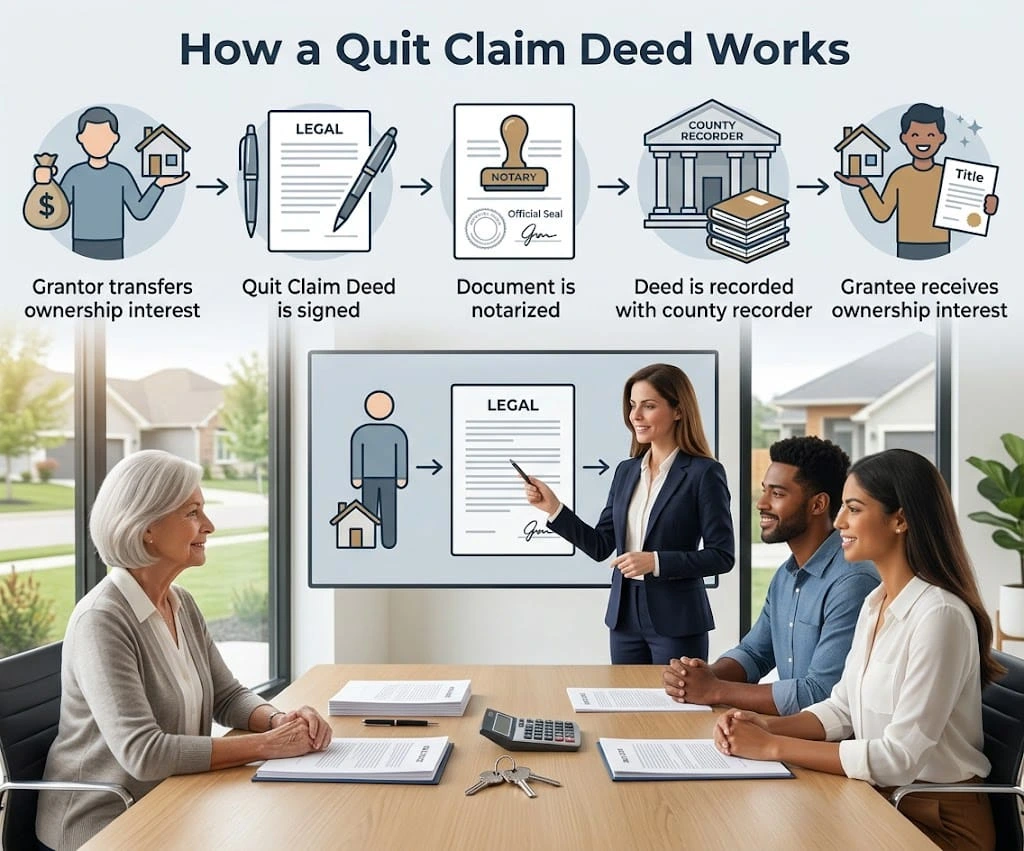
A quit claim deed transfers a person’s ownership interest in real estate from one party to another. The process is simple, but it must follow your state’s legal requirements to be valid.
When the deed is signed and recorded, the person giving up their ownership interest transfers whatever legal rights they have in the property to the new owner. However, the deed does not promise that those rights are complete or free from legal problems.
Unlike a warranty deed, a quit claim deed does not protect the new owner against title defects, unpaid liens, or ownership disputes that may already exist.
Who Is the Grantor and the Grantee?
Every quit claim deed involves two main parties.
Grantor
The grantor is the person transferring their ownership interest in the property. The grantor may own the entire property, only part of it, or in some cases, no legal interest at all, since the quit claim deed transfers only the interest the grantor actually has.
Grantee
The grantee is the person receiving the ownership interest. After the deed is signed and recorded, the grantee receives whatever ownership rights the grantor had, though the grantee does not receive any guarantee that the title is clear.
Understanding these two terms makes it much easier to understand how quit claim deeds work.
How the Transfer Process Works
Although the exact rules vary by state, the basic process is similar across the United States.
Step 1: Prepare the Quit Claim Deed
The deed must include important information, such as the full legal names of the grantor and grantee, the property’s legal description, the property’s address, any required statement of consideration, and the date of the transfer. Some states also require additional disclosures.
Step 2: Sign the Deed
The grantor signs the quit claim deed. Many states require the signature to be notarised, and some states also require one or more witnesses.
Step 3: Deliver the Deed
After signing, the grantor gives the deed to the grantee. The transfer is generally not complete until the grantee accepts the deed.
Step 4: Record the Deed
The signed deed should be recorded with the county recorder, county clerk, or other local land records office. Recording the deed creates a public record of the ownership transfer, and it also helps protect the grantee’s ownership rights against future claims.
What Information Does a Quit Claim Deed Include?
A quit claim deed is more than a simple transfer letter, it’s a legal document that must identify both the property and the people involved. Most quit claim deeds include:
- The name of the grantor
- The name of the grantee
- The property’s legal description
- The property’s street address
- The county where the property is located
- The date of the transfer
- The grantor’s signature
- A notary acknowledgment, where required
- Recording information after filing
Some states also require tax forms or transfer declarations before the deed can be recorded.
What Rights Does a Quit Claim Deed Transfer?
A quit claim deed transfers only the ownership interest the grantor currently has, and this is one of the most important things to understand.
For example, if the grantor owns 100% of the property, the grantee receives that ownership interest. If the grantor owns only a 50% share, only that share transfers, and if the grantor has no legal ownership, the grantee receives no ownership rights. The deed does not create ownership, it only transfers existing ownership rights.
What a Quit Claim Deed Does Not Do
Many people misunderstand what this type of deed can accomplish. A quit claim deed does not:
- Guarantee clear ownership
- Promise that the grantor legally owns the property
- Remove existing liens
- Remove unpaid property taxes
- Eliminate title defects
- Protect the grantee against ownership disputes
- Automatically remove someone from a mortgage
These limits make quit claim deeds very different from warranty deeds.
Real-Life Example
Suppose David owns a house before he gets married. A few years later, he decides to add his wife, Emily, to the property’s title. Instead of selling the home to her, David signs a quit claim deed that transfers an ownership interest in the property.
After the deed is recorded, Emily becomes a legal owner of the home. However, if David’s mortgage remains in his name alone, the quit claim deed does not make Emily responsible for the loan. Likewise, if both names are on the mortgage, signing the deed alone does not remove either person’s financial responsibility.
This example shows why it’s important to understand the difference between property ownership and mortgage responsibility.
Why Recording the Deed Matters
Some people think signing the deed is enough, but in most cases, recording it is just as important. Recording the deed creates a public record of the ownership transfer, helps protect the grantee’s ownership rights, reduces the risk of future ownership disputes, and makes future property transactions easier. If a deed is never recorded, proving ownership later may become more difficult.
When Is a Quit Claim Deed Used?
A quit claim deed is not used for every real estate transaction. In most cases, people use it when they already know and trust each other, and since the deed does not guarantee a clear title, it’s usually not the best choice for buying a home from a stranger.
Instead, quit claim deeds are common in family, legal, and estate planning situations where the goal is to transfer ownership quickly and simply. Below are the most common situations where a quit claim deed may be used.
Transferring Property Between Family Members
One of the most common uses of a quit claim deed is transferring property between family members. For example, parents may transfer a home to their children as part of an estate plan, and siblings may transfer ownership after inheriting a family property. Because transferring property as a gift can have federal tax implications, it is worth checking the IRS guidance before completing the transfer. Because family members usually know the property’s history, they often do not require the title guarantees that come with a warranty deed.
Example: A mother owns a vacation home and decides to give it to her daughter. Instead of selling the property, she signs a quit claim deed to transfer her ownership interest.
Adding a Spouse to the Property Title
Many people buy a home before they get married, and later, they may decide to add their spouse as a legal owner. A quit claim deed makes this process simple.
After the deed is signed and recorded, both spouses appear on the property’s title. However, adding a spouse to the title does not automatically add them to the mortgage, if the lender’s loan documents remain unchanged, only the original borrower may still be responsible for the home loan.
Removing a Spouse After Divorce
A quit claim deed is also common after a divorce. If one spouse keeps the family home, the other spouse may sign a quit claim deed to give up their ownership interest.
Example: John and Lisa divorce. As part of the divorce settlement, Lisa keeps the house, and John signs a quit claim deed transferring his ownership interest to Lisa. After the deed is recorded, Lisa becomes the property’s sole owner. However, if John’s name remains on the mortgage, he may still be legally responsible for the loan until the lender removes him or the mortgage is refinanced.
Transferring Property Into or Out of a Trust
Many homeowners create a living trust to help manage their assets or simplify estate planning. To place a home into the trust, the owner often signs a quit claim deed transferring ownership from themselves to the trust. Later, if the property needs to be transferred out of the trust, another quit claim deed may be used. This type of transfer usually does not involve selling the property, instead, it changes the legal owner listed on the title.
Correcting Errors on a Property Title
Sometimes mistakes happen when a property deed is prepared or recorded. For example, the deed may contain a misspelled name, an incorrect legal description, a missing middle initial, or an ownership error. A quit claim deed may help correct these mistakes by transferring the ownership interest using the correct information. However, more serious title problems may require additional legal documents or court action.
Transferring Property Between Business Entities
Property owners sometimes move real estate between different legal entities. For example, a person may transfer a rental property from personal ownership to an LLC, from one business entity to another, or from a trust back to individual ownership. A quit claim deed can often be used for these internal ownership changes because the parties already understand the property’s ownership history. If you are setting up a new business before making such a transfer, you may also want to read our guide on how to start a cleaning business for an example of the steps involved in establishing a business.
Settling Ownership Between Co-Owners
When two or more people own property together, one owner may decide to give up their share. Rather than selling the entire property, they can transfer only their ownership interest through a quit claim deed. This commonly happens when one sibling keeps an inherited home, one business partner leaves a real estate investment, or one co-owner buys out another owner’s share. The quit claim deed records the transfer of that ownership interest.
Situations Where a Quit Claim Deed May Not Be the Best Choice
Although quit claim deeds are useful, they’re not right for every situation. You should be cautious about using one when buying a home from someone you do not know, purchasing investment property from a stranger, the property’s ownership history is unclear, there are known title disputes, or you want legal protection against future ownership claims. In these situations, many buyers prefer a warranty deed because it provides stronger legal assurances about the property’s title.
Quick Summary: Common Uses of a Quit Claim Deed
| Situation | Is a Quit Claim Deed Commonly Used? |
| Transfer property to a family member | ✔ Yes |
| Add a spouse to the property title | ✔ Yes |
| Remove a spouse after divorce | ✔ Yes |
| Transfer property into a trust | ✔ Yes |
| Correct minor title errors | ✔ Yes |
| Transfer ownership between business entities | ✔ Yes |
| Sell a home to an unknown buyer | ✘ No |
| Buy property that may have title issues | ✘ No |
Quit Claim Deed vs. Warranty Deed
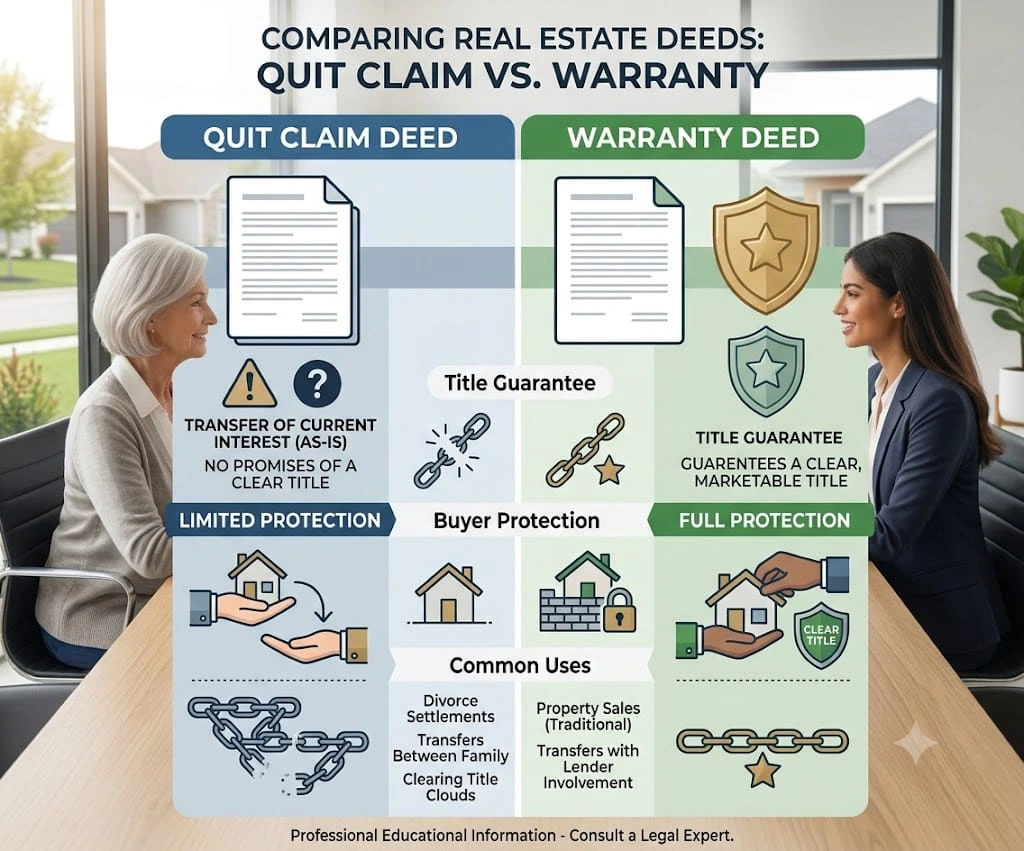
Choosing the right type of deed is an important part of any real estate transaction. Although a quit claim deed and a warranty deed both transfer ownership, they offer very different levels of protection.
The biggest difference is simple: a quit claim deed transfers whatever ownership interest the grantor has without making any promises about the property’s title, while a warranty deed guarantees that the grantor owns the property and has the legal right to transfer it. It also promises that the title is free from undisclosed claims, liens, or ownership disputes. Because of these guarantees, warranty deeds are the standard choice for most home sales in the United States.
Quick Comparison
| Feature | Quit Claim Deed | Warranty Deed |
| Transfers ownership interest | ✔ Yes | ✔ Yes |
| Guarantees the grantor owns the property | ✘ No | ✔ Yes |
| Guarantees a clear title | ✘ No | ✔ Yes |
| Protects the buyer from title defects | ✘ No | ✔ Yes |
| Commonly used between family members | ✔ Yes | Sometimes |
| Commonly used in traditional home sales | Rarely | ✔ Yes |
| Best for trusted parties | ✔ Yes | Sometimes |
| Best for buying from a stranger | ✘ No | ✔ Yes |
Although terminology varies by state, most jurisdictions recognise multiple deed types that offer different levels of protection. Buyers purchasing property through a traditional real estate transaction generally receive greater legal protection under a warranty deed than under a quit claim deed.
Unlike a warranty deed, a quit claim deed does not protect the grantee against title defects, hidden liens, or competing ownership claims. The grantee accepts whatever ownership interest the grantor has without any warranties about the property’s title.
What First-Time Home Buyers Should Know
If you’re buying your first home, you’ll most likely receive a warranty deed, not a quit claim deed. In a typical home purchase, the seller provides legal assurances that they own the property and have the right to transfer it, and buyers also commonly receive a title search and may purchase title insurance to help protect against certain ownership issues.
Because a quit claim deed does not include these warranties, it’s rarely used in traditional home sales between unrelated buyers and sellers. If you’re purchasing a property and the seller wants to use a quit claim deed instead of a warranty deed, take time to understand why, asking questions and seeking professional advice can help you make an informed decision.
When Should You Use a Quit Claim Deed?
A quit claim deed is usually the better choice when ownership is changing between people who already know and trust one another. Common examples include transferring property between parents and children, adding a spouse to the title after marriage, removing a spouse after divorce, moving property into or out of a living trust, and correcting certain ownership or title errors. In these situations, the parties often know the property’s history, so a full title warranty may not be necessary.
Advantages of a Quit Claim Deed
A quit claim deed has several benefits in the right situation.
Fast and Simple
The transfer process is usually straightforward and involves fewer legal guarantees than other deeds.
Common for Family Transfers
It works well when ownership changes between people who already trust each other.
Useful for Correcting Ownership Records
It can help fix certain title mistakes or update ownership information.
Often Less Expensive
Because quit claim deeds are relatively simple, preparing them may involve lower legal costs than more complex property transfers. However, recording fees and other costs still apply.
Disadvantages of a Quit Claim Deed
Despite its convenience, a quit claim deed also has important drawbacks.
No Title Guarantee
The grantor does not promise that they own the property.
No Protection Against Existing Liens
The property may still have unpaid taxes, mortgages, or other legal claims.
Higher Risk for Buyers
If someone else later proves ownership, the grantee may have limited legal protection.
Not Ideal for Standard Home Purchases
Most buyers prefer the security of a warranty deed when purchasing real estate.
How to File a Quit Claim Deed
Filing a quit claim deed is usually a straightforward process, though each state has its own legal requirements. Some states require witnesses, while others only require a notarised signature, and recording fees and forms may also vary by county.
Even though the process is simple, it’s important to complete each step correctly, since a mistake on the deed could delay the transfer or create title problems in the future. Below is a general overview of how a quit claim deed is filed in the United States.
Step 1: Obtain the Correct Quit Claim Deed Form
The first step is to get a quit claim deed form that meets your state’s legal requirements. Many county recorder or county clerk offices provide approved forms, and you can also prepare a custom deed through a real estate attorney or a legal document service. Before completing the form, make sure it’s designed for the state where the property is located.
Step 2: Enter the Required Information
A quit claim deed must include accurate information about the property and the people involved. Most deeds require the grantor’s full legal name, the grantee’s full legal name, the property’s legal description, the property’s street address, the county where the property is located, a statement of consideration (if required), and the date of the transfer. The legal description should match the description shown on the previous deed or official property records.
Step 3: Sign the Deed
The grantor must sign the quit claim deed. In most states, the signature must be notarised before the deed can be recorded, and some states also require one or more witnesses. Do not sign the deed until you understand your state’s signing requirements.
Step 4: Deliver the Deed to the Grantee
After signing, the deed should be delivered to the grantee. The transfer is generally considered complete once the grantee accepts the deed, though recording the deed is still an important step because it creates a public record of the transfer.
Step 5: Record the Deed
The completed deed should be filed with the local county recorder, county clerk, register of deeds, or another land records office, depending on your state. Recording the deed helps create a public record of the ownership transfer, protect the grantee’s ownership rights, reduce future title disputes, and make future property transactions easier. Recording requirements and fees vary by state and county.
Recording Requirements
Although the rules differ across the United States, many counties require the following before accepting a quit claim deed for recording:
- A completed quit claim deed.
- The grantor’s signature.
- A notarised acknowledgment.
- The correct legal description of the property.
- Payment of the required recording fee.
- Any state or local transfer tax forms, if applicable.
Some counties may reject a deed if required information is missing or incorrect.
State-Specific Rules for Quit Claim Deeds
Although the basic purpose of a quit claim deed is the same across the United States, the legal requirements for preparing, signing, and recording one can vary from state to state. Each state has its own real estate laws, recording procedures, and document requirements, and in many cases, counties within the same state may also have their own filing rules, fees, and formatting standards. Before signing or filing a quit claim deed, always check the requirements in the state where the property is located.
- Witness and Notary Requirements
- Recording Offices May Have Different Procedures
- Recording Fees and Transfer Taxes Vary by State
- Required Forms May Be Different
- Community Property and Marital Property Laws
- Where to Find Your State’s Requirements
Questions to Ask Before Signing a Quit Claim Deed
Before signing a quit claim deed, ask:
1. Who currently owns the property?
Check the current deed records to confirm the ownership history.
2. Are there existing liens or debts?
A quit claim deed does not remove mortgages, tax liens, or other claims against the property.
3. Why is a quit claim deed being used?
Understanding the reason behind the transfer can help determine whether it is appropriate.
4. Is another type of deed more suitable?
If the transfer involves buying property from someone you do not know, a warranty deed may provide better protection.
5. Has the deed been properly recorded?
An improperly completed or unrecorded deed can create future ownership problems.
How Much Does a Quit Claim Deed Cost?
The cost of filing a quit claim deed depends on where the property is located and whether you prepare the document yourself or hire a professional. Common expenses may include:
| Expense | Typical Cost |
| Recording fee | Varies by county |
| Notary fee | Varies by state |
| Document preparation | Varies |
| Attorney fee (if used) | Varies |
Some counties charge a flat recording fee, while others base the fee on the number of pages or other local rules. If you hire a real estate attorney, the total cost may be higher, though professional guidance can help prevent costly mistakes, especially if the property’s ownership is complicated.
Common Mistakes to Avoid
Even a small error can delay the recording process or create future legal issues. Here are some of the most common mistakes.
Using the Wrong Legal Description
The property’s legal description must match the official land records. Using only the street address may not be enough.
Misspelling Names
The grantor’s and grantee’s names should exactly match their legal documents. Incorrect names can create problems with future title searches.
Forgetting to Notarise the Signature
Many states require the grantor’s signature to be notarised. A deed without the required notarisation may be rejected for recording.
Failing to Record the Deed
Some people sign the deed but never record it. Without recording, proving ownership later may become more difficult.
Assuming the Mortgage Changes Automatically
This is one of the most common misunderstandings. A quit claim deed transfers ownership rights, it does not automatically remove a person’s responsibility for a mortgage. If you want to be released from a home loan, you usually need the lender’s approval or a mortgage refinance.
Do You Need a Lawyer to File a Quit Claim Deed?
Not always. Many simple property transfers can be completed without hiring an attorney, for example, adding a spouse to the title or transferring property into a living trust may be straightforward. However, legal advice may be helpful if the property’s ownership is disputed, there are liens or title defects, the transfer involves multiple owners, you’re unsure which type of deed to use, or the transfer is part of a divorce or estate matter. An attorney can also help ensure the deed meets your state’s legal requirements before it is recorded.
Risks of Using a Quit Claim Deed
A quit claim deed can be useful in the right situation, but it also comes with important risks. Since the deed does not guarantee ownership or a clear title, the person receiving the property accepts more risk than they would with a warranty deed. Before signing or accepting a quit claim deed, it’s important to understand these potential issues.
You May Not Receive Full Ownership
A quit claim deed transfers only the ownership interest the grantor actually has. If the grantor owns the entire property, the grantee receives full ownership. However, if the grantor owns only part of the property, only that share transfers, and if the grantor has no legal ownership at all, the grantee receives no ownership rights. This is why it’s important to understand the property’s ownership history before accepting a quit claim deed.
Existing Liens Stay With the Property
Many people believe a quit claim deed removes existing debts attached to a property, but this is not true. A quit claim deed does not remove mortgage liens, tax liens, court judgments, mechanic’s liens, or other legal claims against the property. If these issues already exist, they may still affect the property after the transfer.
Ownership Disputes May Arise Later
A quit claim deed does not protect the grantee if another person later claims ownership. For example, ownership disputes may occur if a previous owner was left off the title, an heir claims an ownership interest, an earlier deed was recorded incorrectly, or fraud occurred during a previous transfer. Resolving these disputes can take time and may require legal action.
When Should You Use a Quit Claim Deed?
A quit claim deed can be useful in certain situations, but it is not the right choice for every property transfer. The best option depends on your relationship with the other party and the level of protection you need.
Good Situations for a Quit Claim Deed
A quit claim deed is commonly used when the parties already know each other and understand the property’s history.
Examples include:
- Transferring property between family members
- Adding a spouse to a title
- Removing a spouse after divorce
- Moving property into a trust
- Correcting minor title errors
- Transferring ownership between business entities
When to Choose a Warranty Deed Instead
A warranty deed is usually the better choice when you need stronger protection about ownership and title history.
Consider a warranty deed when:
- Buying a home from a stranger
- Purchasing investment property
- Buying land from another party
- Obtaining mortgage financing
- You need protection against hidden title problems
Frequently Asked Questions
Where Can You Get a Quit Claim Deed Form?
You can typically find one through official county recorder forms, state-specific templates, attorney-prepared deeds, title company assistance, or online legal document services. Using the correct state-specific form matters, since requirements vary by location.
Can a Quit Claim Deed Be Reversed?
Sometimes. If both parties agree, another deed may transfer the ownership back. However, if there’s fraud, forgery, or another legal problem, reversing a quit claim deed may require a court order.
Does a Quit Claim Deed Avoid Probate?
Not by itself. A quit claim deed simply transfers ownership, and whether probate can be avoided depends on how the property is owned and whether estate planning tools, such as a living trust, are used.
Is a Quit Claim Deed Proof of Ownership?
No. A quit claim deed only transfers whatever ownership interest the grantor has. It does not prove that the grantor legally owned the property or that the title is free from defects.
Can You Sell Property With a Quit Claim Deed?
Yes. A person who receives property through a quit claim deed may later sell it if they have legal ownership. However, buyers and lenders
Can a Quit Claim Deed Be Used Between Family Members?
Yes. This is one of the most common uses of a quit claim deed. Parents may transfer property to children, siblings may transfer inherited property, or spouses may add or remove each other from a property title.
Before You Sign a Quit Claim Deed
Before signing or accepting a quit claim deed, review the following checklist:
- Confirm who currently owns the property.
- Verify that the legal description of the property is accurate.
- Understand that a quit claim deed transfers ownership interest but does not guarantee a clear title.
- Check whether your state requires witnesses, notarisation, or additional forms.
- Make sure the deed will be recorded with the correct county office.
- Understand that signing a quit claim deed does not automatically remove anyone from an existing mortgage.
Final Thoughts
A quit claim deed may look like a simple property document, but its effects can be significant. The most important thing to understand is that a quit claim deed transfers ownership interest, it does not guarantee ownership, clear the title, or remove financial obligations connected to the property.
In many real estate situations, quit claim deeds work well because the people involved already understand the property’s history. Family transfers, divorce-related ownership changes, trust transfers, and adding or removing someone from a title are common examples where this type of deed may make sense.
However, problems often arise when people treat a quit claim deed like a guarantee. A signed deed does not erase liens, fix ownership disputes, or automatically remove someone from a mortgage. These are separate legal issues that require separate solutions.
Before signing or accepting a quit claim deed, take time to verify ownership records, understand what rights are being transferred, and check your state’s recording requirements. A small mistake in a property transfer can create complications later.
The right deed depends on your specific situation. If the transfer involves family members or trusted parties, a quit claim deed may provide a simple solution. If you are buying property from someone you do not know, a deed with stronger title protections may be a safer choice.
When dealing with real estate ownership, taking the time to understand the document before signing is one of the best ways to protect your property rights.