How Long Is 7 Business Days? Complete Guide With Examples
You’re probably here because you’re waiting for something important, a package, a bank refund, a job application, or an approval from a government agency. You were told it would take 7 business days, but now you’re wondering what that actually means.
This is one of the most common sources of confusion. Many people count every day on the calendar, while others aren’t sure whether weekends or public holidays should be included. The answer isn’t always as simple as “one week.”
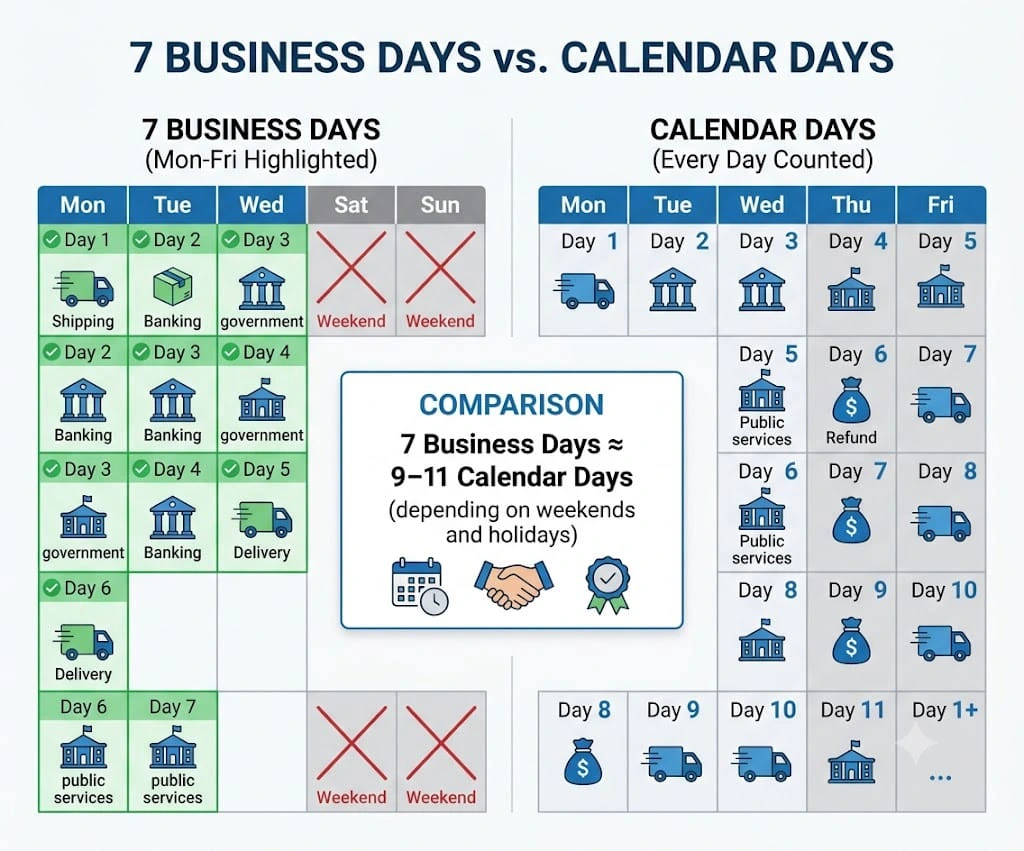
After researching how businesses, banks, shipping carriers, and government agencies commonly calculate business days, we’ve found that 7 business days usually equal 9–11 calendar days. However, the exact timeline depends on your starting date, weekends, holidays, and the organization’s processing policy.
In this guide, you’ll learn how to calculate 7 business days correctly, avoid common mistakes, and estimate your timeline with confidence.
Understanding What 7 Business Days Means
Plenty of people find themselves asking “how long is 7 business days?” right after ordering a package, waiting on a refund, applying for a loan, or signing a contract. The phrase sounds simple on the surface, but it trips people up more often than you’d expect.
A business day is simply a normal working day. In the United States, business days run Monday through Friday, and this is when most banks, government offices, schools, and companies are actually open and operating. Saturdays, Sundays, and federal holidays generally don’t count toward the total.
So when a company tells you something will take 7 business days, they’re not talking about seven calendar days. Only the actual working days count toward that number.
Understanding this distinction goes a long way toward helping you avoid missed deadlines and unrealistic expectations down the road.
What Is Considered a Business Day?
A business day is any day when most businesses are open and regular work is actually happening.
In the United States, this usually includes:
- Monday
- Tuesday
- Wednesday
- Thursday
- Friday
These days count because businesses typically process orders, payments, applications, and customer requests during their regular working hours on these days.
The following days are generally not considered business days:
- Saturday
- Sunday
- Federal holidays
- Bank holidays
Some industries, like hospitals, restaurants, and emergency services, operate every single day of the week. Even so, they often still rely on the standard Monday-to-Friday schedule when calculating their official processing times.
Business Days vs. Calendar Days
One of the most common mistakes people make is confusing business days with calendar days entirely.
A calendar day includes every day of the week without exception, while a business day only includes regular working days.
The table below makes the difference clear.
| Business Days | Calendar Days |
| Monday to Friday | Monday to Sunday |
| Excludes weekends | Includes weekends |
| Excludes most public holidays | Includes public holidays |
| Used for processing and deadlines | Used for general time measurement |
Simple Formula for Calculating Business Days
You can estimate business days using a fairly simple rule:
Business Days = Calendar Days − Weekends − Public Holidays
For example, if your seven-business-day timeline happens to include one weekend and one federal holiday, the total number of calendar days will run longer than seven.
This formula comes in handy when you’re trying to estimate delivery dates, refund processing times, banking transactions, and government application deadlines.
How to Count 7 Business Days
Counting business days is actually easier than most people assume once you break it down.
Here are the simple steps to follow.
Step 1: Find Your Starting Date
Start with the date your order, request, or application was officially accepted. Many companies begin counting on the next business day, especially if you submit your request after their normal business hours.
Step 2: Skip Weekends
Ignore Saturdays and Sundays entirely, since these days don’t count unless a company specifically says otherwise.
Step 3: Skip Public Holidays
If a federal holiday shows up somewhere in the timeline, skip that day too and continue counting on the next available business day.
Step 4: Stop at Day Seven
The seventh working day becomes your estimated completion or delivery date.
Does the First Day Count?
This is another question that comes up constantly.
In many cases, the day you actually place your order doesn’t count toward the total. For example, if you order something on Friday afternoon, the warehouse might not process it until Monday, which then becomes Business Day 1.
That said, some companies do start counting on the same day if they receive your request before their daily cut-off time. It’s always worth checking the company’s processing policy if you need an exact date.
Why Companies Use Business Days
Businesses rely on business days because many important processes only happen during normal working hours.
These include shipping orders, processing refunds, bank transfers, credit card payments, loan approvals, government applications, legal paperwork, and customer support requests.
Using business days helps companies set realistic expectations while still accounting for weekends and public holidays along the way.
Although business days generally mean Monday through Friday, there’s no universal rule that applies to every single organization. Banks, shipping companies, government agencies, and private businesses may all follow different processing schedules or observe additional holidays of their own. If an exact deadline really matters to you, it’s always worth checking the company’s official policy directly.
Real-Life Examples of 7 Business Days
Knowing the definition of business days certainly helps, but seeing real examples makes the actual counting process much easier to follow.
Below are some common situations you might run into in everyday life.
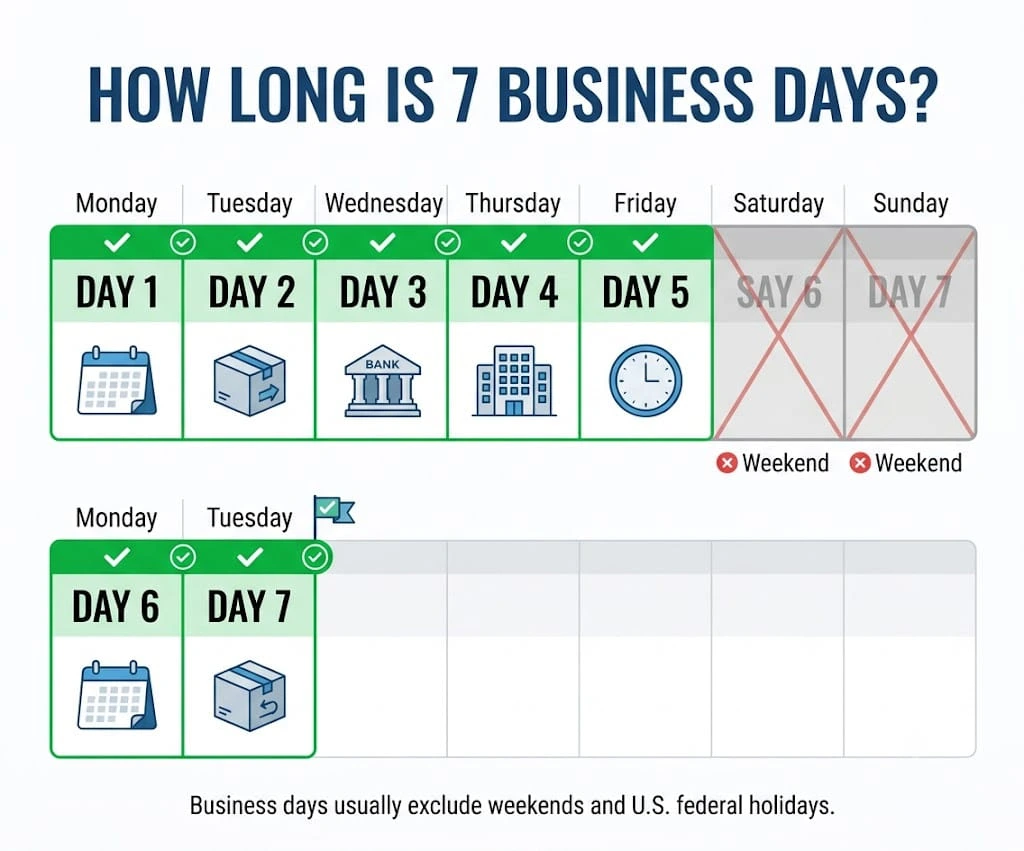
Example 1: Starting on Monday
If your order gets confirmed on Monday before the company’s cut-off time, the count usually begins that same day.
| Day | Count |
| Monday | Day 1 |
| Tuesday | Day 2 |
| Wednesday | Day 3 |
| Thursday | Day 4 |
| Friday | Day 5 |
| Saturday | Not Counted |
| Sunday | Not Counted |
| Monday | Day 6 |
| Tuesday | Day 7 |
Estimated completion lands on Tuesday of the following week.
Example 2: Starting on Friday
Plenty of people place orders on Fridays and assume delivery will land the following Friday, but that isn’t always correct.
| Day | Count |
| Friday | Day 1 |
| Saturday | Not Counted |
| Sunday | Not Counted |
| Monday | Day 2 |
| Tuesday | Day 3 |
| Wednesday | Day 4 |
| Thursday | Day 5 |
| Friday | Day 6 |
| Monday | Day 7 |
Estimated completion actually lands on Monday of the second week.
Example 3: A Federal Holiday Falls in Between
Public holidays can genuinely delay your timeline, since they’re never counted as business days.
Suppose you start counting on Monday, but Thursday happens to be a federal holiday.
| Day | Count |
| Monday | Day 1 |
| Tuesday | Day 2 |
| Wednesday | Day 3 |
| Thursday (Holiday) | Not Counted |
| Friday | Day 4 |
| Saturday | Not Counted |
| Sunday | Not Counted |
| Monday | Day 5 |
| Tuesday | Day 6 |
| Wednesday | Day 7 |
In this case, the holiday ends up pushing the completion date back by one additional day.
What Can Delay 7 Business Days?
Business days are only one part of the overall timeline. Several other factors can also affect when your order, payment, or request actually gets completed.
Here are the most common reasons behind those delays.
Weekends
Weekends are the single biggest reason why business days end up taking longer than calendar days. For example, two weekends alone can add four extra calendar days onto a seven-business-day period.
Public Holidays
Federal holidays are never counted as business days. Some common U.S. holidays that come up often include New Year’s Day, Memorial Day, Independence Day, Labor Day, Thanksgiving Day, and Christmas Day.
If one of these holidays falls during your waiting period, you should expect at least an extra day, sometimes more.
Company Cut-Off Times
Many businesses work with a daily processing deadline. Orders placed before 2:00 PM, for instance, may begin processing that same day, while orders placed after 2:00 PM often don’t start processing until the next business day.
Even a difference of a few minutes can push your entire timeline forward by one full business day.
Processing Time
Shipping isn’t always the same thing as processing. Some companies need one or two business days just to prepare your order before shipping even begins. It’s always worth checking whether the estimated time you were given includes processing, or only the delivery portion.
How Different Industries Use Business Days
Many industries rely on business days, though they don’t always use them in exactly the same way. Understanding these differences helps you set more realistic expectations wherever you’re dealing with a timeline.
Shipping and Online Shopping
Online stores often promise delivery within a certain number of business days. Standard shipping may take 5–7 business days, economy shipping may take 7–10 business days, and express shipping may take 1–3 business days.
It’s worth remembering that the shipping countdown usually only starts after your order has actually been processed. If you order during a busy holiday season, delivery may take even longer simply because carriers are handling a much higher volume of packages than usual.
How Different Shipping Carriers Handle Business Days
Shipping companies can have different delivery schedules, especially when it comes to weekends. While most shipping estimates are based on business days, some carriers do offer Saturday or Sunday delivery for select services.
| Carrier | Are Saturdays Business Days? | Notes |
| USPS | Some services | Priority Mail Express often includes Saturday delivery. |
| UPS | Limited services | Standard Ground typically follows business days. |
| FedEx | Depends on service | Weekend delivery is available for selected services and locations. |
Even when a package does get delivered on a weekend, the official processing timeline may still be calculated using business days behind the scenes.
Delivery estimates can vary quite a bit depending on the shipping carrier, service level, weather conditions, and holiday schedules. Before pinning down a delivery date, it’s worth checking the carrier’s official service alerts or holiday schedule for the most accurate picture.
Banking and Financial Services
Banks rely on business days for a wide range of financial transactions, including bank transfers, wire transfers, check deposits, credit card payments, and loan approvals.
Suppose your bank tells you a transfer will take 7 business days. If weekends and a public holiday happen to fall during that period, the transfer could realistically take almost two full calendar weeks before the funds actually become available.
Banks generally process ACH transfers, wire transfers, and many other payment services strictly during business days. That said, processing times can still vary depending on the specific financial institution and payment network involved.
Refund Processing
Many businesses process refunds within 5 to 7 business days. That timeline typically includes refund approval, payment processing, bank verification, and finally the credit landing in your account.
Even after a company issues your refund, your bank may still need additional business days to complete the transaction on their end. This is exactly why refunds sometimes show up later than people expect.
Government Services
Government agencies often rely on business days rather than calendar days. This shows up in passport applications, driver’s license services, tax processing, permit applications, and public records requests.
Government offices are usually closed on weekends and federal holidays, so those days simply get excluded from the calculation entirely.
Legal and Contract Deadlines
Business days show up constantly in legal agreements. A contract might state that documents must be submitted within 7 business days, which means weekends and official holidays generally don’t count unless the contract specifically says otherwise. The same timing rules can matter during real estate transactions, especially when reviewing closing costs for home buyers and sellers.
Missing the correct deadline in these situations could genuinely affect your legal rights or delay the entire process.
Human Resources and Hiring
Many employers lean on business days throughout the hiring process, including background checks, employment verification, job offer acceptance, onboarding paperwork, and payroll processing.
If an employer tells you your background check will take 7 business days, don’t expect it to wrap up within a single calendar week, since the process follows normal working days only.
Other Industries That Use Business Days
Business days show up in plenty of industries beyond banking and shipping.
Insurance providers often use business days when reviewing claims, processing reimbursements, and issuing payments. Hospitals, clinics, and medical offices may calculate appointment requests, insurance approvals, and medical record processing the same way. Real estate transactions like home inspections, mortgage approvals, title searches, and closing documents often follow business-day timelines as well.
Business-to-business transactions rely on business days too. Suppliers, vendors, and service providers often use business days when setting payment terms, delivery schedules, invoice due dates, and contract milestones. If an invoice states that payment will be processed within 7 business days, for instance, weekends and public holidays usually aren’t included in that count. Understanding how business days work helps businesses manage cash flow, avoid late payments, and meet their contractual deadlines.
Schools, colleges, and universities often use business days when processing admissions, transcript requests, financial aid applications, enrollment documents, and graduation verification. If a university says your transcript will be ready in 7 business days, weekends and school holidays generally don’t count toward that processing time.
Utility providers for electricity, internet, water, and gas may also estimate installation dates and service requests using business days.
These examples show just how useful understanding business days really is in everyday life, well beyond shipping or banking alone.
Common Situations Where You’ll See “7 Business Days”
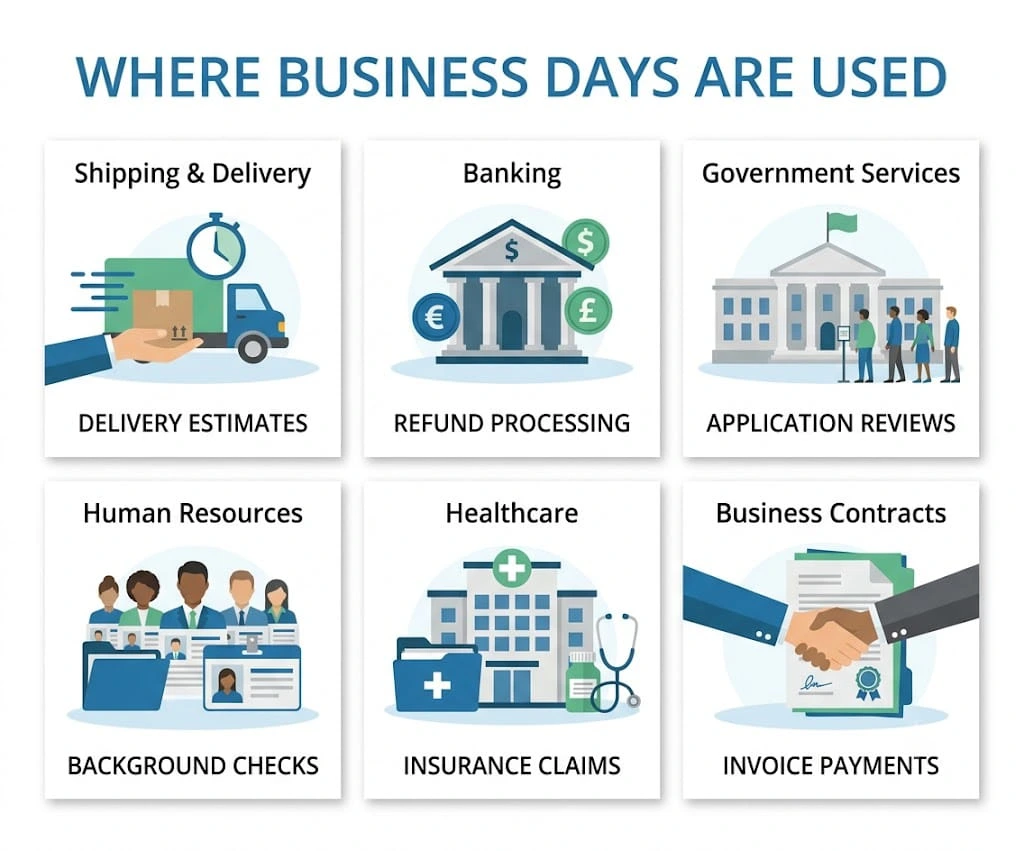
You’ll likely come across this exact timeline in plenty of situations, including online shopping deliveries, bank transfers, credit card refunds, insurance claims, warranty replacements, payroll adjustments, mortgage applications, government paperwork, school admissions, and business contracts.
Knowing how business days work genuinely helps you plan ahead and avoid unnecessary stress in these moments.
Quick Comparison: Business Days in Different Situations
| Situation | Typical Timeline |
| Online Shopping | Shipping and delivery estimates |
| Bank Transfer | Processing and settlement |
| Refund | Payment return to your account |
| Government Services | Application processing |
| Legal Documents | Filing deadlines |
| HR and Payroll | Hiring and employee processing |
Business Days vs. Working Days
Many people assume business days and working days mean exactly the same thing, and in a lot of situations, they actually do. Still, small differences can pop up depending on the company, industry, or country involved.
A business day usually refers to the days when businesses, banks, and government offices are open. A working day, on the other hand, often refers to the specific days an employee is scheduled to work.
For example, a retail employee might work on a Saturday, while the company’s accounting department still treats Saturday as a non-business day entirely. This is exactly why it’s worth reading the terms carefully rather than assuming they line up perfectly.
| Business Days | Working Days |
| Used by businesses and government offices | Used for employee work schedules |
| Usually Monday to Friday | Depends on the employer |
| Often excludes public holidays | May include weekends in some jobs |
| Common for contracts and processing times | Common for payroll and staffing |
Do Saturdays Count as Business Days?
In most cases, no. Saturday is generally not considered a business day in the United States, though there are a few exceptions worth knowing about.
Some businesses do operate on Saturdays, including retail stores, restaurants, grocery stores, medical clinics, and delivery services. Even so, their official processing schedules often still follow the standard Monday-through-Friday pattern. You might receive a package on Saturday, for instance, while your bank still won’t process a transfer until Monday.
Do Sundays Count as Business Days?
Almost never. Most banks, government offices, courts, and corporate offices remain closed on Sundays entirely, which is why Sunday usually gets skipped when counting business days. If a deadline happens to fall on a Sunday, it’s typically moved to the next available business day instead.
Do Public Holidays Count?
No. Federal holidays are normally excluded from business day calculations altogether. If a holiday falls during your seven-business-day period, simply skip that day and keep counting on the next business day.
Here are some common U.S. federal holidays that may affect your processing times:
- New Year’s Day
- Martin Luther King Jr. Day
- Presidents’ Day
- Memorial Day
- Juneteenth National Independence Day
- Independence Day
- Labor Day
- Columbus Day
- Veterans Day
- Thanksgiving Day
- Christmas Day
During holiday seasons, many businesses also deal with heavier workloads overall. As a result, some services may end up taking longer than the standard estimate suggests.
Common U.S. Federal Holidays That Affect Business Days
Most businesses, banks, and government agencies don’t count federal holidays as business days. If one of these holidays falls during your waiting period, your completion date usually shifts to the next business day.
| Federal Holiday | Counted as a Business Day? |
| New Year’s Day | No |
| Martin Luther King Jr. Day | No |
| Presidents’ Day | No |
| Memorial Day | No |
| Juneteenth National Independence Day | No |
| Independence Day | No |
| Labor Day | No |
| Columbus Day | No |
| Veterans Day | No |
| Thanksgiving Day | No |
| Christmas Day | No |
Keep in mind that private businesses may follow their own separate holiday schedules, so it’s always worth checking the company’s policy directly if you need an exact deadline.
Most U.S. businesses and government agencies don’t count federal holidays as business days. The official U.S. federal holiday schedule is published by the U.S. Office of Personnel Management (OPM). Private businesses may still follow different holiday schedules of their own, so it’s always a good idea to check the company’s policy if an exact deadline matters to you.
Why the Starting Time Matters
Many people focus purely on the date, but the actual time of day can affect your timeline just as much.
Suppose a company’s daily cut-off time is 3:00 PM. If you submit your request at 2:45 PM, processing may begin that same day, but if you submit it at 3:15 PM instead, processing may not begin until the next business day.
This small difference alone can delay your completion date by an entire business day, which is exactly why many companies clearly spell out their daily processing deadlines.
Business Days in Different Countries
Business days aren’t the same everywhere in the world, so understanding these differences matters if you’re working with international companies.
| Country | Typical Business Week |
| United States | Monday to Friday |
| Canada | Monday to Friday |
| United Kingdom | Monday to Friday |
| United Arab Emirates | Monday to Friday |
Although many countries share a Monday-to-Friday workweek, each one has its own set of public holidays. These holidays can affect delivery dates, banking services, and government processing quite a bit. It’s always worth checking the local holiday calendar when dealing with international orders or deadlines.
Common Mistakes When Counting Business Days
People often make small mistakes that end up leading to incorrect deadlines. Here are the most common errors worth avoiding.
Counting Non-Business Days
One of the most common mistakes is counting days that are not considered business days. In most cases, Saturdays, Sundays, and U.S. federal holidays should be skipped when calculating business days. Forgetting to exclude these dates often leads to incorrect delivery estimates, payment timelines, or application deadlines.
Starting the Count Too Early
Another common mistake is assuming the countdown begins immediately after placing an order or submitting a request. Many companies first complete a processing period before the business-day timeline begins. Orders placed after a daily cut-off time may also start counting on the next business day instead of the same day.
Assuming Every Company Uses the Same Rules
Every business runs its own policies. Some process orders on Saturdays, while others only process during regular office hours. Reading the terms and conditions carefully can help you avoid unpleasant surprises later on.
Tips for Calculating Business Days Correctly
You don’t need complicated formulas to count business days accurately. These simple tips can help along the way.
Check the Starting Date
Confirm exactly when the company officially begins counting your timeline.
Read the Company’s Policy
Many businesses explain exactly how they count business days, so it’s worth taking a few minutes to read through the shipping or processing information provided.
Use a Calendar
Mark each business day directly on a calendar. Skipping weekends becomes much easier once you can actually see the dates laid out in front of you.
Quick Reference Table
Use this table whenever you need a fast answer.
| Question | Answer |
| Are weekends included? | No |
| Are federal holidays included? | No |
| Do banks use business days? | Yes |
| Do government offices use business days? | Yes |
| Can the starting day count? | Sometimes, depending on the company |
| Can processing begin the next day? | Yes, especially after the daily cut-off time |
Why Understanding Business Days Matters
Knowing how business days actually work can save you a lot of time and frustration down the line.
It helps you track deliveries more accurately, plan bank transfers with confidence, meet legal deadlines on time, understand refund timelines realistically, prepare government applications properly, and generally set expectations that match reality.
Whether you’re waiting on a package, a payment, or an important document, understanding business days goes a long way toward avoiding unnecessary confusion.
How to Find the Date 7 Business Days From Today
If you need to know the exact date 7 business days from today, start with today’s date and count only Monday through Friday, skipping Saturdays, Sundays, and any public holidays that fall within the period.
For the most accurate result, it helps to use an actual calendar and follow the step-by-step method explained earlier in this guide. Doing so helps you avoid mistakes caused by weekends or unexpected holiday closures.
Frequently Asked Questions About 7 Business Days
Below are answers to the most common questions people ask about business days, kept short, clear, and easy to follow.
Is 7 Business Days the Same as One Week?
No. One week has 7 calendar days, including weekends, while seven business days usually take 9 to 11 calendar days since Saturdays and Sundays aren’t counted. If a public holiday falls during that period, the timeline can stretch out even longer.
How Many Calendar Days Are 7 Business Days?
In most cases, 7 business days equal roughly 9 to 11 calendar days. Here’s a simple guide for reference:
| Business Days | Approximate Calendar Days |
| 1 | 1–3 |
| 3 | 3–5 |
| 5 | 5–7 |
| 7 | 9–11 |
| 10 | 12–14 |
Keep in mind that holidays may extend these estimates further.
How Long Is 7 Business Days From Today?
The answer depends on today’s date, whether today counts as Day 1, any weekends falling during the period, and any public holidays involved. The easiest way to find the exact date is to count only weekdays while skipping over weekends and holidays entirely.
Does the Day I Place My Order Count?
Sometimes. Many businesses begin counting on the next business day, especially if you place your order after their daily cut-off time. An order placed at 10:00 AM might count as Day 1, while one placed at 6:00 PM might not start counting until the next business day. It’s always worth checking the company’s shipping or processing policy directly.
Do Federal Holidays Count as Business Days?
No. Federal holidays are excluded from business day calculations entirely. If one falls during your waiting period, simply skip that day and continue counting on the next business day.
Why Does My Package Take Longer Than 7 Business Days?
Several factors can increase delivery time, including bad weather, heavy holiday shopping seasons, customs inspections, incorrect delivery addresses, warehouse delays, and carrier disruptions. Even when the shipping estimate says seven business days, unexpected events can still add extra time on top of that.
Is 7 Business Days Different for Banks?
Banks follow business days quite closely. Most banking services, including check deposits, ACH transfers, wire transfers, and loan processing, only move forward on business days, with weekends and federal holidays generally excluded.
Is 7 Business Days Different for Online Shopping?
Not usually. Most online stores use the standard Monday-to-Friday business week, though every retailer has its own processing times. Some begin counting the moment you place the order, while others only start once your payment has been verified or your package has been prepared for shipping.
How Can I Calculate Business Days More Accurately?
Start with the processing date, count only Monday through Friday, skip Saturdays and Sundays, skip federal holidays, and stop once you reach the required number of business days. Using an actual calendar makes this whole process much easier to manage.
Is 7 Business Days the Same as 10 Calendar Days?
Not always. In many cases, seven business days end up equaling about 10 calendar days, though depending on your starting day and any public holidays, the total may range anywhere from 9 to 13 calendar days.
What Happens If the Last Business Day Falls on a Holiday?
If the final business day happens to be a public holiday, the deadline is usually pushed to the next business day. This is common practice for banks, government agencies, and many private companies alike.
Why Do Refunds Take 7 Business Days?
Refunds typically involve several steps, including approval, payment processing, and bank settlement. Each of these steps may only occur during business days, which is exactly why refunds can end up taking longer than people expect.
Can Companies Count Saturdays as Business Days?
Some companies do, especially those that operate on weekends. That said, most businesses in the United States calculate their official processing times using Monday through Friday unless they clearly state otherwise.
Final Thoughts
Understanding how long 7 business days take is easier once you know what counts as a business day. In most cases, 7 business days equal about 9–11 calendar days, but weekends, public holidays, and company processing times can extend the timeline.
One thing we’ve consistently found while reviewing business-day policies across banks, shipping carriers, employers, and government agencies is that there is no universal rule. The safest approach is to check when the countdown begins and whether holidays or processing periods are excluded.
Whether you’re waiting for a delivery, refund, payment, or application update, knowing how business days work helps you plan more accurately and avoid unnecessary frustration.