Average Engagement Ring Cost in 2026: How much should I spend?
Buying an engagement ring can feel surprisingly stressful. You may start with one simple question, “What is the average engagement ring cost?”, only to find very different prices depending on the diamond, setting, metal, and retailer. Then there is the pressure of the old two or three months’ salary rule, wedding expenses, and the fear of either overspending or choosing a ring that does not feel special enough.
From working through the factors that actually drive engagement ring prices, one thing becomes clear: there is no single price that every buyer should pay. The national average is useful as a starting point, but your own budget should reflect your income, savings, debt, upcoming wedding costs, and what matters most to you in the ring.
In this guide, we’ll break down the average engagement ring cost in the U.S., explain what affects the price, and show you how to set a realistic budget without relying on outdated spending rules. You’ll also learn how diamond quality, carat weight, setting, metal, and natural versus lab-grown diamonds can change what you get for your money.
The goal is not to find the most expensive ring you can afford. It is to understand the numbers well enough to make a confident decision that fits both your finances and your partner’s style.
How reliable is the average engagement ring cost?
There isn’t a single price that represents every U.S. engagement ring buyer, and recent sources report different averages because they rely on different samples and methods. Before comparing prices, it’s helpful to understand the basics through an engagement ring buying guide. For example, The Knot reported an average engagement ring spend of $4,600 based on its 2025 Real Weddings Study, while BriteCo reported an average of $6,504 based on its 2025 U.S. insurance appraisal data. These figures illustrate exactly why the “average” should be treated as a benchmark rather than a spending rule.
Your actual budget can end up much lower or higher depending on the diamond or gemstone you choose, along with its carat weight, cut, clarity, and metal setting, and whether you go with a natural or lab-grown diamond. In the end, the most useful number isn’t the national average at all; it’s the amount that fits comfortably into your own finances without pressuring your other goals.
Average Engagement Ring Cost in the U.S.
There’s no single number that represents what every American spends on an engagement ring, since different surveys and jewelry industry sources report different averages. Recent U.S. data generally puts the average spend somewhere in the range of the mid-$4,000s to mid-$6,000s, depending on which source and methodology you’re looking at.
| Engagement Ring Budget | What It May Offer |
| Under $2,000 | Simple settings, smaller stones, or alternative gemstones |
| $2,000–$4,000 | Many attractive diamond and gemstone options |
| $4,000–$7,500 | A broad range of traditional diamond rings |
| $7,500–$10,000 | Larger or higher-quality stones and more detailed settings |
| $10,000+ | Premium diamonds, larger stones, luxury settings, or custom designs |
These ranges are only general examples, and the same budget can produce very different rings depending on the diamond’s cut, color, clarity, carat weight, shape, metal, and setting. For instance, spending $5,000 on a well-cut smaller diamond can produce a very different-looking ring than spending that same $5,000 on a larger diamond with lower color or clarity grades.
What Does the Average Engagement Ring Cost Actually Mean?
An average is a useful reference point, but it doesn’t tell you what you personally should spend, think of it more as a statistical snapshot than a recommended budget. If one person spends $2,000 and another spends $8,000, the average between them works out to $5,000, but that doesn’t mean either person should have actually spent that amount.
Your own budget should come from your financial situation rather than from a national figure. Before you start shopping, it’s worth considering your monthly income, your savings, any existing debt, upcoming wedding expenses, your emergency savings, other financial goals, whether you plan to finance the ring, and your partner’s expectations and style. This approach will serve you far better than simply trying to match the national average.
How Much Should You Spend on an Engagement Ring?
There’s no universal rule for how much you should spend on an engagement ring. A common guideline suggests spending two or three months of your salary, but this isn’t a financial requirement, it became popular through jewelry marketing rather than as a formal budgeting standard.
A better approach is to choose an amount you can afford without damaging your broader financial plans. Someone earning $60,000 a year, for example, may be perfectly comfortable spending $3,000, while another person earning the same salary might have student loans, high living costs, or upcoming wedding expenses that make a $1,500 ring the smarter choice. Both decisions can be equally reasonable.
Is the Two or Three Months’ Salary Rule Still Relevant?
The two- or three-month salary rule is best viewed as an old tradition rather than a real budgeting formula. There’s no financial benefit to spending a specific percentage of your income on a ring, and taking on expensive debt just to follow this rule can create unnecessary financial stress.
Instead, start with a total amount you can comfortably afford. If your budget is $3,000, shop around that number; if it’s $8,000, focus on getting the best combination of stone quality, setting, and design within that range. The goal isn’t to spend the most money possible, it’s to buy a ring that fits both your relationship and your finances.
How to Set a Realistic Engagement Ring Budget
Setting a budget before you start shopping makes the entire process much easier. Suppose, for example, you have $8,000 in savings but still have upcoming wedding costs and want to keep an emergency fund intact, spending the full $8,000 on a ring probably wouldn’t be a sensible choice in that situation.
Instead, decide how much you can spend while still protecting your other financial goals. A simple process looks like this: review your current finances, set aside money for essential expenses, keep your emergency savings intact, consider upcoming wedding costs, choose a maximum ring budget, and leave room for taxes and possible extra costs. Once you’ve settled on a maximum budget, avoid shopping above it simply because a salesperson shows you a more expensive option.
Build Your Budget Around Priorities
You don’t need to spend equally on every part of the ring, instead, decide what matters most to you. If sparkle matters most, prioritize diamond cut. If size matters most, compare different shapes and grades. If sustainability or price is the priority, consider a lab-grown diamond, and if uniqueness matters, consider a gemstone or vintage ring. If the setting is what’s most important to you, allocate more of your budget toward the design itself. This approach makes it much easier to get a ring that feels valuable without spending more than necessary.
Engagement Ring Cost vs. Wedding Band Cost
Another point that’s easy to overlook is that the engagement ring may not be the only piece of jewelry you need to budget for, since many couples also purchase one or two wedding bands. The cost of a wedding band can vary widely depending on the metal, design, diamond or gemstone details, and whether it’s custom-made.
| Ring | Typical Budget Consideration |
| Engagement ring | Usually the larger jewelry purchase |
| Women’s wedding band | Can range from a simple band to a diamond design |
| Men’s wedding band | Often simpler, but varies by metal and style |
| Matching set | May help coordinate the overall look |
You should also think about whether the engagement ring and wedding band will sit comfortably together. Some engagement rings have unusual shapes or large settings that make certain wedding bands difficult to pair with, so choosing both pieces with the final look in mind can help you avoid an expensive surprise later on.
What Determines the Cost of an Engagement Ring?
The average engagement ring cost can give you a starting point, but it doesn’t explain why one ring costs $2,000 while another costs $8,000 or more. The final price depends on several factors, the most important being the diamond or gemstone, carat weight, cut, color, clarity, setting, metal, and craftsmanship. Understanding these factors helps you spend your budget where it actually matters most.
Carat Weight
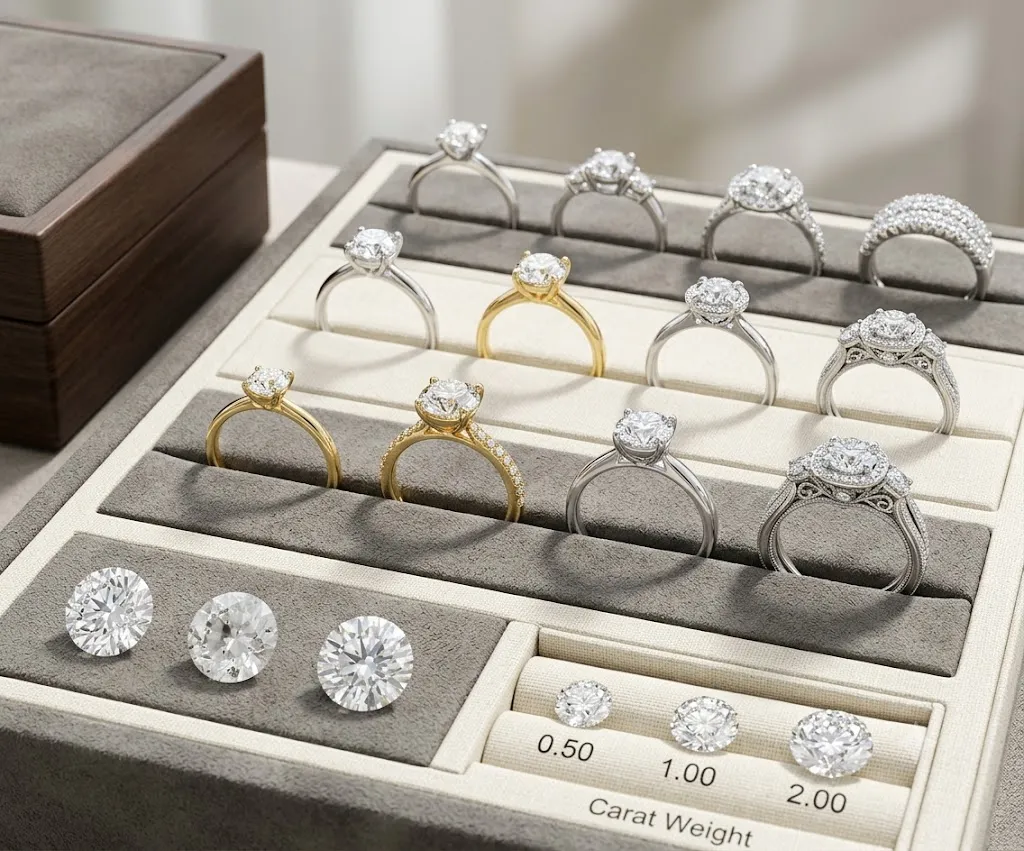
Carat refers to the weight of a diamond, not its physical size. A higher carat weight usually means a higher price, especially when other quality factors stay similar, though price doesn’t increase in a simple, fixed way alongside carat weight. A 2-carat diamond, for example, can cost much more than two 1-carat diamonds of similar quality, since larger diamonds are rarer and that rarity increases their value.
The shape of the diamond also affects how large it appears from above, and some shapes can look larger for their carat weight than others. If size matters to you but your budget is limited, it’s worth comparing different shapes instead of automatically reaching for a higher carat weight.
The 4Cs of Diamond Quality
If you’re buying a traditional diamond engagement ring, the 4Cs, cut, color, clarity, and carat, are among the most important factors affecting its price. These characteristics work together, so you shouldn’t judge a diamond by only one of them.
Cut describes how well a diamond has been shaped and finished to interact with light. A well-cut diamond returns more light and appears brighter and more lively, which is why cut is one of the best places to prioritize quality, a beautiful diamond isn’t simply about being large. A smaller diamond with a strong cut can genuinely look more impressive than a larger diamond with poor proportions.
Color refers to how much visible yellow or brown tint a diamond has. For traditional white diamonds, higher color grades are generally more expensive, though you may not need the very highest grade to get a diamond that looks bright and attractive. The setting can also affect how the diamond’s color reads visually, a warm-toned metal, for example, may make a slightly warmer diamond less noticeable.
Clarity measures the presence of internal and external characteristics in a diamond. Diamonds with fewer visible inclusions are generally more expensive, but a diamond doesn’t necessarily need the highest clarity grade to look clean to the naked eye. This is an area where careful selection can help you get better value, so instead of paying for a clarity grade you can’t actually see, compare diamonds based on their real-world appearance.
Carat measures diamond weight, and a higher carat weight generally increases price. That said, two diamonds with the same carat weight can have very different prices because of differences in cut, color, clarity, shape, and certification, which is exactly why carat alone shouldn’t determine your buying decision.
Diamond Shape Can Change the Price
The shape of a diamond can also influence its cost. Popular shapes include round, oval, princess, cushion, emerald, pear, marquise, radiant, and Asscher. Round diamonds are often priced differently from other shapes because of demand and the cutting process involved.
Some fancy shapes can offer more visible size for the same carat weight, which can be useful if you want a larger-looking center stone without stretching your budget as much. Ultimately, the right choice depends on your partner’s style and what you want the ring to look like.
Natural vs. Lab-Grown Diamonds
One of the biggest choices affecting the price of a diamond engagement ring is whether you choose a natural diamond or a laboratory-grown one. Natural diamonds form in the Earth over extremely long periods, while lab-grown diamonds are created using technology in controlled environments, but both have essentially the same chemical composition and crystal structure.
Lab-grown diamonds are generally less expensive than comparable natural diamonds, which means a buyer with a fixed budget may be able to choose a larger or higher-quality lab-grown stone for the same amount of money. The choice ultimately comes down to personal preference, so it’s worth weighing your priorities, budget, and feelings about each option before buying.
Engagement Ring Setting and Mettle Choice
The setting is the part of the ring that holds the center stone and contributes heavily to its overall appearance. Common styles include solitaire, halo, three-stone, pavé, bezel, cathedral, and vintage-inspired designs. A simple solitaire generally uses less material and fewer additional stones than an intricate design, while a halo or pavé setting may require several smaller diamonds and more detailed craftsmanship, both of which can increase the price.
The metal used for the ring band also affects the final price. Common choices include yellow gold, white gold, rose gold, and platinum. Gold rings are commonly available in different karat levels, such as 14K and 18K, while platinum is a popular premium option because of its durability, though it typically costs more than most gold options.
When comparing rings, it helps to look at the complete setting rather than comparing metal prices alone, since the weight of the metal, the design, the craftsmanship, and the stone details all affect the final price together.
Alternative Gemstones
A diamond isn’t the only option for an engagement ring, some couples choose sapphires, rubies, emeralds, or other gemstones as the center stone. Alternative gemstones can create a distinctive look and may cost less than a comparable diamond, though prices vary greatly based on the gemstone type, quality, size, origin, and rarity.
A sapphire, for example, can be an attractive choice for someone who wants a colored center stone rather than a traditional white diamond, and this route can also give you more flexibility if your budget is limited.
Customization and Craftsmanship
Custom engagement rings can carry additional costs because they require specialized design and craftsmanship. Customization may involve changing the setting, selecting a specific gemstone, adding engraving, creating a unique band, changing the metal, adding side stones, or designing a completely custom ring from scratch.
However, customization doesn’t always mean spending a huge amount of money. Working with a jeweler early in the process can help you understand which changes fit your budget and which ones add significant costs.
Ring Size and Sizing Costs
Ring size can also affect your final expenses, although usually not as much as the diamond or setting does. A ring may need to be resized if the original size is incorrect, simple resizing may be relatively inexpensive, while complicated designs can cost more, and rings with intricate patterns or stones around much of the band can be particularly difficult to resize.
If you don’t know your partner’s ring size, ask a trusted friend or family member for help, or discreetly borrow a ring they already wear on the correct finger.
Sales Tax and Other Costs
The price displayed on a ring isn’t always the final amount you’ll pay. Depending on where you purchase it, you may also need to account for sales tax, resizing, customization, shipping, insurance, appraisal, and future maintenance. A ring priced at $5,000, for example, will cost more once applicable sales tax is added, which is exactly why it’s smart to leave some room between your maximum spending limit and the advertised ring price.
Does Certification Affect Engagement Ring Cost?
For a diamond, a grading report from a respected independent gemological laboratory can provide important information about the stone’s characteristics, typically documenting factors such as carat weight, color, clarity, and cut grade where applicable.
Certification terminology can sometimes be confusing because sellers use different terms, so in practice it’s better to check who actually graded the diamond and what the report states rather than relying on the word “certified” alone. A grading report doesn’t automatically make a diamond better, it simply gives you independent information that makes it easier to compare stones.
Why Two Similar Engagement Rings Can Have Different Prices
Two rings can look very similar in photographs but carry very different prices. Two rings may both contain a 1-carat round diamond, for example, but their prices can differ because of cut quality, color grade, clarity grade, diamond origin, certification, metal, setting design, brand or jeweler, and craftsmanship.
This is exactly why comparing rings by carat weight alone can lead to a poor buying decision, instead, compare the complete ring and the quality of the stone together.
How to Get the Best Engagement Ring for Your Budget
Once you know what affects the price of an engagement ring, the next step is making your budget work harder for you. You don’t have to choose the largest diamond or the most expensive setting; small changes in the stone, shape, metal, and design can make a major difference in the final price. The goal is to get the best combination of quality, appearance, style, and value without spending more than you can comfortably afford.
Choose the Features That Matter Most
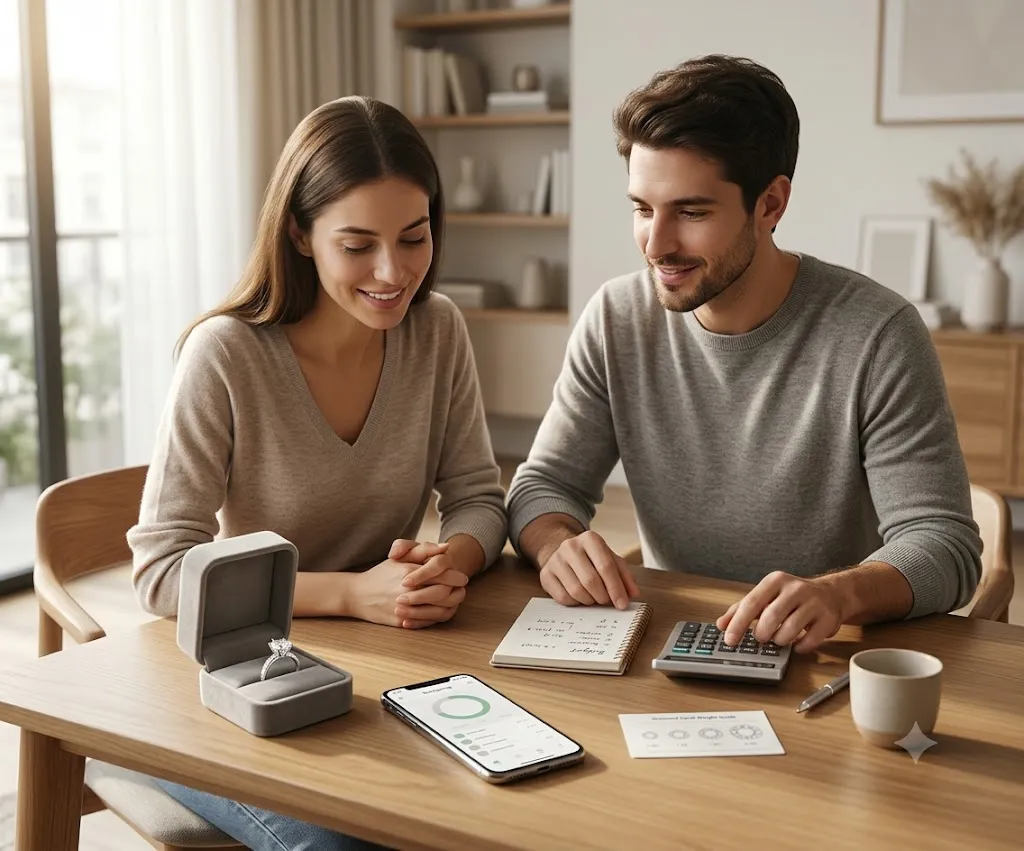
Start by deciding what matters most to you and your partner. Some buyers care most about the size of the center stone, while others care more about sparkle, metal, design, or the story behind the ring.
| Priority | What to Consider |
| More sparkle | Prioritize diamond cut |
| Larger appearance | Compare diamond shapes and settings |
| Lower price | Consider lab-grown diamonds or gemstones |
| Classic style | Consider a solitaire setting |
| More detail | Look at halo or pavé settings |
| Unique appearance | Consider colored gemstones or vintage rings |
| Long-term flexibility | Choose a setting that can be upgraded |
Once you know your priorities, you can avoid paying for features that matter less to you.
Consider a Smaller Diamond With a Better Cut
One of the simplest ways to improve value is to focus on cut quality instead of chasing carat weight. A well-cut diamond returns light effectively and appears bright and lively, while a larger diamond with weaker cut quality may not have the same visual impact.
Suppose you have a $5,000 budget: you could spend most of it on a larger center stone with lower grades, or you could choose a slightly smaller stone with a stronger cut and a complementary setting. The second option often produces a ring that looks more attractive overall, though this doesn’t mean carat size is unimportant, just that it’s only one part of the buying decision.
Compare Different Diamond Shapes
Changing the shape of the center stone can help you get more visual size from your budget. Oval, pear, marquise, and elongated radiant diamonds can appear larger from the top compared with some other shapes of the same carat weight, though appearance still depends on the individual diamond, since two stones with the same carat weight and shape can look different from each other.
If you want a larger-looking center stone, it’s worth comparing several shapes before making your final decision.
Consider a Lab-Grown Diamond
If you want a diamond but have a limited budget, a lab-grown diamond can be worth considering, since lab-grown diamonds generally cost less than comparable natural diamonds. This can give you more flexibility with size or quality while staying within the same budget, someone with a $4,000 budget, for example, may be able to consider a larger lab-grown diamond than they could with a natural diamond of similar characteristics.
The decision between natural and lab-grown diamonds is a personal one, so weigh your budget, preferences, and priorities before choosing.
Consider Alternative Gemstones
Diamonds are traditional, but they’re not the only choice. Sapphires, rubies, emeralds, and other gemstones can create distinctive engagement rings, and depending on the gemstone and its quality, some options may also cost less than a comparable diamond.
Sapphires in particular are popular for engagement rings because they come in several colors and offer good durability for everyday wear. Alternative gemstones can also make sense if your partner prefers color or wants something less traditional.
Choose a Simple Setting
The setting can make a noticeable difference to the total cost. A simple solitaire setting usually has a cleaner design and fewer additional stones, while more complex designs may require extra diamonds, more metal, and additional craftsmanship.
If the center stone is your main priority, a simple setting lets you put more of your budget toward the stone itself. A larger center stone paired with a simple solitaire may suit someone who prioritizes size, while a smaller center stone with a halo or pavé setting may work better for someone who wants more overall sparkle and detail, neither choice is better, it just depends on what you want the ring to achieve.
Consider Different Metal Options
The metal you choose can also affect the final price. Gold is available in different colors and karat levels, while platinum is often positioned as a premium option. If you like the appearance of platinum but it pushes the ring beyond your budget, it’s worth comparing different gold options instead, since white gold, yellow gold, and rose gold can each create a very different appearance without changing the center stone at all. The best choice ultimately depends on your partner’s style, lifestyle, and budget.
Look at Vintage and Estate Rings
Vintage and estate engagement rings offer another way to find something distinctive, often featuring older design styles, unique settings, or details that are less common in modern mass-produced jewelry. An estate ring can also offer a distinctive piece at a different price point than a newly made custom ring.
Condition matters a great deal here, though. Before purchasing a vintage or estate engagement ring, ask about the ring’s condition, previous repairs, stone quality, metal type, resizing options, any available documentation, and future maintenance needs. A professional inspection can help you understand exactly what you’re buying.
Don’t Forget the Wedding Band
When setting your engagement ring budget, remember that the engagement ring may be only part of your total jewelry spending, since you’ll likely also need money for a wedding band. Some couples choose a simple band, while others want diamonds or a custom design, and the two rings should work comfortably together.
If you plan to wear both rings together, consider the pairing before buying the engagement ring, this can help you avoid choosing a setting that makes finding a suitable wedding band difficult or expensive later.
Leave Room for Additional Costs
Avoid using every dollar of your budget on the ring’s listed price. Depending on the purchase, you may also have costs for sales tax, resizing, insurance, appraisal, shipping, customization, and future repairs or maintenance. If your maximum budget is $5,000, for example, you may not want to choose a ring priced exactly at $5,000 before tax, leaving some room gives you more financial flexibility.
Should You Finance an Engagement Ring?
Financing can make an expensive ring appear more affordable because the cost is divided into monthly payments, but a monthly payment doesn’t change the total cost of the ring. Before financing, check the interest rate, the total amount you’ll repay, the repayment period, any fees, and what happens if you miss a payment.
If financing the ring would create financial stress or interfere with other important expenses, choosing a less expensive ring may be the smarter option.
Can You Upgrade an Engagement Ring Later?
Yes, an engagement ring doesn’t have to be the final version forever. Some couples choose a ring that fits their finances today and upgrade the diamond, setting, or wedding bands later on. You could, for example, start with a smaller center stone and eventually replace it with a larger one.
If you think you may want an upgrade in the future, discuss the possibility with your jeweler before buying, since some settings and designs are easier to modify than others. This approach can help you enjoy a meaningful ring now without putting unnecessary pressure on your current finances.
Choose a Jeweler You Can Trust
Price shouldn’t be the only factor when comparing engagement rings. A reputable jeweler should be able to explain the diamond or gemstone, provide relevant documentation, answer questions clearly, and explain the terms of the purchase.
Before buying, ask about diamond grading documentation, return and exchange policies, warranty coverage, resizing, repairs, cleaning and maintenance, and insurance or appraisal documentation. A trustworthy buying experience can be just as important as finding a good price.
Engagement Ring Budget Examples
Here are a few simplified examples of how different budgets could be approached.
Around $2,000 — At this level, consider a smaller natural diamond, a lab-grown diamond, an alternative gemstone, or a simple setting. The key is to avoid spending most of the budget on unnecessary design details.
Around $4,000 — This budget provides more flexibility. You could compare lab-grown and natural diamonds, different shapes, and several setting styles, and prioritizing cut quality can help create a visually impressive ring.
Around $6,000 — At this level you have a wider range of options for diamond quality, size, and setting, and you may be able to choose between a larger center stone, a more detailed setting, or a higher-quality stone depending on your priorities.
$10,000 or More — A larger budget opens the door to premium natural diamonds, larger stones, detailed settings, custom designs, and higher-end craftsmanship. However, a bigger budget doesn’t automatically mean better value, so you should still compare the diamond, setting, certification, craftsmanship, and overall price carefully.
Engagement Ring Buying Checklist
Before making the purchase, use this quick checklist:
- Set your maximum budget.
- Decide what features matter most.
- Compare natural and lab-grown diamonds.
- Learn the 4Cs.
- Compare different diamond shapes.
- Review the setting and metal.
- Check the diamond grading report.
- Ask about taxes and additional costs.
- Confirm the return policy.
- Ask about resizing.
- Consider insurance and appraisal.
- Make sure the ring suits your partner’s style.
- Avoid spending more because of pressure.
A little preparation can make the buying process much easier.
The Best Engagement Ring Is Not Always the Most Expensive
The average engagement ring cost is useful for understanding the market, but it shouldn’t determine your personal budget. A well-chosen ring at $2,500 can be a better purchase for one couple than a $10,000 ring is for another. Focus on what you can comfortably afford, decide which features matter most, and spend on the things you can see, value, and enjoy, not simply on a higher price tag.
Average Engagement Ring Cost
The price of an engagement ring can vary depending on where you live, what you buy, and how you shop. A ring that costs $4,000 in one market may have a very different design or diamond from a $4,000 ring somewhere else, which is why comparing rings by their complete details, rather than by price alone, matters so much.
Engagement Ring Costs Can Vary by Region
National averages are useful, but they don’t tell the whole story. Engagement ring spending can vary by region because of differences in income, local jewelry markets, living costs, and buying habits. Some older industry data has shown higher average spending in areas such as the Mid-Atlantic and lower averages in parts of the Southeast, though these figures can change over time and should be treated as general benchmarks rather than fixed prices.
If you’re shopping in a particular state or city, local prices may be more useful to you than a national average, since a local jeweler may offer different pricing from a national online retailer because of differences in inventory, overhead, services, customization, and promotions.
How Much Should You Spend on an Engagement Ring?
There’s no universal answer here. The right engagement ring budget is simply the amount you can spend without putting your other financial goals at risk. For some people that might be $2,000; for others it could be $5,000, $8,000, or more. The national average is just a reference point, and it should never become a spending requirement, a good budget should leave you comfortable with your other expenses, savings goals, and future wedding costs.
| Budget | What You May Find |
| Under $1,000 | Simple settings, smaller stones, or alternative gemstones |
| $1,000–$3,000 | Smaller diamonds, lab-grown diamonds, or gemstone rings |
| $3,000–$5,000 | More options for diamond size and setting |
| $5,000–$10,000 | Larger or higher-quality stones and detailed settings |
| $10,000+ | Larger diamonds, premium stones, luxury settings, or custom designs |
Questions to Ask Before Buying an Engagement Ring
Asking the right questions can help you avoid surprises. Before purchasing, ask the jeweler the following:
- What exactly is included in the price? Confirm whether it includes the center stone, setting, side stones, taxes, shipping, or other services.
- Does the diamond come with a grading report? Ask who issued the report and review the details before buying.
- Can the ring be resized? Some designs are easier to resize than others.
- What is the return or exchange policy? Make sure you understand the time limit and any conditions.
- Is the ring covered by a warranty? Find out what the warranty covers and what it doesn’t.
- How should the ring be maintained? Ask about cleaning, inspections, repairs, and long-term care.
- Can the setting be upgraded later? If you may want a larger center stone in the future, ask whether the setting can accommodate an upgrade.
Engagement ring prices vary widely, so national averages should be treated as reference points rather than fixed prices. For this guide, current figures were compared across wedding research, consumer-finance resources, and jewelry-industry data: The Knot’s 2025 study reported an average spend of $4,600, BriteCo’s 2025 appraisal-based data reported $6,504, and Zola’s 2026 guidance places typical spending in a broader range of about $3,000 to $7,000. Because these sources measure different groups and use different methodologies, their numbers shouldn’t be treated as conflicting answers, instead, they show just how widely engagement ring spending can vary across U.S. couples.
Frequently Asked Questions
What Is the Average Engagement Ring Cost in the U.S.?
Recent U.S. estimates commonly place the average engagement ring cost in the mid-thousands of dollars, although reported averages vary by source and year. A broad shopping range of roughly $2,000 to $10,000 covers many buyers, but there’s no single price that applies to everyone.
Is $5,000 a Lot for an Engagement Ring?
A $5,000 engagement ring sits around the middle of the range many buyers consider, but whether it’s expensive depends on your financial situation. It can buy a wide range of attractive rings depending on the diamond, setting, metal, and whether the stone is natural or lab-grown.
Is $2,000 Enough for an Engagement Ring?
Yes. A $2,000 budget can provide several solid options, including a smaller natural diamond, a lab-grown diamond, an alternative gemstone, or a simpler setting.
Is $10,000 Too Much for an Engagement Ring?
Not necessarily. A $10,000 ring can be reasonable if it fits comfortably within your finances, the important point is that you shouldn’t spend $10,000 simply because you believe you’re expected to.
Should You Spend Three Months’ Salary on a Ring?
No. The three-month salary rule is a traditional guideline, not a financial requirement. Your budget should be based on what you can afford without creating unnecessary financial pressure.
What Makes an Engagement Ring More Expensive?
Several factors affect the price, including diamond carat weight, cut, color, clarity, shape, natural versus lab-grown origin, setting, metal, craftsmanship, customization, and brand.
Is a Lab-Grown Diamond Cheaper Than a Natural Diamond?
Generally, yes. Lab-grown diamonds are typically less expensive than comparable natural diamonds, which can allow buyers to choose a larger or higher-quality diamond for the same budget.
What Is the Most Important Diamond Quality Factor?
There’s no single factor that matters most to every buyer, though cut quality is particularly important for a traditional diamond since it strongly affects how the stone interacts with light and appears visually.
Does a Bigger Diamond Mean a Better Engagement Ring?
No. Carat measures weight, not overall quality. A larger diamond can have lower cut, color, or clarity characteristics, and a smaller, well-cut diamond may actually look more attractive.
Should You Buy the Engagement Ring Online?
Buying online can provide a wider selection and make price comparison easier. However, check the seller’s reputation, grading documentation, return policy, warranty, shipping terms, and customer reviews before purchasing.
How Much Does a Wedding Band Cost Compared With an Engagement Ring?
Wedding bands vary widely in price. A simple band can cost considerably less than an engagement ring, while diamond, platinum, or custom bands can cost much more, so it’s worth budgeting for the wedding band separately if you plan to purchase one.
Conclusion
The average engagement ring cost can give you a useful starting point, but it should never become a spending target by itself. Two couples with the same income can have completely different financial priorities, and both can make sensible choices.
The most practical approach is to set your budget first, then decide which features matter most. If you care about sparkle, diamond cut may deserve more of your budget. If size matters more, comparing different diamond shapes, grades, or lab-grown options may help you get a larger center stone for the same amount. A simpler setting can also leave more room in the budget for the diamond itself.
One of the biggest lessons when evaluating engagement ring prices is that higher cost does not automatically mean better value. A well-chosen ring at $3,000 can be a better decision for one buyer than a $10,000 ring for another. What matters is how well the ring balances quality, design, personal meaning, and financial comfort.
Before you buy, remember to account for costs beyond the advertised ring price, including the setting, taxes, sizing, customization, and potentially a wedding band. Taking these expenses into account from the beginning can help prevent an attractive ring from turning into an uncomfortable financial commitment.